

Đề thi tham khảo Trung học Phổ thông Quốc gia môn Tiếng Anh - Năm học 2019-2020 - Trường THCS&THPT Võ Nguyên Giáp (Có đáp án)
 6 trang
28/12/2025
210
6 trang
28/12/2025
210
Bạn đang xem tài liệu "Đề thi tham khảo Trung học Phổ thông Quốc gia môn Tiếng Anh - Năm học 2019-2020 - Trường THCS&THPT Võ Nguyên Giáp (Có đáp án)", để tải tài liệu gốc về máy hãy click vào nút Download ở trên.
Tóm tắt nội dung tài liệu: Đề thi tham khảo Trung học Phổ thông Quốc gia môn Tiếng Anh - Năm học 2019-2020 - Trường THCS&THPT Võ Nguyên Giáp (Có đáp án)
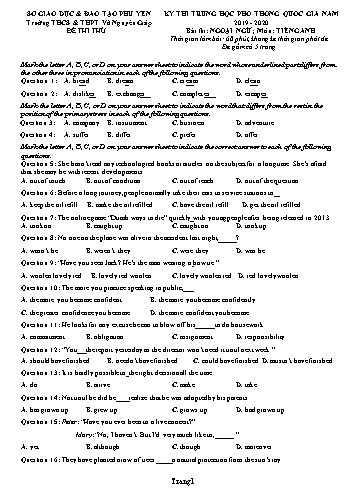
 SỞ GIÁO DỤC & ĐÀO TẠO PHÚ YÊN KỲ THI TRUNG HỌC PHỔ THÔNG QUỐC GIA NĂM
 Trường THCS & THPT Võ Nguyên Giáp 2019 - 2020
 ĐỀ THI THỬ Bài thi: NGOẠI NGỮ; Môn: TIẾNG ANH
 Thời gian làm bài: 60 phút, không kể thời gian phát đề
 Đề gồm có 5 trang
Mark the letter A, B, C, or D on your answer sheet to indicate the word whose underlined part differs from
the other three in pronunciation in each of the following questions.
 Question 1: A. bread B. dream C. cream D. clean
 Question 2: A. dislikes B. exchanges C. completes D. escapes
 Mark the letter A, B, C, or D on your answer sheet to indicate the word that differs from the rest in the
position of the primary stress in each of the following questions.
 Question 3: A. company B. instrument C. business D. adventure
 Question 4: A. suffer B. differ C. prefer D. offer
Mark the letter A, B, C, or D on your answer sheet to indicate the correct answer to each of the following
questions.
Question 5: She hasn’t read any technological books or articles on the subject for a long time. She’s afraid
that she may be with recent developments.
A. out of touch B. out of condition C. out of reach D. out of the question
Question 6: Before a long journey, people normally take their cars to service stations to .
A. keep the oil refill B. make the oil refilled C. have the oil refill D. get the oil refilled
Question 7: The online game “Dumb ways to die” quickly with young people after being released in 2013.
A. took on B. caught up C. caught on D. took up
Question 8: No one on the plane was alive in the accident last night, ?
A. wasn’t he B. weren’t they C. were they D. was he
Question 9: “Have you seen Jack? He’s the man wearing a bow tie.”
A. woolen lovely red B. lovely red woolen C. lovely woolen red D. red lovely woolen
Question 10: The more you practice speaking in public, .
A. the more you become confident B. the more you become confidently
C. the greater confidence you become D. the more confident you become
Question 11: He looks for any excuse he can to blow off his to do housework.
A. commitment B. obligation C. assignment D. responsibility
Question 12: “You the report yesterday as the director won’t need it until next week.”
A. should have finished B. needn’t have finished C. could have finished D. mustn’t have finished
Question 13: It is hardly possible to the right decision all the time.
A. do B. arrive C. make D. take
Question 14: Not until he did he realize that he was adopted by his parents.
A. has grown up B. grew up C. grows up D. had grown up
Question 15: Peter: “Have you ever been to a live concert?”
 Mary: “No, I haven’t. But I’d very much like to, .”
A. yet B. although C. though D. moreover
Question 16: They have planted a row of trees a natural protection from the sun’s ray.
 Trang 1 A. When Marry was young, she loved her stuffed animal so as not to sleep with it.
 B. As Marry couldn’t sleep without her stuffed animal when she was young, she loved it.
 C. When Marry was young, she loved her stuffed animal so much that she couldn’t sleep without it.
 D. When Marry was young, she loved her stuffed animal though she couldn’t sleep without it.
Mark the letter A, B, C, or D on your answer sheet to indicate the underlined part that needs correction in
each of the following questions.
Question 27: Air pollution, together with littering, are causing many problems in our large, industrial
cities A B C D
Question 28: Because of its ability to survive close to human habitations, the Virginia deer has actually
 A B C
increased their range and numbers
 D
Question 29: Higher education is very importance to national economies, and it is also a source of trained and
 A B
educated personnel for the whole country.
 C D
Mark the letter A, B, C, or D on your answer sheet to indicate the sentence that is closest in meaning to each
of the following questions.
Question 30: Difficult though the exam was, he still passed it with flying colours.
A. Because the exam was difficult, he passed it with flying colours.
B. No matter how difficult the exam was, he still passed it with very high marks.
C. Althoug the exam was difficult, but he still passed it with flying colours.
D. The exam was not too difficult, so he could pass it with flying colours.
Question 31: But for the dog, we would have got completely lost.
A. We got lost but we got the dog with us.
B. We didn’t lose our way as we brought the dog.
C. If we had brought the dog, we wouldn’t have got lost.
D. It was easy to lose our way even if we had the dog with us.
Question 32: She has always had a good relationship with her stepmother.
A. She has always got on well with her stepmother.
B. Her stepmother has always been her good relative.
C. She has always got away well with her stepmother.
D. Her stepmother has had as her friend.
Read the following passage and mark the letter A, B, C, or D on your answer sheet to indicate the correct
word or phrase that best fits each of the numbered blanks.
 The invention of the mobile phone has undoubtedly revolutionized the way people communicate and
influenced every aspect of our lives. The issue is whether this technological innovation has (33) ______ more
harm than good. In order to answer the question, we must first turn to the types of consumers. Presumably,
most parents (34) ______ are always worrying about their children’s safety buy mobile phones for them to
track their whereabouts. We can also assume that most teenagers want mobile phones to avoid missing out on
social contact. In this context, the advantages are clear. (35) ________, we cannot deny the fact that text
messages have been used by bullies to intimidate fellow students. There is also (36) ________ evidence that
texting has affected literacy skills.
 The widespread use of mobile phone has, out of question, affected adult consumers too. What
employee, on the way home from work, would be reluctant to answer a call from their boss? Apparently, only
18% of us, according to a survey, are willing to switch off our mobile phones once we've left the office.
 Admittedly, mobile phones can be intrusive but there are obvious benefits to possessing one. Personally
speaking, they are invaluable when it comes to making social or business arrangements at short (37) _______.
They also provide their owners with a sense of security in emergency situations.
Question 33: A. doneB. playedC. madeD. brought
 Trang 3 mothers used simplified syntax, short utterances and nonsense sounds, and transformed certain sounds into
baby talk. Other investigators have noted that when mothers talk to babies who are only a few months old, they
exaggerate the pitch, loudness, and intensity of their words. They also exaggerate their facial expressions, hold
vowels longer, and emphasize certain words.
 More significant for language development than their response to general intonation is observation that
tiny babies can make relatively fine distinctions between speech sounds. Other words, babies enter the world
with the ability to make precisely those perceptual discriminations that are necessary if they are to acquire aural
language.
 Babies obviously derive pleasure from sound input, too: even as young as nine months they will listen to
songs or stories, although the words themselves are beyond their understanding. For babies, language is a
sensory-motor delight rather than the route to prosaic meaning that it often is for adults.
Question 43: The passage mentions all of the following as ways adults modify their speech when talking to
babies EXCEPT
A. giving all words equal emphasis B. speaking with shorter sentences
C. speaking more loudly than normal D. using meaningless sounds
Question 44: The word "emphasize" in the passage is closest in meaning to
A. stress B. repeatC. explain D. leave out
Question 45: Which of the following can be inferred about the findings described in paragraph 2?
A. Babies who are exposed to more than one language can speak earlier than babies exposed to a single
language.
B. Mothers from different cultures speak to their babies in similar ways.
C. Babies ignore facial expressions in comprehending aural language.
D. The mothers observed by the researchers were consciously teaching their babies to speak.
Question 46: What point does the author make to illustrate that babies are born with the ability to acquire
language?
A. Babies begin to understand words in songs.
B. Babies exaggerate their own sounds and expressions.
C. Babies are more sensitive to sounds than are adults.
D. Babies notice even minor differences between speech sounds.
Question 47: According to the author, why do babies listen to songs and stories, even though they can not
understand them?
A. They understand the rhythm.B. They enjoy the sound.
C. They can remember them easily.D. They focus on the meaning of their parents' words.
Question 48: What does the passage mainly discuss?
A. How babies differentiate between the sound of the human voice and other sounds
B. The differences between a baby's and an adult's ability to comprehend language
C. How babies perceive and respond to the human voice in their earliest stages of language development
D. The response of babies to sounds other than the human voice
Question 49: Why does the author mention a bell and a rattle in lines 3-4?
A. To contrast the reactions of babies to human and nonhuman sounds
B. To give examples of sounds that will cause a baby to cry
C. To explain how babies distinguish between different nonhuman sounds
D. To give examples of typical toys that babies do not like
Question 50: The word "they" in the passage refer to
A.A. responses B. sorts of auditory stimuli C. the babiesD. sounds
 Trang 5
File đính kèm:
- de_thi_tham_khao_trung_hoc_pho_thong_quoc_gia_mon_tieng_anh.doc

