

Đề thi Trung học Phổ thông Quốc gia năm 2017 môn Tiếng Anh - Mã đề thi 417
 6 trang
27/12/2025
210
6 trang
27/12/2025
210
Bạn đang xem tài liệu "Đề thi Trung học Phổ thông Quốc gia năm 2017 môn Tiếng Anh - Mã đề thi 417", để tải tài liệu gốc về máy hãy click vào nút Download ở trên.
Tóm tắt nội dung tài liệu: Đề thi Trung học Phổ thông Quốc gia năm 2017 môn Tiếng Anh - Mã đề thi 417
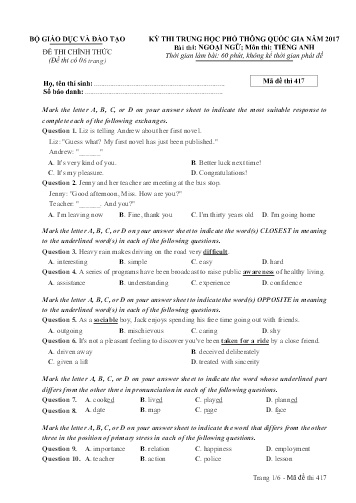
 BỘ GIÁO DỤC VÀ ĐÀO TẠO KỲ THI TRUNG HỌC PHỔ THÔNG QUỐC GIA NĂM 2017
 Bài thi: NGOẠI NGỮ; Môn thi: TIẾNG ANH
 ĐỀ THI CHÍNH THỨC Thời gian làm bài: 60 phút, không kể thời gian phát đề
 (Đề thi có 06 trang)
 Họ, tên thí sinh: ......................................................................... Mã đề thi 417
 Số báo danh: .............................................................................
 Mark the letter A, B, C, or D on your answer sheet to indicate the most suitable response to
 complete each of the following exchanges.
 Question 1. Liz is telling Andrew about her first novel.
 Liz: "Guess what? My first novel has just been published."
 Andrew: "______"
 A. It's very kind of you. B. Better luck next time!
 C. It's my pleasure. D. Congratulations!
 Question 2. Jenny and her teacher are meeting at the bus stop.
 Jenny: "Good afternoon, Miss. How are you?"
 Teacher: "______. And you?"
 A. I'm leaving now B. Fine, thank you C. I'm thirty years old D. I'm going home
 Mark the letter A, B, C, or D on your answer sheet to indicate the word(s) CLOSEST in meaning
 to the underlined word(s) in each of the following questions.
 Question 3. Heavy rain makes driving on the road very difficult.
 A. interesting B. simple C. easy D. hard
 Question 4. A series of programs have been broadcast to raise public awareness of healthy living.
 A. assistance B. understanding C. experience D. confidence
 Mark the letter A, B, C, or D on your answer sheet to indicate the word(s) OPPOSITE in meaning
 to the underlined word(s) in each of the following questions.
 Question 5. As a sociable boy, Jack enjoys spending his free time going out with friends.
 A. outgoing B. mischievous C. caring D. shy
 Question 6. It's not a pleasant feeling to discover you've been taken for a ride by a close friend.
 A. driven away B. deceived deliberately
 C. given a lift D. treated with sincerity
 Mark the letter A, B, C, or D on your answer sheet to indicate the word whose underlined part
 differs from the other three in pronunciation in each of the following questions.
 Question 7. A. cooked B. lived C. played D. planned
 Question 8. A. date B. map C. page D. face
 Mark the letter A, B, C, or D on your answer sheet to indicate the word that differs from the other
 three in the position of primary stress in each of the following questions.
 Question 9. A. importance B. relation C. happiness D. employment
 Question 10. A. teacher B. action C. police D. lesson
 Trang 1/6 - Mã đề thi 417 Question 25. "No, I won't go to work at the weekend," said Sally.
 A. Sally promised to go to work at the weekend.
 B. Sally refused to go to work at the weekend.
 C. Sally apologized for not going to work at the weekend.
 D. Sally regretted not going to work at the weekend.
Mark the letter A, B, C, or D on your answer sheet to indicate the underlined part that needs
correction in each of the following questions.
Question 26. Many people object to use physical punishment in dealing with discipline problems
 A B C
at school.
 D
Question 27. Animals like frogs have waterproof skin that prevents it from drying out quickly
 A B C
in air, sun, or wind.
 D
Question 28. My brother usually ask me for help when he has difficulty with his homework.
 A B C D
Mark the letter A, B, C, or D on your answer sheet to indicate the sentence that best combines
each pair of sentences in the following questions.
Question 29. Some kinds of fish live in fresh water. Others live in sea water.
 A. Some kinds of fish live in fresh water, and others live in sea water.
 B. Some kinds of fish live in fresh water, so others live in sea water.
 C. Some kinds of fish live in fresh water, for others live in sea water.
 D. Some kinds of fish live in fresh water, or others live in sea water.
Question 30. My mother is very busy with her work at the office. She still takes good care of us.
 A. My mother is so busy with her work at the office that she cannot take good care of us.
 B. Because my mother is very busy with her work at the office, she takes good care of us.
 C. My mother is too busy with her work at the office to take good care of us.
 D. In spite of being very busy with her work at the office, my mother takes good care of us.
Read the following passage and mark the letter A, B, C, or D on your answer sheet to indicate the
correct word or phrase that best fits each of the numbered blanks from 31 to 35.
 In the early twentieth century, an American woman named Emily Post wrote a book on
etiquette. This book explained the proper behavior Americans should follow in many different social
(31)______, from birthday parties to funerals. But in modern society, it is not simply to know the
proper rules for behavior in your own country. It is necessary for people (32)______ work or travel
abroad to understand the rules of etiquette in other cultures as well.
 Cultural (33)______ can be found in such simple processes as giving or receiving a gift. In
Western cultures, a gift can be given to the receiver with relatively little ceremony. When a gift is
offered, the receiver usually takes the gift and expresses his or her thanks. (34)______, in some
Asian countries, the act of gift-giving may appear confusing to Westerners. In Chinese culture, both
the giver and receiver understand that the receiver will typically refuse to take the gift several times
 Trang 3/6 - Mã đề thi 417 Question 40. The word "origins" in paragraph 3 is closest in meaning to ______.
 A. countries B. families C. beginnings D. stories
Question 41. According to the passage, which of the following is NOT true about the tradition of
tooth giving in the West?
 A. Children put their lost teeth under their pillows.
 B. Lost teeth are traditionally given to an angel or fairy.
 C. Children give money to the Tooth Fairy.
 D. Children hope to get money or gifts from the Tooth Fairy.
Question 42. The phrase "the wee hours" in paragraph 3 probably refers to the period of time
______.
 A. long before bedtime B. late in the morning
 C. early in the evening D. soon after midnight
Read the following passage and mark the letter A, B, C, or D on your answer sheet to indicate the
correct answer to each of the questions from 43 to 50.
 Earth is richly supplied with different types of living organisms which co-exist in their
environments, forming complex, interrelated communities. Living organisms depend on one another
for nutrients, shelter, and other benefits. The extinction of one species can set off a chain reaction
that affects many other species, particularly if the loss occurs near the bottom of the food chain. For
example, the extinction of a particular insect or plant might seem inconsequential. However, there
may be fish or small animals that depend on that resource for foodstuffs. The loss can threaten the
survival of these creatures and larger predators that prey upon them. Extinction can have a ripple
effect that spreads throughout nature.
 In addition to its biological consequences, extinction poses a moral dilemma for humans, the
only species capable of saving the others. The presence of humans on the planet has affected all
other life forms, particularly plants and animals. Human lifestyles have proven to be incompatible
with the survival of some other species. Purposeful efforts have been made to eliminate animals that
prey on people, livestock, crops, or pose any threat to human livelihoods. Some wild animals have
been decimated by human desire for meat, hides, fur, or other body parts with commercial value.
Likewise, demand for land, water, and other natural resources has left many wild plants and animals
with little to no suitable habitat. Humans have also affected nature by introducing non-native species
to local areas and producing pollutants having a negative impact on the environment. The
combination of these human-related effects and natural obstacles such as disease or low birthrates
has proven to be too much for some species to overcome. They have no chance of survival without
human help.
 As a result, societies have difficult choices to make about the amount of effort and money they
are willing to spend to save imperiled species. Will people accept limits on their property rights,
recreational activities, and means of livelihood to save a plant or an animal? Should saving such
popular species as whales and dolphins take priority over saving obscure, annoying, or fearful
species? Is it the responsibility of humans to save every kind of life form from disappearing, or is
extinction an inevitable part of nature, in which the strong survive and the weak perish? These are
some difficult questions that people face as they ponder the fate of other species living on this planet.
 (Source:
 Trang 5/6 - Mã đề thi 417
File đính kèm:
- de_thi_trung_hoc_pho_thong_quoc_gia_nam_2017_mon_tieng_anh_m.pdf

