

Đề thi Trung học Phổ thông Quốc gia năm 2017 môn Tiếng Anh - Mã đề thi 416
 6 trang
27/12/2025
520
6 trang
27/12/2025
520
Bạn đang xem tài liệu "Đề thi Trung học Phổ thông Quốc gia năm 2017 môn Tiếng Anh - Mã đề thi 416", để tải tài liệu gốc về máy hãy click vào nút Download ở trên.
Tóm tắt nội dung tài liệu: Đề thi Trung học Phổ thông Quốc gia năm 2017 môn Tiếng Anh - Mã đề thi 416
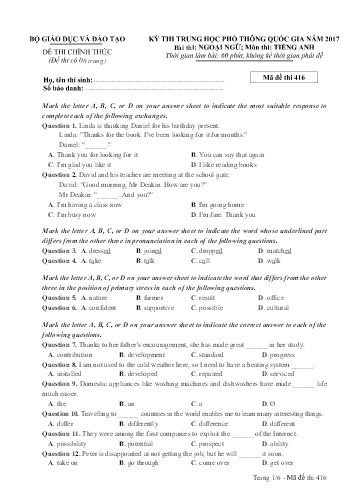
 BỘ GIÁO DỤC VÀ ĐÀO TẠO KỲ THI TRUNG HỌC PHỔ THÔNG QUỐC GIA NĂM 2017
 Bài thi: NGOẠI NGỮ; Môn thi: TIẾNG ANH
 ĐỀ THI CHÍNH THỨC Thời gian làm bài: 60 phút, không kể thời gian phát đề
 (Đề thi có 06 trang)
 Họ, tên thí sinh: ......................................................................... Mã đề thi 416
 Số báo danh: .............................................................................
 Mark the letter A, B, C, or D on your answer sheet to indicate the most suitable response to
 complete each of the following exchanges.
 Question 1. Linda is thanking Daniel for his birthday present.
 Linda: "Thanks for the book. I've been looking for it for months."
 Daniel: "______."
 A. Thank you for looking for it B. You can say that again
 C. I'm glad you like it D. I like reading books
 Question 2. David and his teacher are meeting at the school gate.
 David: "Good morning, Mr Deakin. How are you?"
 Mr Deakin: "______. And you?"
 A. I'm having a class now B. I'm going home
 C. I'm busy now D. I'm fine. Thank you
 Mark the letter A, B, C, or D on your answer sheet to indicate the word whose underlined part
 differs from the other three in pronunciation in each of the following questions.
 Question 3. A. dressed B. joined C. dropped D. matched
 Question 4. A. take B. talk C. call D. walk
 Mark the letter A, B, C, or D on your answer sheet to indicate the word that differs from the other
 three in the position of primary stress in each of the following questions.
 Question 5. A. nature B. farmer C. result D. office
 Question 6. A. confident B. supportive C. possible D. cultural
 Mark the letter A, B, C, or D on your answer sheet to indicate the correct answer to each of the
 following questions.
 Question 7. Thanks to her father's encouragement, she has made great ______ in her study.
 A. contribution B. development C. standard D. progress
 Question 8. I am not used to the cold weather here, so I need to have a heating system ______.
 A. installed B. developed C. repaired D. serviced
 Question 9. Domestic appliances like washing machines and dishwashers have made ______ life
 much easier.
 A. the B. an C. a D. Ø
 Question 10. Travelling to ______ countries in the world enables me to learn many interesting things.
 A. differ B. differently C. difference D. different
 Question 11. They were among the first companies to exploit the ______ of the Internet.
 A. possibility B. potential C. prospect D. ability
 Question 12. Peter is disappointed at not getting the job, but he will ______ it soon.
 A. take on B. go through C. come over D. get over
 Trang 1/6 - Mã đề thi 416 Question 23. A. having B. making C. taking D. giving
Question 24. A. Otherwise B. In addition C. Therefore D. For example
Question 25. A. when B. what C. that D. where
Question 26. A. compete B. competition C. competitive D. competitively
Question 27. A. employ B. apply C. study D. decide
Read the following passage and mark the letter A, B, C, or D on your answer sheet to indicate the
correct answer to each of the questions from 28 to 34.
 Children all around the world love to read comic books. Maybe they like to read the kind of
comic books that come out once a month, like Spiderman or Batman, or maybe they like manga-
style comic books. That means that publishers who make comic books need to keep in touch with
the things young people like to do. One thing that many young people today are interested in is
technology, so of course kids want to read digital comic books on electronic devices.
 Let's take Japanese manga as an example. There are lots of people around the world who enjoy
reading manga. However, in the past, it was difficult to find translated versions of manga in comic
bookstores. But that did not stop manga fans. Some fans who could translate Japanese into their own
language started translating manga themselves. Then they scanned the pages of manga books and
uploaded the scanned pages to the Internet with their translation. This practice has become so
popular. People in the comic book industry made up a name for it. By combining the words scan
and translation, they call it "scanlation", and it is a big problem today. The people who do scanlation
usually share their manga for free, so readers do not buy manga books. Writers, artists, and
publishers all end up losing money because of scanlation. Another problem is piracy in the comic
book industry. Illegal copies of old and brand new comics alike have been hurting comic book sales.
 Despite the progress made in converting comics to digital formats, hardcopy comic books are
still by far the most popular format among fans. In the meantime, comic book publishers and stores
will just have to keep an eye on their buyers' habits. As the popularity of digital books for e-readers
and tablets grows, the popularity of digital comic books will grow as well.
 (Source: Reading Advantage by Casey Malarcher)
Question 28. What is the passage mainly about?
 A. The manga industry in Japan
 B. Problems in the book industry
 C. The need for digital comic books
 D. Children's most favourite type of books
Question 29. The word "they" in paragraph 1 refers to ______.
 A. things B. children C. comic books D. publishers
Question 30. According to paragraph 1, Spiderman is the name of ______.
 A. an electronic device B. a TV programme C. a comic book D. a child
Question 31. According to paragraph 2, the practice of "scanlation" mostly involves ______.
 A. scanning uploaded manga books
 B. scanning and translating manga books
 C. selling translated manga books
 D. translating uploaded manga books
 Trang 3/6 - Mã đề thi 416 Question 35. What does the passage mainly discuss?
 A. The end of the "dilution" era
 B. Marine pollution and its many forms
 C. Noise and its disruptive effects on marine life
 D. Various kinds of harmful pollutants
Question 36. The word "negligible" in paragraph 1 is closest in meaning to ______.
 A. serious B. unpredictable C. positive D. insignificant
Question 37. It can be inferred from paragraph 2 that the "dilution" policy is related to ______.
 A. treating harmful materials in the oceans properly
 B. neglecting the effects of dumping trash into the oceans
 C. helping the ecosystem of the oceans flourish
 D. dealing with the problems of water pollution
Question 38. The word "they" in paragraph 4 refers to ______.
 A. marine organisms B. the oceans
 C. man-made pollutants D. ocean's depths
Question 39. The word "spawn" in paragraph 5 can be best replaced by ______.
 A. appear B. produce C. limit D. prevent
Question 40. According to the passage, nitrogen-rich fertilizers ______.
 A. cannot be found inland
 B. do not relate to the disappearance of marine life
 C. cause a shortage of oxygen in the ocean water
 D. are created by massive blooms of algae
Question 41. Which of the following statements is NOT supported in the passage?
 A. Many pollutants deposited in the oceans finally become part of the global food chain.
 B. It is apparent that the oceans have been polluted for a long time.
 C. The oceans in the past were more contaminated than they are now.
 D. Industrial wastes and agricultural run-off are blamed for the degradation of the oceans.
Question 42. Whales and dolphins are mentioned in the final paragraph as an example of marine
creatures that ______.
 A. can communicate with each other via sound waves
 B. are forced to migrate because of water pollution
 C. suffer from loud or persistent sounds at sea
 D. can survive earthquakes because of their large bodies
Mark the letter A, B, C, or D on your answer sheet to indicate the sentence that is closest in
meaning to each of the following questions.
Question 43. "We will not leave until we see the manager," said the customers.
 A. The customers agreed to leave before they saw the manager.
 B. The customers decided to leave because they did not see the manager.
 C. The customers refused to leave until they saw the manager.
 D. The customers promised to leave before they saw the manager.
Question 44. They were late for the meeting because of the heavy snow.
 A. Had it not snowed heavily, they would have been late for the meeting.
 B. If it snowed heavily, they would be late for the meeting.
 C. But for the heavy snow, they wouldn't have been late for the meeting.
 D. If it didn't snow heavily, they wouldn't be late for the meeting.
 Trang 5/6 - Mã đề thi 416
File đính kèm:
- de_thi_trung_hoc_pho_thong_quoc_gia_nam_2017_mon_tieng_anh_m.pdf

