

Đề thi Trung học Phổ thông Quốc gia năm 2017 môn Tiếng Anh - Mã đề thi 407
 6 trang
27/12/2025
210
6 trang
27/12/2025
210
Bạn đang xem tài liệu "Đề thi Trung học Phổ thông Quốc gia năm 2017 môn Tiếng Anh - Mã đề thi 407", để tải tài liệu gốc về máy hãy click vào nút Download ở trên.
Tóm tắt nội dung tài liệu: Đề thi Trung học Phổ thông Quốc gia năm 2017 môn Tiếng Anh - Mã đề thi 407
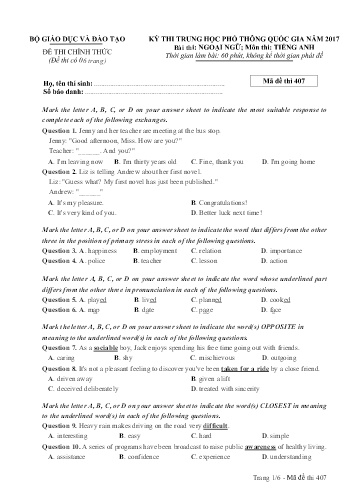
 BỘ GIÁO DỤC VÀ ĐÀO TẠO KỲ THI TRUNG HỌC PHỔ THÔNG QUỐC GIA NĂM 2017
 Bài thi: NGOẠI NGỮ; Môn thi: TIẾNG ANH
 ĐỀ THI CHÍNH THỨC Thời gian làm bài: 60 phút, không kể thời gian phát đề
 (Đề thi có 06 trang)
 Họ, tên thí sinh: ......................................................................... Mã đề thi 407
 Số báo danh: .............................................................................
 Mark the letter A, B, C, or D on your answer sheet to indicate the most suitable response to
 complete each of the following exchanges.
 Question 1. Jenny and her teacher are meeting at the bus stop.
 Jenny: "Good afternoon, Miss. How are you?"
 Teacher: "______. And you?"
 A. I'm leaving now B. I'm thirty years old C. Fine, thank you D. I'm going home
 Question 2. Liz is telling Andrew about her first novel.
 Liz: "Guess what? My first novel has just been published."
 Andrew: "______"
 A. It's my pleasure. B. Congratulations!
 C. It's very kind of you. D. Better luck next time!
 Mark the letter A, B, C, or D on your answer sheet to indicate the word that differs from the other
 three in the position of primary stress in each of the following questions.
 Question 3. A. happiness B. employment C. relation D. importance
 Question 4. A. police B. teacher C. lesson D. action
 Mark the letter A, B, C, or D on your answer sheet to indicate the word whose underlined part
 differs from the other three in pronunciation in each of the following questions.
 Question 5. A. played B. lived C. planned D. cooked
 Question 6. A. map B. date C. page D. face
 Mark the letter A, B, C, or D on your answer sheet to indicate the word(s) OPPOSITE in
 meaning to the underlined word(s) in each of the following questions.
 Question 7. As a sociable boy, Jack enjoys spending his free time going out with friends.
 A. caring B. shy C. mischievous D. outgoing
 Question 8. It's not a pleasant feeling to discover you've been taken for a ride by a close friend.
 A. driven away B. given a lift
 C. deceived deliberately D. treated with sincerity
 Mark the letter A, B, C, or D on your answer sheet to indicate the word(s) CLOSEST in meaning
 to the underlined word(s) in each of the following questions.
 Question 9. Heavy rain makes driving on the road very difficult.
 A. interesting B. easy C. hard D. simple
 Question 10. A series of programs have been broadcast to raise public awareness of healthy living.
 A. assistance B. confidence C. experience D. understanding
 Trang 1/6 - Mã đề thi 407
Question 23. A. locations B. situations C. positions D. conditions
Question 24. A. who B. whose C. where D. which
Question 25. A. differ B. different C. differently D. differences
Question 26. A. Therefore B. However C. Otherwise D. Moreover
Question 27. A. show B. take C. get D. feel
Read the following passage and mark the letter A, B, C, or D on your answer sheet to indicate the
correct answer to each of the questions from 28 to 34.
 Different cultures follow their own special customs when a child's baby teeth fall out. In Korea,
for example, they have the custom of throwing lost teeth up on the roof of a house. According to
tradition, a magpie will come and take the tooth. Later, the magpie will return with a new tooth for
the child. In other Asian countries, such as Japan and Vietnam, children follow a similar tradition of
throwing their lost teeth onto the roofs of houses.
 Birds aren't the only animals thought to take lost teeth. In Mexico and Spain, tradition says a
mouse takes a lost tooth and leaves some money. However, in Mongolia, dogs are responsible for
taking teeth away. Dogs are highly respected in Mongolian culture and are considered guardian
angels of the people. Tradition says that the new tooth will grow good and strong if the baby tooth
is fed to a guardian angel. Accordingly, parents in Mongolia will put their child's lost tooth in a piece
of meat and feed it to a dog.
 The idea of giving lost teeth to an angel or fairy is also a tradition in the West. Many children
in Western countries count on the Tooth Fairy to leave money or presents in exchange for a tooth.
The exact origins of the Tooth Fairy are a mystery, although the story probably began in England
or Ireland centuries ago. According to tradition, a child puts a lost tooth under his or her pillow
before going to bed. In the wee hours, while the child is sleeping, the Tooth Fairy takes the tooth
and leaves something else under the pillow. In France, the Tooth Fairy leaves a small gift. In the
United States, however, the Tooth Fairy usually leaves money. These days, the rate is $1 to $5 per
tooth, adding up to a lot of money from the Tooth Fairy!
 (Source: Reading Challenge 2 by Casey Malarcher & Andrea Janzen)
Question 28. What is the passage mainly about?
 A. Presents for young children's lost teeth B. Animals eating children's lost teeth
 C. Customs concerning children's new teeth D. Traditions concerning children's lost teeth
Question 29. The word "their" in paragraph 1 refers to ______.
 A. houses' B. children's C. roofs' D. countries'
Question 30. According to the passage, where is a child's lost tooth thought to be taken away by a
mouse?
 A. In Mongolia B. In Mexico and Spain
 C. In Japan and Vietnam D. In Korea
Question 31. According to paragraph 2, parents in Mongolia feed their child's lost tooth to a dog
because ______.
 A. they believe that this will make their child's new tooth good and strong
 B. they hope that their child will get some gifts for his or her tooth
 C. they know that dogs are very responsible animals
 D. they think dogs like eating children's teeth
 Trang 3/6 - Mã đề thi 407 Question 35. What does the passage mainly discuss?
 A. Humans and endangered species B. The importance of living organisms
 C. Measures to protect endangered species D. Causes of animal extinction
Question 36. The word "inconsequential" in paragraph 1 is closest in meaning to ______.
 A. unimportant B. unavoidable C. unexpected D. unrecognizable
Question 37. Which of the following can result from the loss of one species in a food chain?
 A. The connections among the creatures in the food chain become closer.
 B. Larger predators will look for other types of prey.
 C. There might be a lack of food resources for some other species.
 D. Animals will shift to another food chain in the community.
Question 38. The word "They" in paragraph 2 refers to ______.
 A. human-related effects B. some species
 C. low birthrates D. natural obstacles
Question 39. In paragraph 2, non-native species are mentioned as ______.
 A. a kind of harmless animals B. an achievement of human beings
 C. a harmful factor to the environment D. a kind of useful plants
Question 40. The word "perish" in paragraph 3 is closest in meaning to ______.
 A. develop B. complete C. remain D. disappear
Question 41. According to the passage, which of the following statements is NOT true?
 A. Humans have difficult choices to make about saving endangered species.
 B. The existence of humans is at the expense of some other species.
 C. No other species can threaten the survival of humans on Earth.
 D. Some animals and plants cannot survive without human help.
Question 42. Which of the following can be inferred from the passage?
 A. Animal and plant species which pose threats to humans will die out soon.
 B. Saving popular animal and plant species should be given a high priority.
 C. Humans will make changes in their lifestyles to save other species.
 D. The dilemma humans face between maintaining their lives and saving other species remains.
Mark the letter A, B, C, or D on your answer sheet to indicate the sentence that best combines
each pair of sentences in the following questions.
Question 43. Some kinds of fish live in fresh water. Others live in sea water.
 A. Some kinds of fish live in fresh water, for others live in sea water.
 B. Some kinds of fish live in fresh water, so others live in sea water.
 C. Some kinds of fish live in fresh water, or others live in sea water.
 D. Some kinds of fish live in fresh water, and others live in sea water.
Question 44. My mother is very busy with her work at the office. She still takes good care of us.
 A. My mother is so busy with her work at the office that she cannot take good care of us.
 B. Because my mother is very busy with her work at the office, she takes good care of us.
 C. In spite of being very busy with her work at the office, my mother takes good care of us.
 D. My mother is too busy with her work at the office to take good care of us.
 Trang 5/6 - Mã đề thi 407
File đính kèm:
- de_thi_trung_hoc_pho_thong_quoc_gia_nam_2017_mon_tieng_anh_m.pdf

