

Đề thi Trung học Phổ thông Quốc gia năm 2017 môn Tiếng Anh - Mã đề thi 404
 6 trang
23/12/2025
270
6 trang
23/12/2025
270
Bạn đang xem tài liệu "Đề thi Trung học Phổ thông Quốc gia năm 2017 môn Tiếng Anh - Mã đề thi 404", để tải tài liệu gốc về máy hãy click vào nút Download ở trên.
Tóm tắt nội dung tài liệu: Đề thi Trung học Phổ thông Quốc gia năm 2017 môn Tiếng Anh - Mã đề thi 404
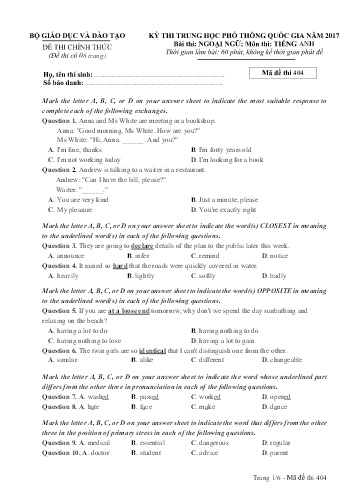
 BỘ GIÁO DỤC VÀ ĐÀO TẠO KỲ THI TRUNG HỌC PHỔ THÔNG QUỐC GIA NĂM 2017
 ĐỀ THI CHÍNH THỨC Bài thi: NGOẠI NGỮ; Môn thi: TIẾNG ANH
 (Đề thi có 06 trang) Thời gian làm bài: 60 phút, không kể thời gian phát đề
 Họ, tên thí sinh: ......................................................................... Mã đề thi 404
 Số báo danh: .............................................................................
 Mark the letter A, B, C, or D on your answer sheet to indicate the most suitable response to
 complete each of the following exchanges.
 Question 1. Anna and Ms White are meeting in a bookshop.
 Anna: "Good morning, Ms White. How are you?"
 Ms White: "Hi, Anna. ______. And you?"
 A. I'm fine, thanks B. I'm forty years old
 C. I'm not working today D. I'm looking for a book
 Question 2. Andrew is talking to a waiter in a restaurant.
 Andrew: "Can I have the bill, please?"
 Waiter: "______."
 A. You are very kind B. Just a minute, please
 C. My pleasure D. You're exactly right
 Mark the letter A, B, C, or D on your answer sheet to indicate the word(s) CLOSEST in meaning
 to the underlined word(s) in each of the following questions.
 Question 3. They are going to declare details of the plan to the public later this week.
 A. announce B. infer C. remind D. notice
 Question 4. It rained so hard that the roads were quickly covered in water.
 A. heavily B. lightly C. softly D. badly
 Mark the letter A, B, C, or D on your answer sheet to indicate the word(s) OPPOSITE in meaning
 to the underlined word(s) in each of the following questions.
 Question 5. If you are at a loose end tomorrow, why don't we spend the day sunbathing and
 relaxing on the beach?
 A. having a lot to do B. having nothing to do
 C. having nothing to lose D. having a lot to gain
 Question 6. The twin girls are so identical that I can't distinguish one from the other.
 A. similar B. alike C. different D. changeable
 Mark the letter A, B, C, or D on your answer sheet to indicate the word whose underlined part
 differs from the other three in pronunciation in each of the following questions.
 Question 7. A. washed B. passed C. worked D. opened
 Question 8. A. hate B. face C. make D. dance
 Mark the letter A, B, C, or D on your answer sheet to indicate the word that differs from the other
 three in the position of primary stress in each of the following questions.
 Question 9. A. medical B. essential C. dangerous D. regular
 Question 10. A. doctor B. student C. advice D. parent
 Trang 1/6 - Mã đề thi 404 Question 23. A. encouraged B. forbidden C. assisted D. opposed
Question 24. A. sound B. sense C. taste D. touch
Question 25. A. in contrast B. moreover C. therefore D. in addition
Question 26. A. which B. where C. who D. whose
Question 27. A. usefully B. use C. usefulness D. useful
Read the following passage and mark the letter A, B, C, or D on your answer sheet to indicate
the correct answer to each of the questions from 28 to 34.
 When naming a child, some parents seem to choose a name based simply on their personal
preference. In other families, grandparents or professional name-makers come up with a child's
name. In some cases, the time of a child's birth influences how the child's name is determined.
 In many European cultures, names are typically chosen by parents. Parents' choice for their
child's name may be based on names of their relatives or ancestors. For example, in Italy, children
are traditionally named after their grandparents. The parents generally use the father's parents' names
first. If they have more children, then they will use the mother's parents' names. Similarly, some
people in Eastern Europe name their children after relatives who have died. This tradition is seen as
a means to protect the child from the Angel of Death.
 Traditionally in some Asian countries, a child's grandfather or a fortune-teller chooses the
child's name. In contrast to the tradition of naming children after relatives, the child's name is chosen
to influence the child's character. For example, names may be based on a connection to certain
elements such as fire, water, earth, wood, or metal. Or the name might include a written character
meaning beauty, strength, or kindness.
 In certain African cultures, when a child is born plays a large part in determining the child's
name. In Ghana's Akan culture, the day a child is born determines the child's name. But each day
has different names for boys and girls. For instance, a boy born on Friday is named Kofi, whereas a
girl born on the same day is named Afua. Both Kofi and Afua mean "wanderer" or "explorer."
Children with these names are seen as travelers.
 No matter where the name comes from, a child's name is the first gift in life. Whether the name
is chosen according to preference or dictated by tradition, it reflects something about a child's
culture. For that reason, all names should be treasured and respected.
 (Source: Reading Challenge 2 by Casey Malarcher & Andrea Janzen)
Question 28. What is the main idea of the passage?
 A. The choice of name for a child in Asia
 B. The history of child naming around the world
 C. The practice of child naming in Europe
 D. The tradition of child naming in different cultures
Question 29. According to the passage, in many European cultures, names are typically selected
by ______.
 A. ancestors B. parents C. relatives D. grandparents
Question 30. The word "means" in paragraph 2 is closest in meaning to ______.
 A. sign B. symbol C. route D. way
 Trang 3/6 - Mã đề thi 404 Question 35. What does the passage mainly discuss?
 A. The size of tropical rainforest loss
 B. Causes and effects of rainforest destruction
 C. The rate of rainforest destruction in the Amazon
 D. Typical patterns of extinction of rainforest species
Question 36. According to paragraph 1, which of the following about the rate of rainforest
destruction is TRUE?
 A. It was greater in the early 1990s than in the 1980s.
 B. It was the same in the early 1990s as in the 1980s.
 C. It was greater in the 1980s than in the early 1990s.
 D. It kept increasing from the 1980s to the 1990s.
Question 37. The word "rebounded" in paragraph 1 could be best replaced by ______.
 A. remained unchanged B. fallen again C. risen again D. gone up and down
Question 38. Which of the following can result from the loss of tropical rainforests?
 A. The decrease in wasted lands
 B. The disappearance of many rainforest species
 C. The disappearance of landless farmers
 D. The increase in the rainforest habitat
Question 39. According to the passage, what is the most common cause of deforestation in different
regions?
 A. The search for oil B. The search for valuable woods
 C. The search for rare animals D. The search for new farm lands
Question 40. The word "regenerate" in paragraph 2 is closest in meaning to ______.
 A. recover B. renew C. repeat D. refine
Question 41. The phrase "these lands" in paragraph 3 refers to ______.
 A. lands for raising cattle B. lands sold and colonized
 C. lands abandoned and wasted D. lands for planting
Question 42. What can be inferred about rainforests from the passage?
 A. Rainforest destruction can be reduced with the help of cattle ranchers.
 B. The cycle of rainforest destruction will come to an end.
 C. Human beings are the main contributor to deforestation in tropical regions.
 D. Most tropical rainforests have been sold to plantation owners.
Mark the letter A, B, C, or D on your answer sheet to indicate the underlined part that needs
correction in each of the following questions.
Question 43. Working as a doctor would give me a chance taking care of people's health.
 A B C D
Question 44. Jane help her mother to do the housework when she has free time.
 A B C D
Question 45. Many living organisms depend largely on the environment for the satisfaction of its
 A B C D
needs.
 Trang 5/6 - Mã đề thi 404
File đính kèm:
- de_thi_trung_hoc_pho_thong_quoc_gia_nam_2017_mon_tieng_anh_m.pdf

