

Đề thi tốt nghiệp Trung học Phổ thông môn Tiếng Anh - Năm học 2019-2020 - Trường THPT Duy Tân (Có đáp án)
 5 trang
30/12/2025
530
5 trang
30/12/2025
530
Bạn đang xem tài liệu "Đề thi tốt nghiệp Trung học Phổ thông môn Tiếng Anh - Năm học 2019-2020 - Trường THPT Duy Tân (Có đáp án)", để tải tài liệu gốc về máy hãy click vào nút Download ở trên.
Tóm tắt nội dung tài liệu: Đề thi tốt nghiệp Trung học Phổ thông môn Tiếng Anh - Năm học 2019-2020 - Trường THPT Duy Tân (Có đáp án)
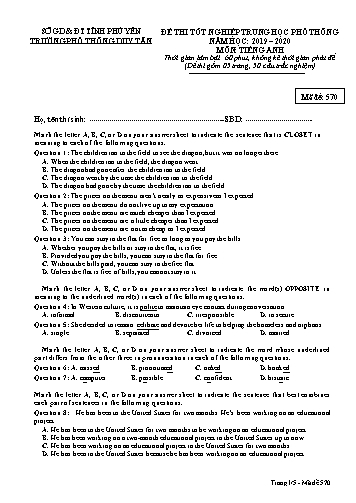
 SỞ GD & ĐT TỈNH PHÚ YÊN ĐỀ THI TỐT NGHIỆP TRUNG HỌC PHỔ THÔNG
TRƯỜNG PHỔ THÔNG DUY TÂN NĂM HỌC: 2019 – 2020
 MÔN: TIẾNG ANH
 Thời gian làm bài: 60 phút, không kể thời gian phát đề
 (Đề thi gồm 05 trang, 50 câu trắc nghiệm)
 Mã đề: 570
 Họ, tên thí sinh: ..................................................................... SBD: ..................................
 Mark the letter A, B, C, or D on your answer sheet to indicate the sentence that is CLOSET in
 meaning to each of the following questions.
 Question 1: The children ran to the field to see the dragon, but it was no longer there.
 A. When the children ran to the field, the dragon went.
 B. The dragon had gone after the children ran to the field.
 C. The dragon went by the time the children ran to the field.
 D. The dragon had gone by the time the children ran to the field.
 Question 2: The prices on the menu aren’t nearly as expensive as I expected.
 A. The prices on the menu do not live up to my expectation.
 B. The prices on the menu are much cheaper than I expected.
 C. The prices on the menu are a little cheaper than I expected.
 D. The prices on the menu are not as cheap as I expected.
 Question 3: You can stay in the flat for free as long as you pay the bills.
 A. Whether you pay the bills or stay in the flat, it is free.
 B. Provided you pay the bills, you can stay in the flat for free.
 C. Without the bills paid, you can stay in the free flat.
 D. Unless the flat is free of bills, you cannot stay in it.
 Mark the letter A, B, C, or D on your answer sheet to indicate the word(s) OPPOSITE in
 meaning to the underlined word(s) in each of the following questions.
 Question 4: In Western culture, it is polite to maintain eye contact during conversation.
 A. informal B. discourteous C. irresponsible D. in secure
 Question 5: She decided to remain celibate and devote her life to helping the homeless and orphans.
 A. single B. separated C. divorced D. married
 Mark the letter A, B, C, or D on your answer sheet to indicate the word whose underlined
 part differs from the other three in pronunciation in each of the following questions.
 Question 6: A. missed B. pronounced C. naked D. booked
 Question 7: A. computer B. possible C. confident D. historic
 Mark the letter A, B, C, or D on your answer sheet to indicate the sentence that best combines
 each pair of sentences in the following questions.
 Question 8: . He has been to the United States for two months. He’s been working on an educational
 project.
 A. He has been to the United States for two months to be working on an educational project.
 B. He has been working on a two-month educational project in the United States up to now.
 C. He has been working on an educational project in the United States for two months.
 D. He has been in the United States because he has been working on an educational project.
 Trang 1/5 - Mã đề 570 Question 17: On a resume, which job should be listed first?
 A. Your most important job. B. Your most recent job.
 C. Your first job. D. Your most relevant job.
Question 18: The word “brief” is closet in meaning to _________?
 A. accurate B. precise C. informative D. short
Question 19: Which of the following should NOT be on your resume?
 A. The year you received your bachelor’s degree.
 B. The description of the tasks that you did in your last job.
 C. Your nationality and the fact that you are single.
 D. Your name, telephone, and fax number.
 Read the following passage and mark the letter A, B, C, or D on your answer sheet to indicate
the correct word or phrase that best fits each of the numbered blanks.
 WAYS TO IMPROVE YOUR MEMORY
 A good memory is often seen as something that comes naturally, and a bad memory as
something that cannot be changed, but actually (20)______ is a lot that you can do to improve your
memory.
 We all remember the things we are interested in and forget the ones that bore us. This no
doubt explains the reason (21)______ schoolboys remember football results effortlessly but
struggle with dates from their history lessons! Take an active interest in what you want to
remember, and focus on it (22)______ .One way to “make” yourself more interested is to ask questions
- the more the better!
 Physical exercise is also important for your memory, because it increases your heart (23)______ and
sends more oxygen to your brain, and that makes your memory work better. Exercise also
reduces stress, which is very bad for the memory.
 The old saying that-eating fish makes you brainy may be true after all. Scientists have discovered
that the fats (24)______ in fish like tuna, sardines and salmon - as well as in olive oil- help to improve
the memory. Vitamin-rich fruits such as oranges, strawberries and red grapes are all good “brain food”,
too.
 (Source: ―New Cutting Edge‖, Cunningham, S. & Moor. 2010. Harlow: Longman)
Question 20: A. there B. this C. that D. it
Question 21: A. which B. why C. what D. how
Question 22: A. slightly B. consciously C. hardly D. easily
Question 23: A. rate B. level C. degree D. grade
Question 24: A. made B. founded C. found D. existed
Choose the one word or phrase – A, B, C or D – that best completes the sentence or substitutes
for the underlined word or phrase.
Question 25: We’re going to freeze out here if you don’t let us ____ the bus.
 A. get on B. take off C. go into D. come up
Question 26: Computer is one of the most important ________of the 20th century.
 A. inventions B. inventors C. inventings D. inventories
Question 27: Why don’t you raise your hand to ___ the teacher’s attention instead of shouting like
this?
 A. capture B. pull C. attract D. draw
Question 28: Since he failed his exam, he had to ______ for it again.
 A. make B. pass C. sit D. take
Question 29: The survey was to find out the young people’s attitudes______ love and marriage.
 A. above B. towards C. beneath D. with
Question 30: The children, _____ parents work late, are taken home by bus.
 A. whose B. their C. that D. whom
 Trang 3/5 - Mã đề 570 Clearly, change simply takes time. But in addition, there has been active resistance on the part of
many managers. These executives claim that supervising the telecommuters in a large work force
scattered across the country would be too difficult, or, at least, systems for managing them are not yet
developed, thereby complicating the manager’s responsibilities.
 It is also true that employees who are given the option of telecommuting are reluctant to accept the
opportunity. Most people feel that they need regular interaction with a group, and many are concerned
that they will not have the same consideration for advancement if they are not more visible in the
office setting. Some people feel that even when a space in their homes is set aside as a work area, they
never really get away from the office.
Question 43: With which of the following topics is the passage primarily concerned?
 A. The advantages of telecommuting B. The failure of telecommuting
 C. A definition of telecommuting D. An overview of telecommuting
Question 44: How many Americans are involved in telecommuting?
 A. More than 8 million. B. Fewer than estimated in USA Today.
 C. Fewer than last year. D. More than predicted in Business Week.
Question 45: The phrase “of no consequence” means ________.
 A. of no good B. of no use C. irrelevant D. unimportant
Question 46: The author mentions all of the following as concerns of telecommuting EXCEPT
________.
 A. The lack of interaction with a group. B. The opportunities of advancement.
 C. The work place is in the home. D. The different system of supervision.
Question 47: The word “them” in the second paragraph refers to________ .
 A. responsibilities B. executives C. telecommuters D. systems
Question 48: The reason why telecommuting has not become popular is that the employees
________.
 A. are ignorant of telecommuting.
 B. feel that a work area in their home is away from the office.
 C. need regular interaction with their families
 D. are worried about the promotion if they are not seen at the office.
Question 49: It can be inferred from the passage that the author is_________.
 A. a telecommuter B. a reporter C. the manager D. a statistician
Question 50: When Business Week published “The Portable Executive”, it implied that_________.
 A. most telecommuters were satisfied with their work.
 B. the trend for telecommuting was optimistic.
 C. systems for managing telecommuters were not effective.
 D. there are resistance on the part of many managers about telecommuting.
 ----------- THE END ----------
 Trang 5/5 - Mã đề 570
File đính kèm:
- de_thi_tot_nghiep_trung_hoc_pho_thong_mon_tieng_anh_nam_hoc.doc
 25_ANH_DTAN_HD.docx

