

Đề thi thử Trung học Phổ thông Quốc gia môn Tiếng Anh - Năm học 2018-2019 - Trường PT DTNT tỉnh Phú Yên (Có đáp án)
 5 trang
30/12/2025
520
5 trang
30/12/2025
520
Bạn đang xem tài liệu "Đề thi thử Trung học Phổ thông Quốc gia môn Tiếng Anh - Năm học 2018-2019 - Trường PT DTNT tỉnh Phú Yên (Có đáp án)", để tải tài liệu gốc về máy hãy click vào nút Download ở trên.
Tóm tắt nội dung tài liệu: Đề thi thử Trung học Phổ thông Quốc gia môn Tiếng Anh - Năm học 2018-2019 - Trường PT DTNT tỉnh Phú Yên (Có đáp án)
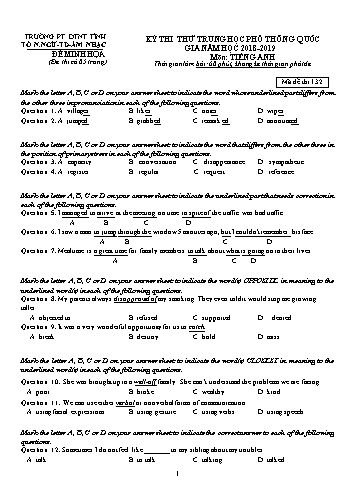
 TRƯỜNG PT DTNT TỈNH KỲ THI THỬ TRUNG HỌC PHỔ THÔNG QUỐC
TỔ N.NGỮ-TD-ÂM NHẠC GIA NĂM HỌC 2018-2019
 ĐỀ MINH HỌA Môn: TIẾNG ANH
 (Đề thi có 05 trang) Thời gian làm bài: 60 phút, không kể thời gian phát đề
 Mã đề thi 132
Mark the letter A, B, C or D on your answer sheet to indicate the word whose underlined part differs from
the other three in pronunciation in each of the following questions.
Question 1. A. villages B. likes C. notes D. wipes
Question 2. A. jumped B. grabbed C. remarked D. announced
Mark the letter A, B, C or D on your answer sheet to indicate the word that differs from the other three in
the position of primary stress in each of the following questions.
Question 3. A. capacity B. conversation C. disappearance D. sympathetic
Question 4. A. register B. regular C. request D. reference
Mark the letter A, B, C or D on your answer sheet to indicate the underlined part that needs correction in
each of the following questions.
Question 5. I managed to arrive at the meeting on time in spite of the traffic was bad traffic.
 A B C D
Question 6. I saw a man to jump through the window 5 minutes ago, but I couldn't remember his face.
 A B C D
Question 7. Mealtime is a great time for family members to talk about what is going on in their lives.
 A B C D
Mark the letter A, B, C or D on your answer sheet to indicate the word(s) OPPOSITE in meaning to the
underlined word(s) in each of the following questions.
Question 8. My parents always disapproved of my smoking. They even told it would stop me growing
taller.
 A. objected to B. refused C. supported D. denied
Question 9. It was a very wonderful opportunity for us to catch.
 A. break B. destroy C. hold D. miss
Mark the letter A, B, C or D on your answer sheet to indicate the word(s) CLOSEST in meaning to the
underlined word(s) in each of the following questions.
Question 10. She was brought up in a well-off family. She can’t understand the problems we are facing.
 A. poor B. broke C. wealthy D. kind
Question 11. We can use either verbal or nonverbal forms of communication.
 A. using facial expressions B. using gesture C. using verbs D. using speech
Mark the letter A, B, C or D on your answer sheet to indicate the correct answer to each of the following
questions.
Question 12. Sometimes I do not feel like _______ to my sibling about my troubles.
 A. talk B. to talk C. talking D. talked
 1 Rachel Carson was born in 1907 in Springdale, Pennsylvania. She studied biology at college and
zoology at Johns Hopkins University, where she received her master’s degree in 1933. In 1936, she was
hired by the U.S. Fish and Wildlife Service, where she worked most of her life.
 Carson’s first book, Under the Sea Wind, was published in 1941. It received excellent reviews, but
sales were poor until it was reissued in 1952. In that year she published The Sea Around Us, which
provided a fascinating look beneath the ocean’s surface, emphasizing human history as well as geology and
marine biology. Her imagery and language had a poetic quality. Carson consulted no less than 1,000 printed
sources. She had voluminous correspondence and frequent discussions with experts in the field. However,
she always realized the limitations of her nontechnical readers.
 In 1962, Carson published Silent Spring, a book that sparked considerable controversy. It proved
how much harm was done by the uncontrolled, reckless use of insecticides. She detailed how they poison
the food supply of animals, kill birds and fish, and contaminate human food. At the time, spokesmen for the
chemical industry mounted personal attacks against Carson and issued propaganda to indicate that her
findings were flawed. However, her work was proved by a 1963 report of the President’s Science Advisory
Committee.
 (Source: TOEFL Reading)
Question 28. The passage mainly discusses Rachel Carson’s work
 A. as a researcher B. at college
 C. at the U.S. Fish and Wildlife Service D. as a writer
Question 29. According to the passage, what did Carson primarily study at Johns Hopkins University?
 A. oceanography B. zoology C. literature D. history
Question 30. When she published her first book, Carson was closest to the age of
 A. 26 B. 29 C. 34 D. 45
Question 31. It can be inferred from the passage that in 1952, Carson’s book Under the Sea Wind
 A. was outdated B. became more popular than her other books
 C. was praised by critics D. was sold many copies
Question 32. Which of the following was NOT mentioned in the passage as a source of information for The
Sea Around Us?
 A letters from scientists B. a research expedition
 C. talks with experts D. printed matter
Question 33. Which of the following words or phrases is LEAST accurate in describing The Sea Around
Us?
 A. highly technical B. poetic C. fascinating D. well-researched
Question 34. The word “reckless” in line 11 is closest in meaning to________ .
 A. unnecessary B. limited C. continuous D. irresponsible
Question 35. According to the passage, Silent Spring is primarily
 A. an attack on the use of chemical preservatives in food
 B. a discussion of the hazards insects pose to the food supply
 C. a warning about the dangers of misusing insecticides
 D. an illustration of the benefits of the chemical industry
Mark the letter A, B, C or D on your answer sheet to indicate the sentence that is closest in the meaning
to each of the following questions.
Question 36. “Would you like to come to my birthday party, Mary?” said Mike.
 A. Mike didn’t know that Mary had come to his birthday party.
 B. Mike was told to come to Mary’s birthday party.
 3 Question 44. A. tall B. large C. high D. many
Question 45. A. by B. from C. at D. in
Read the following passage and mark the letter A, B, C or D on your answer sheet to indicate the correct
answer to each of the questions from 46 to 50.
 Ever since humans inhabited the earth, they have made use of various forms of communication.
Generally, this expression of thoughts and feelings has been in the form of oral speech. When there is a
language barrier, communication is accomplished through sign language in which motions stand for letters,
words, and ideas. Tourists, the deaf, and the mute have had to resort to this form of expression. Many of
these symbols of whole words are very picturesque and exact and can be used internationally; spelling,
however, cannot.
 Body language transmits ideas or thoughts by certain actions, either intentionally or unintentionally.
A wink can be a way of flirting or indicating that the party is only joking. A nod signifies approval, while
shaking the head indicates a negative reaction.
 Other forms of nonlinguistic language can be found in Braille (a system of raised dots read with the
fingertips), signal flags, Morse code, and smoke signals. Road maps and picture signs also guide, warn, and
instruct people.
 While verbalization is the most common form of language, other Systems and techniques also
express human thoughts and feelings.
 (Source: TOEFL Reading)
 Question 46. Which of the following best summarizes this passage?
 A. When language is a barrier, people will find other forms of communication.
 B. Everybody uses only one form of communication.
 C. Nonlinguistic language is invaluable to foreigners.
 D. Although other forms of communication exist, verbalization is the fastest.
 Question 47. The word "these" in paragraph1 refers to
 A. tourists B. the deaf and the mute
 C. thoughts and feelings D. sign language motions
 Question 48. All of the following statements are true EXCEPT
 A. there are many forms of communication in existence today
 B. verbalization is the most common form of communication
 C. the deaf and mute use an oral form of communication
 D. ideas and thoughts can be transmitted by body language
 Question 49. Which form other than oral speech would be most commonly used among blind people?
 A. Picture signs B. Braille C. Body language D. Signal flags
 Question 50. The word "wink" in paragraph 2 means most nearly the same as
 A. close one eye briefly B. close two eyes briefly
 C. nob the head up and down D. shake the head from side to side
 KEY: 1. A 2. B 3. A 4. C 5. D 6. A 7. D 8. C 9. D 10. D
 11. D 12. C 13. A 14. C 15. B 16. C 17. D 18. B 19. A 20. C
 21. D 22. B 23. D 24. B 25. C 26. D 27. C 28. D 29. B 30. C
 31. D 32. B 33. A 34. D 35. C 36. C 37. B 38. C 39. D 40. A
 41. D 42. C 43. A 44. C 45. B 46. A 47. D 48. C 49. B 50. A
 5
File đính kèm:
- de_thi_thu_trung_hoc_pho_thong_quoc_gia_mon_tieng_anh_nam_ho.doc

