

Đề thi thử tốt nghiệp Trung học Phổ thông năm 2019 môn Tiếng Anh - Trường THPT Nguyễn Huệ (Có đáp án)
 5 trang
21/02/2026
40
5 trang
21/02/2026
40
Bạn đang xem tài liệu "Đề thi thử tốt nghiệp Trung học Phổ thông năm 2019 môn Tiếng Anh - Trường THPT Nguyễn Huệ (Có đáp án)", để tải tài liệu gốc về máy hãy click vào nút Download ở trên.
Tóm tắt nội dung tài liệu: Đề thi thử tốt nghiệp Trung học Phổ thông năm 2019 môn Tiếng Anh - Trường THPT Nguyễn Huệ (Có đáp án)
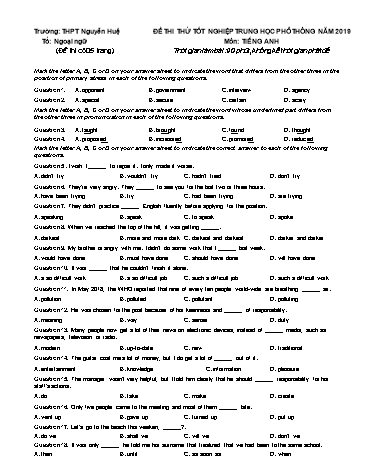
 Trường: THPT Nguyễn Huệ ĐỀ THI THỬ TỐT NGHIỆP TRUNG HỌC PHỔ THÔNG NĂM 2019
 Tổ: Ngoại ngữ Môn: TIẾNG ANH
 (Đề thi có 05 trang) Thời gian làm bài: 90 phút, không kể thời gian phát đề
Mark the letter A, B, C or D on your answer sheet to indicate the word that differs from the other three in the
position of primary stress in each of the following questions.
Question 1. A. opponent B. government C. interview D. agency
Question 2. A. special B. secure C. certain D. scary
Mark the letter A, B, C or D on your answer sheet to indicate the word whose underlined part differs from
the other three in pronunciation in each of the following questions.
Question 3. A. taught B. brought C. found D. thought
Question 4. A. proposed B. increased C. promised D. reduced
Mark the letter A, B, C or D on your answer sheet to indicate the correct answer to each of the following
questions.
Question 5. I wish I ______ to repair it. I only made it worse.
A. didn’t try B. wouldn’t try C. hadn’t tried D. don’t try
Question 6. They’re very angry. They ______ to see you for the last two or three hours.
A. have been trying B. try C. had been trying D. are trying
Question 7. They didn’t practice ______ English fluently before applying for the position.
A. speaking B. speak C. to speak D. spoke
Question 8. When we reached the top of the hill, it was getting ______.
A. darkest B. more and more dark C. darkest and darkest D. darker and darker
Question 9. My brother is angry with me. I didn’t do some work that I ______ last week.
A. would have done B. must have done C. should have done D. will have done
Question 10. It was ______ that he couldn’t finish it alone.
A. a so difficult work B. a so difficult job C. such a difficult job D. such a difficult work
Question 11. In May 2018, the WHO reported that nine of every ten people world-wide are breathing ______ air.
A. pollution B. polluted C. pollutant D. polluting
Question 12. He was chosen for the post because of his keenness and ______ of responsibility.
A. meaning B. way C. sense D. duty
Question 13. Many people now get a lot of their news on electronic devices, instead of ______ media, such as
newspapers, television or radio.
A. modern B. up-to-date C. new D. traditional
Question 14. The guitar cost me a lot of money, but I do get a lot of ______ out of it.
A. entertainment B. knowledge C. information D. pleasure
Question 15. The manager wasn’t very helpful, but I told him clearly that he should ______ responsibility for his
staff’s actions.
A. do B. take C. make D. create
Question 16. Only five people came to the meeting and most of them ______ late.
A. went up B. gave up C. turned up D. put up
Question 17. Let’s go to the beach this weeken, ______?.
A. do we B. shall we C. will we D. don’t we
Question 18. It was only ______ he told me his surname that I realized that we had been to the same school.
A. then B. until C. as soon as D. when At the age of sixty-five, Laura Ingalls Wilder began writing a series of novels for young people based on her early
experiences on the American frontier. Born in the state of Wisconsin in1867, she and her family were rugged
pioneers. Seeking better farm land, they went by covered wagon to Missouri in 1869, then on to Kansas the next
year, returning to Wisconsin in 1871, and travelling on to Minnesota and Iowa before settling permanently in South
Dakota in 1879. Because of this constant moving, Wilder’s early education took place sporadically in a succession
of one-room schools. From age thirteen to sixteen, she attended school more regularly, although she never
graduated.
 At the age of eighteen, she married Almanzo James Wilder. They bought a small farm in the Ozarks, where they
remained for the rest of their lives. Their only daughter, Rose, who had become a nationally known journalist,
encouraged her mother to write. Serving as agent and editor, Rose negotiated with Harper’s to publish her mother’s
first book, Little House in the Big Woods. Seven more books followed, each chronicling her early life on the plains.
Written from the perspective of a child, they have remained popular with young readers from many nations. Twenty
years after her death in 1957, more than 20 million copies had been sold, and they had been translated into
fourteen languages. In 1974, a weekly television series, “Little House on the Prairie,” was produced, based on the
stories from the Wilder’s books.
Question 30. What is the main topic of the passage?
A. American pioneer life B. Children’s literature
C. A weekly television series D. Wilder’s career
Question 31. The author mentions all of the following as events in the life of Laura Ingalls Wilder Except ______.
A. She went west by covered wagon B. She graduated from a one-room school
C. She married Almanzo Wilder D. She had one daughter
Question 32. The word “sporadically” in paragraph 1 is closest in meaning to ______.
A. with great success B. for a long time
C. at irregular intervals D. in a very efficient way
Question 33. The word “they” in paragraph 2 refers to _______.
A. the plains B. many nations
C. more books D. young readers
Question 34. It can be inferred from the passage that ______.
A. Laura Ingalls Wilder wrote the scripts for the television series B. the Wilder were not happy living in the Ozarks
C. the Wilder’s books have a universal appeal D. Wilder’s daughter was not a successful writer
Read the following passage and mark the letter A, B, C or D on your answer sheet to indicate the correct
answer to each of the questions from 35 to 42.
 It used to be that if you wanted to watch a sitcom or a sporting event, you’d have to watch it from your television.
As Internet technology improves more and more shows and films are becoming available online. Broadcasting
companies are putting their primetime shows directly on the Internet, and film rental shops are converting their DVD
collections to digital libraries.
 This is probably a good change – at least for viewers. People can now pick exactly what they want to watch,
and decide when and how they want to watch. A study done by Harris Interactive found that more than half of
Americans (56 percent) surf the Internet while “watching” television, and approximately 40 percent say that they
read blogs or go on social networking sites at the same time. But this trend could not be a problem for television
stations. Advertisers aren’t getting a response from viewers, and they don’t want to pay money if their commercials
aren’t being seen. In contrast, people who watch things online seem more engaged with what they watch. They Question 43. When they lose their jobs, they also lose their self-confidence, or believe in their own ability.
 A B C D
Question 44. The popularity of soccer in the United States were increased significantly by the playing of the World
 A B C
Cup in cities throughout the country in 1994.
 D
Question 45. In Japan, public schools are all both free and egalitarian; all students are considered equally and
 A B C
learn the same material.
 D
Mark the letter A, B, C or D on your answer sheet to indicate the sentence that is closest in meaning to each
of the following questions.
Question 46. We stayed in that hotel despite the noise.
A. Because of the noise, we stayed in the hotel. B. Despite the hotel was noisy, we stayed there.
C. Although the hotel was noisy, we stayed there. D. We stayed in that hotel where we like the noise.
Question 47. “If I were you, I wouldn’t trust Neil,” said my sister.
A. My sister accused me of not trusting Neil. B. My sister advised me not to trust Neil.
C. My sister encouraged me not to trust Neil. D. My sister apologized for me not trusting Neil.
Question 48. The weather was getting worse, so Joe was forced to give up his attempt to climb the summit.
A. The weather was so bad that Joe wouldn’t be able to climb the summit.
B. But for such awful weather Joe managed to climb the summit.
C. Joe wasn’t encouraged to try to reach the summit because of the weather, which was extremely bad.
D. Due to the worsening weather, Joe had no alternative but to give up his attempt to climb the summit.
Mark the letter A, B, C or D on your answer sheet to indicate the sentence that best combines each pair of
sentences in the following questions.
Question 49. I owed Bill a favor. I agreed to help him.
A. I only agreed to help Bill because I owed him some money.
B. If I hadn’t owed Bill a favor, I would have agreed to help him.
C. It was only because I owed Bill a favor that I agreed to help him.
D. Although I owed Bill a favor, I agreed to help him.
Question 50. She wore a hearing-aid. However, she could hear the phone ring perfectly well.
A. Wearing a hearing-aid prevented her from hearing the phone ring.
B. She wasn’t so hard of hearing that she couldn’t hear the phone.
C. She could hear the phone ring perfectly well because she wore a hearing-aid.
D. She couldn’t hear the phone unless she wore a hearing-aid.
File đính kèm:
- de_thi_thu_tot_nghiep_trung_hoc_pho_thong_nam_2019_mon_tieng.docx
- DapAn.docx

