

Đề thi thử kỳ thi THPT Quốc gia năm 2020 môn Tiếng Anh - Trường THPT Nguyễn Du (Có đáp án)
 5 trang
30/12/2025
490
5 trang
30/12/2025
490
Bạn đang xem tài liệu "Đề thi thử kỳ thi THPT Quốc gia năm 2020 môn Tiếng Anh - Trường THPT Nguyễn Du (Có đáp án)", để tải tài liệu gốc về máy hãy click vào nút Download ở trên.
Tóm tắt nội dung tài liệu: Đề thi thử kỳ thi THPT Quốc gia năm 2020 môn Tiếng Anh - Trường THPT Nguyễn Du (Có đáp án)
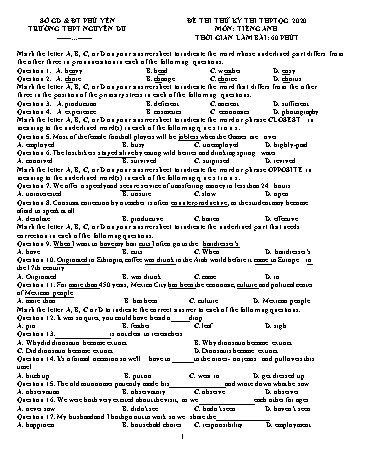
 SỞ GD & ĐT PHÚ YÊN ĐỀ THI THỬ KỲ THI THPTQG 2020
 TRƯỜNG THPT NGUYỄN DU MÔN: TIẾNG ANH
 -------------- THỜI GIAN LÀM BÀI: 60 PHÚT
Mark the letter A, B, C, or D on your answer sheet to indicate the word whose underlined part differs from
the other three in pronunciation in each of the following questions.
Question 1. A. heavy B. head C. weather D. easy
Question 2. A. chore B. change C. choice D. chorus
Mark the letter A, B, C, or D on your answer sheet to indicate the word that differs from the other
three in the position of the primary stress in each of the following questions.
Question 3. A. production B. deficient C. ancient D. sufficient
Question 4. A. experienceB. cosmeticsC. economics D. photography
Mark the letter A, B, C, or D on your answer sheet to indicate the word or phrase CLOSEST in
meaning to the underlined word(s) in each of the following q u e s t i o n s .
Question 5. Most of the female football players will be jobless when the Games are over.
A. employed B. busy C. unemployed D. highly-paid
Question 6. The lost hikers stayed alive by eating wild berries and drinking spring water.
A. connived B. survived C. surprised D. revived
Mark the letter A, B, C, or D on your answer sheet to indicate the word or phrase OPPOSITE in
meaning to the underlined word(s) in each of the following q u e s t i o n s .
Question 7. We offer a speedy and secure service of transferring money in less than 24 hours.
A. uninterested B. unsure C. slow D. open
Question 8. Constant correction by a teacher is often counterproductive, as the student may become
afraid to speak at all.
A. desolate B. productive C. barren D. effective
Mark the letter A, B, C, or D on your answer sheet to indicate the underlined part that needs
correction in each of the following questions.
Question 9. When I want to have my hair cuts I often go to the hairdresser’s.
A. haveΒ. cuts C. When D. hairdresser’s
Question 10. Originated in Ethiopia, coffee was drunk in the Arab world before it came to Europe in
the 17th century.
A. OriginatedΒ. was drunk C. came D. in
Question 11. For more than 450 years, Mexico City has been the economic, culture and political center
of Mexican people.
A. more thanΒ. has been C. culture D. Mexican people
Mark the letter A, B, C or D to indicate the correct answer to each of the following questions.
Question 12. It was so quiet; you could have heard a drop.
A. pin B. feather C. leaf D. sigh
Question 13. is not clear to researchers.
A. Why did dinosaurs become extinct B. Why dinosaurs became extinct
C. Did dinosaurs become extinct D. Dinosaurs became extinct
Question 14. It's a formal occasion so we'll have to to the nines - no jeans and pullovers this
time!
A. hitch upΒ. put on C. wear in D. get dressed up
Question 15. The old astronomer patiently made his and wrote down what he saw.
A. observation Β. observatory C. observe D. observer
Question 16. We were both very excited about the visit, as we each other for ages.
A. never sawΒ. didn't see C. hadn’t seen D. haven’t seen
Question 17. My husband and I both go out to work so we share the .
A. happiness Β. household chores C. responsibility D. employment
 1 B. However hard he tried, he didn't succeed in scoring a goal for his team.
C. No matter how many times he tried, he didn't ever succeed in kicking the ball into the goal.
D. Hard as he tried, he has never been successful in football career.
Read the following passage and mark the letter A, B, C, or D to indicate the correct word or phrase
that best fits each of the numbered blanks.
 One of the most important (31) of a standardized test is time. You'll only be allowed a
certain number of minutes for each section, so it is very important that you use your time (32)
 . The most important time strategy is pacing yourself. Before you begin, take just a few
seconds to survey the test, noting the number of questions and the sections that looks easier than the rest.
Then, make a rough time schedule based on the amount of time (33) to you. Mark
the halfway point on your test and make a note beside that mark of the time when the testing period is half
over.
 Once you begin the test, keep moving. If you work slowly in an attempt to make fewer
mistakes, your mind will become bored and begin to wander. You'll end up making far more mistakes if
you’re not concentrating. If you take too long to answer questions that stump you, you may end up (34)
 out of time before you finish. So don’t stop for difficult questions.
Skip them and move on. You can come back to them later if you have time. A question that takes you
five seconds to answer counts as much as one that takes you several-minutes, so pick up the easy points
first. (35) , answering the easier questions first helps build your confidence and
gets you in the testing groove.
 Question 31. A. factors B. issue C. concern D. information
 Question 32. A. quickly B. fast C. wisely D. hardly
 Question 33. A. close B. similar C. available D. suitable
 Question 34. A. short B. running C. moving D. cutting
 Question 35. A. Therefore B. However C. So D. Besides
 Read the following passage and mark the letter A, B, C, or D on your answer sheet to indicate the correct
 answer to each of the questions from 36 to 42.
 Diseases are a natural part of life on Earth. If there were no diseases, the population would grow too
 quickly and there would not be enough food or other resources. So in a way, diseases are nature's way of
 keeping the Earth in balance. But sometimes they spread very quickly and kill large numbers of people. For
 example, in 1918, an outbreak of the flu spread across the world, killing over 25 million people in only six
 months. Such terrible outbreaks of a disease are called pandemics.
 Pandemics happen when a disease changes in a way that our bodies are not prepared to fight. In 1918, a
 new type of flu virus appeared. Our bodies had no way to fight this new flu virus, and so it spread very quickly
 and killed large numbers of people. While there have been many different pandemic diseases throughout history,
 all of them have a few things in common.
 First, all pandemic diseases spread from one person to another very easily. Second, while they may kill
 many people, they generally do not kill people very quickly. A good example of this would be the Marburg virus.
 The Marburg virus is an extremely infectious disease. In addition, it is deadly. About 70-80% of all the people
 who get the Marburg virus die from the disease. However, the Marburg virus has not become a pandemic because
 most people die within three days of getting the disease. This means that the virus does not have enough time to
 spread to a large number of people. The flu virus of 1918, on the other hand, generally took about a week to ten
 days to kill its victims, so it had more time to spread.
 While we may never be able to completely stop pandemics, we can make them less common. Doctors
 carefully monitor new diseases that they fear could become pandemics. For example, in 2002 and 2003, doctors
 carefully watched SARS. Their health warnings may have prevented SARS from becoming a pandemic.
 Question 36. This passage is mainly about .
 A. how to prevent pandemic diseases.C. pandemic diseases.
 B. pandemic diseases throughout history.D. why pandemics happen.
 3 in the spring?
A. in the woods B. In meadows C. In bushy areas D. In canyons
Question 48. The phrase “easy prey” in the third paragraph could best be replaced by which of the
following?
A. Relaxed B. Protective C. Victims D. Sociable
Question 49. Which of the following word can best replace the word "basking" in the third paragraph?
A. Washing B. Eating C. Sleeping D. Lying
Question 50. Which of the following does NOT contribute to the rattlesnake being an endangered
animal?
A. Hibernating for eight months B. Basking in the sun
C. Congregating together D. Having long intervals between births
ĐÁP ÁN
Question 1. D Question 26. D
Question 2. D Question 27. A
Question 3. C Question 28. A
Question 4. C Question 29. A
Question 5. C Question 30. C
Question 6. B Question 31. A
Question 7. B Question 32. C
Question 8. D Question 33. C
Question 9. B Question 34. B
Question 10. A Question 35. D
Question 11. C Question 36. C
Question 12. A Question 37. C
Question 13. B Question 38. C
Question 14. D Question 39. B
Question 15. A Question 40. B
Question 16. C Question 41. B
Question 17. B Question 42. C
Question 18. A Question 43. D
Question 19. A Question 44. A
Question 20. D Question 45. C
Question 21. C Question 46. C
Question 22. A Question 47. D
Question 23. C Question 48. C
Question 24. B Question 49. D
Question 25. D Question 50. A
 5
File đính kèm:
- de_thi_thu_ky_thi_thpt_quoc_gia_nam_2020_mon_tieng_anh_truon.doc

