

Đề thi THPT Quốc gia môn Tiếng Anh - Năm học 2019-2020 - Trường THPT Phan Chu Trinh (Có đáp án)
 7 trang
28/12/2025
190
7 trang
28/12/2025
190
Bạn đang xem tài liệu "Đề thi THPT Quốc gia môn Tiếng Anh - Năm học 2019-2020 - Trường THPT Phan Chu Trinh (Có đáp án)", để tải tài liệu gốc về máy hãy click vào nút Download ở trên.
Tóm tắt nội dung tài liệu: Đề thi THPT Quốc gia môn Tiếng Anh - Năm học 2019-2020 - Trường THPT Phan Chu Trinh (Có đáp án)
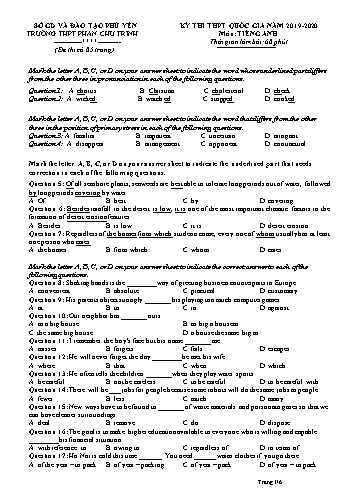
 SỞ GD VÀ ĐÀO TẠO PHÚ YÊN KỲ THI THPT QUỐC GIA NĂM 2019-2020
TRƯỜNG THPT PHAN CHU TRINH Môn: TIẾNG ANH
 --------------****----------- Thời gian làm bài: 60 phút
 (Đề thi có 05 trang)
 Mark the letter A, B, C, or D on your answer sheet to indicate the word whose underlined part differs
 from the other three in pronunciation in each of the following questions.
 Question 1: A. chorus B. Christian C. cholesterol D. check
 Question 2: A. wicked B. watched C. stopped D. cooked
 Mark the letter A, B, C, or D on your answer sheet to indicate the word that differs from the other
 three in the position of primary stress in each of the following questions.
 Question 3: A. familiar B. impatient C. uncertain D. arrogant
 Question 4: A. disappear B. arrangement C. opponent D. contractual
 Mark the letter A, B, C, or D on your answer sheet to indicate the underlined part that needs
 correction in each of the following questions.
 Question 5: Of all seashore plants, seaweeds are best able to tolerate long periods out of water, followed
 by long periods covering by water.
 A. Of B. best C. by D. covering
 Question 6: Besides rainfall in the desert is low, it is one of the most important climatic factors in the
 formation of desert erosion features.
 A. Besides B. is low C. it is D. desert erosion
 Question 7: Regardless of the homes from which students come, every one of whom usually has at least
 one person who cares.
 A. the homes B. from which C. whom D. cares
 Mark the letter A, B, C, or D on your answer sheet to indicate the correct answer to each of the
 following questions.
 Question 8: Shaking hands is the ________ way of greeting business counterparts in Europe.
 A. convenient B. absolute C. practical D. customary
 Question 9: His parents object strongly _______ his playing too much computer games.
 A. at B. to C. in D. against
 Question 10: Our neighbor has _______ ours.
 A. as a big house B. as big a house as
 C. the same big house D. a house the same big as
 Question 11: I remember the boy’s face but his name _______ me.
 A. misses B. forgets C. fails D. escapes
 Question 12: He will never forget the day ________ he met his wife.
 A. where B. that C. when D. which
 Question 13: He often tells the children _______ when they play water sports.
 A. be careful B. not be careless C. to be careful D. to be careful with
 Question 14: There will be ___ jobs for people because some robots will do the same jobs as people.
 A. fewer B. less C. much D. many
 Question 15: New ways have to be found to _______ of waste materials and poisonous gases so that we
 can have cleaner surroundings.
 A. deal B. remove C. do D. dispose
 Question 16: The goal is to make higher education available to everyone who is willing and capable
 ________ his financial situation.
 A. with reference to B. owing to C. regardless of D. in terms of
 Question 17: Ha Noi is cold this time ______. You need ______ warm clothes if you go there.
 A. of the year – to pack B. of year – packing C. of year – pack D. of year – to pack
 Trang 1/6 Read the following passage and mark the letter A, B, C, or D on your answer sheet to indicate the
correct word or phrase that best fits each of the numbered blanks from 36 to 40.
 TAKE A LOOK AT THE WORK
 “To (31) ______ that students will be successful in school, parents need to look for indicators of
school bonding,” said principal Mary Smith. “Talk of friends, (32) _______ about school, and a sense of
belonging to a class and the school are indicators of that.”
 “They also need to look for signs of academic engagement,” added Smith. By looking at the work
their child brings home from school, they can often see indicators that he or she “is becoming an
independent learner and (33) ______ age-appropriate responsibility for personal success.”
 “Parents can tell a lot about a teacher’s curriculum by looking at the work their children bring
home,” said Tim Messick. “If teachers present a curriculum (34) _____ has real-life connections and
actively engages kids, and if those kids can articulate at the end of the day some of the exciting learning
they have experienced, parents will be very happy.”
 “Parents should also expect to see assignments marked and returned promptly,” said Chris Rose.
“If it is obvious that only the students are doing the work, it (35) ______ a very negative impression. If
that’s the case - if the parents don’t think the teacher is doing his job - maybe they’re right.”
 (Adapted from: www.educationworld.com)
Question 31: A. approve B. prove C. insure D. ensure
Question 32: A. enthusiasm B. enthusiastic C. enthuse D. enthusiastically
Question 33: A. setting B. maintaining C. assuming D. solving
Question 34: A. what B. whom C. who D. that
Question 35: A. trusts B. creates C. draws D. takes
Read the following passage and mark the letter A, B, C, or D on your answer sheet to indicate the
correct answer to each of the questions from 36 to 42.
 People travel for a lot of reasons: Some tourists go to see battlefields or religious shrines. Others
are looking for culture, or simply want to have their pictures taken in front of famous places. But most
European tourists are looking for a sunny beach to lie on.
 Northern Europeans are willing to pay a lot of money and put up with a lot of inconveniences for
the sun because they have so little of it. Residents of cities like London, Copenhagen, and Amsterdam
spend a lot of their winter in the dark because the days are so short, and much of the rest of the year in
the rain. This is the reason why the Mediterranean has always attracted them. Every summer, more than
25 million people travel to Mediterranean resorts and beaches for their vacation. They all come for the
same reason, sun!
 The huge crowds mean lots of money for the economies of Mediterranean countries. Italy’s 30,000
hotels are booked solid every summer. And 13 million people camp out on French beaches, parks and
roadsides. Spain’s long sandy coastline attracts more people than anywhere else. 37 million tourists visit
yearly, or one tourist for every person living in Spain.
 But there are signs that the area is getting more tourists than it can handle. The Mediterranean is
already one of the most polluted seas on earth. And with increased tourism, it’s getting worse. The
French can’t figure out what to do with all the garbage left by campers around St. Tropez. And in many
places, swimming is dangerous because of pollution.
 None of this, however, is spoiling anyone’s fun. The Mediterranean gets more popular every year
with tourists. Obviously, they don’t go there for clean water and solitude. They tolerate traffic jams and
seem to like crowded beaches. They don’t even mind the pollution. No matter how dirty the water is, the
coastline still looks beautiful. And as long as the sun shines, it’s still better than sitting in the cold rain in
Berlin, London, or Oslo.
 (Adapted from “Modern Sun Worshippers”)
Question 36: The writer seems to imply that Europeans travel mostly for the reason that ______.
 Trang 3/6 A. Polluted water B. Crowded buses C. Traffic jams D. Rainy weather
Read the following passage and mark the letter A, B, C, or D on your answer sheet to indicate the
correct answer to each of the questions from 43 to 50.
 While some forecasting methods had limited success predicting the 1997 El Nino a few months in
advance, the Columbia University researchers say their method can predict large El Nino events up to
two years in advance. That would be a boon for governments, farmers and others seeking to plan for the
droughts and heavy rainfall El Nino can produce in various parts of the world.
 Using a computer, the researchers matched sea-surface temperatures to later El Nino occurrences
between 1980 and 2000 and were then able to anticipate El Nino events dating back to 1857, using prior
sea-surface temperatures. The results were reported in the latest issue of the journal Nature. The
researchers say their method is not perfect, but Bryan Weare, a meteorologist at the University of
California, Davis, who was not involved in the work, said it “suggests El Nino is indeed predictable.”
“This will probably convince others to search around more for even better methods,” he added. The new
method “makes it possible to predict El Nino at long lead times,” said lead author Dake Chen of
Columbia University’s Lamont-Doherty Earth Observatory. “Other models also use sea-surface
temperatures, but they have not looked as far back because they need other data, which is only available
for recent decades,” Chen said.
 The ability to predict the warming and cooling of the Pacific is of immense importance. The 1997
El Nino, for example, caused an estimated $20 billion in damage worldwide, offset by beneficial effects
in other areas, said David Anderson, of the European Centre for Medium-Range Weather Forecasts in
Reading, England. The 1877 El Nino, meanwhile, coincided with a failure of the Indian monsoon and a
famine that killed perhaps 40 million in India and China, prompting the development of seasonal
forecasting, Anderson said.
 When El Nino hit in 1991 and 1997, 200 million people were affected by flooding in China alone,
according to a 2002 United Nations report. While predicting smaller El Nino events remains tricky, the
ability to predict larger ones should be increased to at least a year if the new method is confirmed,
Anderson wrote in an accompanying commentary. El Nino tends to develop between April and June and
reaches its peak between December and February. The warming tends to last between 9 and 12 months
and occurs every two to seven years. Chen said the new forecasting method does not predict any major
El Nino events in the next two years, although a weak warming toward the end of this year is possible.
 (Source: www.nbcnews.com)
Question 43: The Columbia University researchers studied the relationship between the past EI Nino
occurrences and _______.
A. the droughts and heavy rainfall B. some forecasting methods
C. wind direction and ocean current D. sea-surface temperatures
Question 44: The word “a boon” in paragraph 1 probably means ______.
A. new information B. living condition C. good news D. scientific evidence
Question 45: It is stated in the passage that Bryan Weare ______.
A. worked at the California University, but he used to live at the Columbia University.
B. didn’t do research on El Nino with researchers.
C. had set up a special institute in America to study El Nino.
D. made a contribution to predicting El Nino, which was highly praised by other meteorologists.
Question 46: The word “immense” in paragraph 3 is closest in meaning to ______.
A. main B. enormous C. essential D. special
Question 47: According to the passage, it takes about ______ for El Nino to reach its peak.
A. less than 3 months B. 4 months C. 8 months D. 9 to 12 months
Question 48: The word “tricky” in paragraph 4 is closest in meaning to ______.
A. cunning B. difficult C. normal D. common
Question 49: Which of the following is NOT true according to the passage?
A. The method used by the Columbia University researchers can predict El Nino a few months in
advance.
 Trang 5/6
File đính kèm:
- de_thi_thpt_quoc_gia_mon_tieng_anh_nam_hoc_2019_2020_truong.doc

