

Đề thi minh họa THPT Quốc gia năm 2020 môn Tiếng Anh - Trường THPT Lê Thành Phương
 5 trang
28/12/2025
210
5 trang
28/12/2025
210
Bạn đang xem tài liệu "Đề thi minh họa THPT Quốc gia năm 2020 môn Tiếng Anh - Trường THPT Lê Thành Phương", để tải tài liệu gốc về máy hãy click vào nút Download ở trên.
Tóm tắt nội dung tài liệu: Đề thi minh họa THPT Quốc gia năm 2020 môn Tiếng Anh - Trường THPT Lê Thành Phương
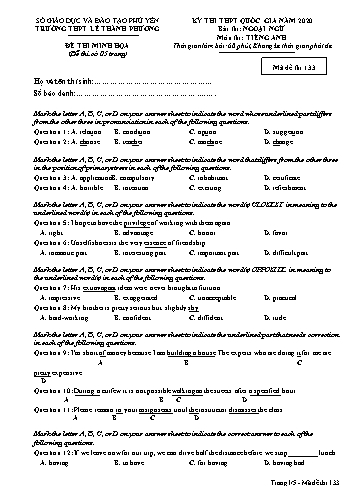
 SỞ GIÁO DỤC VÀ ĐÀO TẠO PHÚ YÊN KỲ THI THPT QUỐC GIA NĂM 2020
TRƯỜNG THPT LÊ THÀNH PHƯƠNG Bài thi: NGOẠI NGỮ
 Môn thi: TIẾNG ANH
 ĐỀ THI MINH HỌA Thời gian làm bài: 60 phút, Không kể thời gian phát đề
 (Đề thi có 05 trang)
 Mã đề thi 133
Họ và tên thí sinh:.
Số báo danh:...
Mark the letter A, B, C, or D on your answer sheet to indicate the word whose underlined part differs
from the other three in pronunciation in each of the following questions.
Question 1: A. relation B. condition C. option D. suggestion
Question 2: A. choose B. teacher C. machine D. change
Mark the letter A, B, C, or D on your answer sheet to indicate the word that differs from the other three
in the position of primary stress in each of the following questions.
Question 3: A. applicationB. compulsory C. inhabitant D. certificate
Question 4: A. horrible B. intention C. exciting D. refreshment
Mark the letter A, B, C, or D on your answer sheet to indicate the word(s) CLOSEST in meaning to the
underlined word(s) in each of the following questions.
Question 5: I hope to have the privilege of working with them again.
 A. right B. advantage C. honor D. favor
Question 6: Unselfishness is the very essence of friendship.
 A. romantic part B. interesting part C. important part D. difficult part
Mark the letter A, B, C, or D on your answer sheet to indicate the word(s) OPPOSITE in meaning to
the underlined word(s) in each of the following questions.
Question 7: His extravagant ideas were never brought to fruition.
 A. impressive B. exaggerated C. unacceptable D. practical
Question 8: My brother is pretty serious but slightly shy.
 A. hard-working B. confident C. diffident D. rude
Mark the letter A, B, C, or D on your answer sheet to indicate the underlined part that needs correction
in each of the following questions.
Question 9: I’m short of money because I am building a house. The experts who are doing it for me are
 A B C
pretty expensive.
 D
Question 10: During a curfew it is not possible walkingon the streets after a specified hour.
 A B C D
Question 11: Please remain in your assign seats until the instructor dismisses the class
 A B C D
Mark the letter A, B, C, or D on your answer sheet to indicate the correct answer to each of the
following questions.
Question 12: If we leave now for our trip, we can drive half the distance before we stop ________ lunch.
 A. having B. to have C. for having D. having had
 Trang 1/5 - Mã đề thi 133 Some people return to college as mature students and take full- or part-time training courses in a
skill that will help them to get a job. The development of open learning, (28) ______ it possible to study
when it is convenient for the students, has increased the opportunities available (29) ______ many people.
This type of study was formerly restricted to book-based learning and (30)______ course but now
includes courses on TV, CD-ROM or the Internet, and self-access courses at language or computer
centers. Americans believe that education is important at all stage of life and should not stop (31)______
people get their first job. About 40% of adults take part in some kind of formal education. About half of
them are trying to get qualifications and skills to help them with their jobs, the (32)______ are taking
recreational subjects for personal satisfaction. Schools and community colleges arrange evening classes,
and a catalog of courses is published by local boards of education.
Question 28: A. finding B. making C. enabling D. keeping
Question 29: A. to B. by C. with D. about
Question 30: A. corresponding B. correspondent C. correspondence D. corresponded
Question 31: A. otherwise B. that C. whereas D. when
Question 32: A. excess B. left C. rest D. remain
Read the following passage and mark the letter A, B, C, or D on your answer sheet to indicate the
correct answer to each of the questions from 33 to 37
 The sea has always interested people. From it they can get food, minerals, and treasures. For
thousands of years, they sailed on the sea. But they could not go far beneath its surface. People want to
explore deep into the sea. However, they are not fishes. Because people must breathe air, they cannot stay
under the water’s surface for any length of time. To explore deep water, men and women face even more
dangers and problems. A diver who wants to stay under water for more than a few minutes must breathe
air or a special mixture of gases. Divers can wear diving suits and have air pumped to them from above.
They can carry tanks of air on their back and breathe through a hose and a mouthpiece. Water weighs 800
times as much as air. Tons of water push against a diver deep in the sea. The diver’s body is under great
pressure. When divers are under great pressure, their blood takes in some of the gases they breathe. As
they rise too quickly, the gases in their blood form bubbles. Divers then suffer from the bends. The bends
can cause divers to double up in pain. Bends can even kill divers..
Question 33: Which statement does the story lead you to believe?
 A. Humans are not at home deep in the sea.
 B. All divers get the bends sooner or later.
 C. The sea began to interest humans in the last few years.
 D. Diving suits do not help divers
Question 34: The story does not say so, but it makes you think that_________.
 A. deep-sea divers should be in good health.
 B. diving under the water too quickly causes the bends
 C. divers can wear diving suits to avoid the bends
 D. divers explore the deep seas only for treasure
Question 35: A diver’s body in deep water________.
 A. is just like a fish’s body.
 B. suffers from the bends.
 C. is under great pressure.
 D. weighs very little.
Question 36: Why do drivers get the bends?
 A. They come to the surface too quickly
 B. They try to do exercises under the water
 C. Their diving suits weigh too much
 D. Their blood takes some of the gases they breathe.
Question 37: The gases in a diver’s blood can form________
 Trang 3/5 - Mã đề thi 133 The result is a remarkable unbroken record of temperature and of atmospheric levels of carbon dioxide.
Almost every time the chill of an ice age descended on the planet, carbon dioxide levels dropped. When
the global temperature dropped 9°F (5°C), carbon dioxide levels dropped to 190 parts per million or so.
Generally, as each ice age ended and the Earth basked in a warm interglacial period, carbon dioxide levels
were around 280 parts per million. Through the 160,000 years of that ice record, the level of carbon
dioxide in the atmosphere fluctuated between 190 and 280 parts per million, but never rose much higher-
until the Industrial Revolution beginning in the eighteenth century and continuing today.
 There is indirect evidence that the link between carbon dioxide levels and global temperature change
goes back much further than the glacial record. Carbon dioxide levels may have been much greater than
the current concentration during the Carboniferous period, 360 to 285 million years ago. The period was
named for a profusion of plant life whose buried remains produced a large fraction of the coal deposits
that are being brought to the surface and burned today.
Question 43: Which of the following does the passage mainly discuss?
 A. Chemical causes of ice ages.
 B. Techniques for studying ancient layers of ice in glaciers.
 C. Evidence of a relationship between levels of carbon dioxide and global temperature.
 D. Effects of plant life on carbon dioxide levels in the atmosphere.
Question 44: According to the passage, the drilling of the glacier in eastern Antarctica was important
because it___________
 A. allowed scientists to experiment with new drilling techniques
 B. permitted the study of surface temperatures in an ice-covered region of the Earth
 C. provided insight about climate conditions in earlier periods
 D. confirmed earlier findings about how glaciers are formed
Question 45: The phrase "tantamount to" in line 5 is closest in meaning to_____________.
 A. complementary to
 B. practically the same as
 C. especially well suited to
 D. unlikely to be confused with
Question 46: According to the passage, scientists used isotopes from the water of the ice core to
determine which of following?
 A. The amount of air that had bubbled to the surface since the ice had formed
 B. The temperature of the atmosphere when the ice was formed
 C. The date at which water had become locked in the glacier
 D. The rate at which water had been frozen in the glacier
Question 47: The word "remarkable" in line 12 is closest in meaning to ____________.
 A. genuine B. permanent
 C. extraordinary D. continuous
Question 48: The passage implies that the warmest temperatures among the periods mentioned occurred
__________________.
 A. in the early eighteenth century
 B. 160,000 years ago
 C. at the end of each ice age
 D. between 360 and 285 million years ago
Question 49: According to the passage, the Carboniferous period was characterized by__________ .
 A. a reduction in the number of coal deposits
 B. the burning of a large amount of coal
 C. an abundance of plants
 D. an accelerated rate of glacier formation
Question 50: The passage explains the origin of which of the following terms?
 A. Glacier B. Isotopes
 C. Industrial Revolution D. Carboniferous period
 ----------- THE END --------
 Trang 5/5 - Mã đề thi 133
File đính kèm:
- de_thi_minh_hoa_thpt_quoc_gia_nam_2020_mon_tieng_anh_truong.docx

