

Đề thi khảo sát năng lực môn Tiếng Anh Lớp 12 - Năm 2019-2020 - Trường THPT Lê Lợi (Có đáp án)
 6 trang
28/12/2025
240
6 trang
28/12/2025
240
Bạn đang xem tài liệu "Đề thi khảo sát năng lực môn Tiếng Anh Lớp 12 - Năm 2019-2020 - Trường THPT Lê Lợi (Có đáp án)", để tải tài liệu gốc về máy hãy click vào nút Download ở trên.
Tóm tắt nội dung tài liệu: Đề thi khảo sát năng lực môn Tiếng Anh Lớp 12 - Năm 2019-2020 - Trường THPT Lê Lợi (Có đáp án)
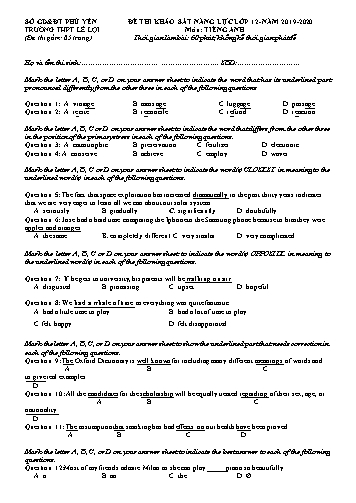
 SỞ GD&ĐT PHÚ YÊN ĐỀ THI KHẢO SÁT NĂNG LỰC LỚP 12- NĂM 2019-2020
TRƯỜNG THPT LÊ LỢI Môn: TIẾNG ANH
(Đề thi gồm: 05 trang) Thời gian làm bài: 60 phút, không kể thời gian phát đề
Họ và tên thí sinh: .SBD:
Mark the letter A, B, C, or D on your answer sheet to indicate the word that has its underlined part
pronounced differently from the other three in each of the following questions
Question 1: A. vintage B. massage C. luggage D. passage
Question 2: A. recite B. reconcile C. refund D. reaction
Mark the letter A, B, C or D on your answer sheet to indicate the word that differs from the other three
in the position of the primary stress in each of the following questions.
Question 3: A. catastrophic B. preservation C. fertilizer D. electronic
Question 4: A. conserve B. achieve C. employ D. waver
Mark the letter A, B, C or D on your answer sheet to indicate the word(s) CLOSEST in meaning to the
underlined word(s) in each of the following questions.
Question 5: The fact that space exploration has increased dramatically in the past thirty years indicates
that we are very eager to learn all we can about our solar system.
 A. seriously B. gradually C. significantly D. doubtfully
Question 6: Jose had a hard time comparing the Iphone to the Samsung phone because to him they were
apples and oranges.
 A. the same B. completely different C. very similar D. very complicated
Mark the letter A, B, C or D on your answer sheet to indicate the word(s) OPPOSITE in meaning to
the underlined word(s) in each of the following questions.
Question 7: If he gets to university, his parents will be walking on air
 A. disgusted B. promising C. upset D. hopeful
Question 8: We had a whale of time as everything was quite fantastic.
 A. had a little time to play B. had a lot of time to play
 C. felt happy D. felt disappointed
Mark the letter A, B, C, or D on your answer sheet to show the underlined part that needs correction in
each of the following questions.
Question 9: The Oxford Dictionary is well known for including many different meanings of words and
 A B C
to give real examples.
 D
Question 10: All the candidates for the scholarship will be equally treated regarding of their sex, age, or
 A B C
nationality.
 D
Question 11: The assumption that smoking has bad effects on our health have been proved.
 A B C D
Mark the letter A, B, C, or D on your answer sheet to indicate the best answer to each of the following
questions.
Question 12:Most of my friends admire Milan as she can play _____ piano so beautifully.
 A. a B. an C. the D. Ø Question 28. A. threat B. problem C. danger D. vanishing
Question 29. A. disappeared B. vanished C. extinct D. empty
Question 30. A. life B. alive C. lively D. live
Question 31. A. spoil B. wound C. wrong D. harm
Question 32. A. left B. alone C. staying D. survive
 Read the following passage and mark the letter A, B, C, or D on your answer sheet to indicate the best
answer to each of the following questions from 33 to 37.
 Genetic modification of foods is not a new practice. It has been practiced for thousands of years
under the name of "selective breeding". Animals and plants were chosen because they had traits that
humans found useful. Some animals were larger and stronger than others, or they yielded more food, or
they had some other trait that humans valued. Therefore, they were bred because of those traits.
Individuals with those traits were brought together and allowed to breed in the hope that their offspring
would have the same traits in greater measure.
 Much the same thing was done with plants. To produce bigger or sweeter fruit, or grow more grain
per unit of land, strains of plants were combined and recombined to produce hybrids, or crossbreeds that
had the desired traits in the right combinations. All the while, however, biologists wondered: is there a
more direct and versatile way to change the traits of plants and animals? Could we rewrite, so to speak,
the heredity of organisms to make them serve our needs better?
 In the 20th century, genetic modification made such changes possible at last. Now, it was possible
to alter the genetic code without using the slow and uncertain process of selective breeding. It even
became possible to blend plants and animals genetically: to insert animal genes into plants, for example,
in order to give the plants a certain trait they ordinarily would lack, such as resistance to freezing. The
result was a tremendous potential to change the very nature of biology.
Question 33: What is the passage mainly about?
 A. The arguments against genetic modification
 B. The benefits brought about by genetic modification
 C. The reasons behind selective breeding of plants
 D. The development of genetic modification
Question 34: The word "them" in paragraph 2 refers to ______.
 A. organisms B. traits C. animals D. plants
Question 35: The word "blend" in paragraph 3 mostly means ______.
 A. combine B. collect C. gather D. carry
Question 36:According to the passage, selective breeding ______.
 A. is slower and uncertain than genetic modification
 B. works much better on plants than on animals
 C. helps change the traits of plants rather than animals
 D. has a huge potential to change the nature of biology
Question 37:Which of the following IS NOT achieved by genetic modification?
 A. Giving plants necessary traits taken from animals’ genes
 B. Producing hybrids or crossbreeds from many animals and plants
 C. Encouraging people to give up selective breeding completely
 D. Making big changes to the very nature of biology
Read the following passage and mark the letter A, B, C, or D on your answer sheet to indicate the best
answer to each of the following questions from 38 to 45.
For many American university students, the weeklong spring break holiday means an endless party on a
sunny beach in Florida or Mexico. In Panama City Beach, Florida, a city with a permanent population of
around 36,000, more than half a million university students arrive during the month of March to play and
 party, making it the number one spring break destination in the United States.
 A weeklong drinking binge is not for anyone, however, and a growing number of American university
students have found a way to make spring break matter. For them, joining or leading a group of volunteers to
travel locally or internationally and work to alleviate problems such as poverty, homelessness, or
 environmental damage makes spring break a unique learning experience that university students can feel
good about. Question 47:"You did not tell the truth, Lucy!"said Nick.
 A.NickwarnedLucynot to tell the truth.
 B.Nick criticized Lucy for not telling the truth.
 C.Nick accused Lucy of telling the truth.
 D.Nickdecided thatLucywas to blame for telling the truth.
Question 48:The thief almost certainly came through the open windows.
 A. The thief might have come through the open windows.
 B. The thief should have come through the open windows.
 C. The thief must have come through the open windows.
 D. The thief could have come through the open windows.
Mark the letter A, B, C, or D on your answer sheet to indicate the sentence that best combines each
pair of sentences in the following questions.
Question 49: I arrived at work. The assistant knocked at the door.
 A. Hardly had I arrived at work then the assistant knocked at the door.
 B. No sooner had I arrived at work than the assistant knocked at the door.
 C. I hardly knew the assistant knocked at the door as I just arrived at work.
 D. I had to arrived at work as the assistant knocked at the door.
Question 50: The students may be intelligent. They will not get used to dealing with practical situations.
 A. Intelligent as may be the students, they will get used to dealing with pratical situations.
 B. The students may be too intelligent to get used to dealing with practical situations.
 C. The students will get used to dealing with practical situations although they are intelligent.
 D. Intelligent as they may be, the students will not get used to dealing with practical situations.
 __________THE END__________
File đính kèm:
- de_thi_khao_sat_nang_luc_mon_tieng_anh_lop_12_nam_2019_2020.doc
- 16_ANH_LL_DA.doc

