

Đề tham khảo THPT Quốc gia môn Tiếng Anh - Năm học 2019-2020 - Trường THPT chuyên Lương Văn Chánh
 12 trang
30/12/2025
520
12 trang
30/12/2025
520
Bạn đang xem tài liệu "Đề tham khảo THPT Quốc gia môn Tiếng Anh - Năm học 2019-2020 - Trường THPT chuyên Lương Văn Chánh", để tải tài liệu gốc về máy hãy click vào nút Download ở trên.
Tóm tắt nội dung tài liệu: Đề tham khảo THPT Quốc gia môn Tiếng Anh - Năm học 2019-2020 - Trường THPT chuyên Lương Văn Chánh
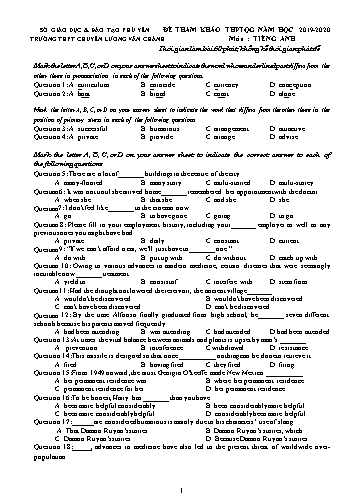
 SỞ GIÁO DỤC & ĐÀO TẠO PHÚ YÊN ĐỀ THAM KHẢO THPTQG NĂM HỌC 2019-2020
TRƯỜNG THPT CHUYÊN LƯƠNG VĂN CHÁNH Môn : TIẾNG ANH
 Thời gian làm bài 60 phút, không kể thời gian phát đề
 Mark the letter A, B, C, or D on your answer sheet to indicate the word whose underlined part differs from the
 other three in pronunciation in each of the following questions.
 Question 1: A. curriculum B. coincide C. currency D. conception
 Question 2: A. boat B. broad C. coast D. alone
 Mark the letter A, B, C, or D on your answer sheet to indicate the word that differs from the other three in the
 position of primary stress in each of the following questions
 Question 3: A. successful B. humorous C. arrangement D. attractive
 Question 4: A. private B. provide C. arrange D. advise
 Mark the letter A, B, C, or D on your answer sheet to indicate the correct answer to each of
 the following questions
 Question 5: There are a lot of_______ buildings in the centre of the city.
 A. many-floored B. many story C. multi-storied D. multi-storey
 Question 6: It was not until she arrived home_______ remembered her appointment with the doctor.
 A. when she B. that she C. and she D. she
 Question7: I don't feel like_______ to the cinema now.
 A. go B. to have gone C. going D. to go
 Question 8: Please fill in your employment history, including your_______ employer as well as any
 previous ones you might have had.
 A. private B. daily C. constant D. current
 Question 9: “If we can’t afford a car, we’ll just have to_______ one.”
 A. do with B. put up with C. do without D. catch up with
 Question 10: Owing to various advances in modern medicine, certain diseases that were seemingly
 incurable now _______ treatment.
 A. yield to B. consist of C. interfere with D. stem from
 Question 11: Had the drought not lowered the reservoir, the ancient village_______
 A. wouldn't be discovered B. wouldn't have been discovered
 C. can't have been discovered D. can't be discovered
 Question 12: By the time Alfonso finally graduated from high school, he_______ seven different
 schools because his parents moved frequently.
 A. had been attending B. was attending C. had attended D.had been attended
 Question 13: At times the vital balance between animals and plants is upset by man’s _______
 A. prevention B. interference C.withdrawal D. resistance
 Question 14: This missile is designed so that once __________ nothing can be done to retrieve it
 A. fired B. having fired C. they fired D. firing
 Question 15: From 1949 onward ,the artist Georgia O’keeffe made New Mexico __________.
 A. her permanent residence was B. where her permanent residence
 C. permanent residence for her D. her permanent residence
 Question 16: To be honest, Harry has _______ than you have.
 A. been more helpful considerably B. been considerably more helpful
 C. been more considerably helpful D. considerably been more helpful
 Question 17:______ are considered humorous is mainly due to his characters’ use of slang.
 A. That Damon Ruyan’s stories B. Damon Ruyan’s stories, which
 C. Damon Ruyan’s stories D. Because Damon Ruyan’s stories
 Question 18:_____, advances in medicine have also led to the present threat of worldwide over-
 population.
 1 One can distinguish between various types of radiation by looking at the source of the radiation, its
wavelength, the 31_______ of energy being carried, any particles involved, etc. Radioactive material
is a physical material that emits radiation. Uranium and plutonium are examples of radioactive
materials. The atoms 32_______ are made of tend to fall apart and give off different kinds of radiation,
like gamma rays and lots of types of particle radiation.
Question 28:A. turns up B. turns on C. turns in D. turns out
Question 29:A. are related B. are used C. are exposed D. are connected
Question 30:A.though B. therefore C. moreover D. likewise
Question 31:A.amount B. number C. sum D. total
Question 32:A. they B. which C. with which D. Þ
Read the following passage and mark the letter A, B, C, or D on your answer sheet to indicate the correct
answer
to each of the questions from 33 to 38
 Some people say that the best defense is a good offense; an octopus, however, would disagree.
In addition to being one of the strangest and most beautiful creatures in nature, the octopus has some
of the most inventive and effective defense mechanisms imaginable. While other animals have teeth,
horns, or claws to help defend them from predators, the octopus concentrates its energy on hiding from
and confusing its attackers. When it wants to get away, the octopus has an impressive arsenal of tricks
at its disposal.
 The most well-known of the octopus’s defense mechanisms is its ability to squirt clouds of ink
into the water. Some octopi use this cloud of ink as camouflage; after squirting the ink, the octopus
retreats into the ink cloud where the predator cannot see it. Other octopi use the ink cloud as a decoy.
If a large, intelligent predator such as a shark knows that octopi use ink clouds for camouflage, it might
simply attack the ink cloud blindly, hoping to make contact with the octopus inside. However, some
sneaky octopi will release the ink cloud in one direction and scurry away in another direction, leaving
the predator with nothing but a mouthful of ink. In addition to confusing predators’ sense of sight,
these ink clouds also confuse their sense of smell. The ink is composed primarily of melanin, which
can shut down a predator’s sense of smell. If an octopus cannot be seen or smelled, it has a much
higher chance of escaping an attack.
 Another defense mechanism possessed by many octopi is the ability to change color, much like a
chameleon. Most animals get their skin color from chemicals in the skin called chromatophores
(melanin is one of these chromatophores). Chromatophores might contain yellow, orange, red, brown,
or black pigments, and the amount of each pigment present in the skin determines an animal’s color.
While most animals are always the same color, some species of octopi can control the amount of each
color pigment in their skin cells, allowing them to change color. Some poisonous octopi, when
provoked, will change their skin to a bright, eye-catching color to warn predators that they are
dangerous and ready to strike. Other octopi use this ability to change their skin to the color and texture
of seaweed or coral, allowing them to blend in with their environment. Finally, some octopi—such as
the mimic octopus—use this color changing ability to masquerade as another type of animal. The body
of an octopus is highly flexible, and some species can combine this flexibility with their color-
changing skills to make themselves resemble more dangerous animals such as sea snakes or eels.
 Yet another defense mechanism possessed by some octopi is the ability to perform an autotomy,
or self-amputation, of one of their limbs and regrow it later. When a predator catches a tentacle the
octopus can amputate this tentacle, thereby unfettering itself, and regrow the tentacle later. However,
some octopi when threatened by a predator will shed a tentacle before being attacked in the hope that
the predator will go after the detached tentacle rather than the octopus itself. While the octopus may
not be the most vicious creature in the ocean, its numerous and clever defense mechanisms help it to
survive in the dangerous undersea world.
 3 By the mid 1960's, most Alaskans didn’t even know the Iditarod Trail existed, or that dog teams
had played a crucial role in Alaska’s early settlements. Dorothy G. Page, a self-made historian,
recognized how few people knew about the former use of sled dogs as working animals and about the
Iditarod Trail’s role in Alaska’s colorful history. To raise awareness about this aspect of Alaskan
history, she came up with the idea to have a dog sled race over the Iditarod Trail. She presented her
idea to an enthusiastic musher, as dog sled drivers are known, named Joe Redington, Sr. Soon the
Pages and the Redingtons were working together to promote the idea of the Iditarod race.
 Many people worked to make the first Iditarod Trail Sled Dog Race a reality in 1967. The Aurora
Dog Mushers Club, along with men from the Adult Camp in Sutton, helped clear years of overgrowth
from the first nine miles of the Iditarod Trail. To raise interest in the race, a $25,000 purse was offered,
with Joe Redington donating one acre of his land to help raise the funds. The short race, approximately
27miles long, was put on a second time in 1969.
 After these first two successful races, the goal was to lengthen the race a little further to the ghost
town of Iditarod by 1973. However in 1972, the U.S. Army reopened the trail as a winter exercise, and
so in 1973, the decision was made to take the race all the way to the city of Nome—over 1,000 miles.
There were many who believed it could not be done and that it was crazy to send a bunch of mushers
out into the vast, uninhabited Alaskan wilderness. But the race went! 22 mushers finished that year,
and to date over 400 people have completed it.
Question 39: The primary purpose of this passage is to
 A. recount the history of the Iditarod trail and the race that memorializes it
 B. describe the obstacles involved in founding the Iditarod race
 C. outline the circumstances that led to the establishment of the Iditarod Trail
 D. reestablish the important place of the Iditarod Trail in Alaska’s history
Question 40: Based on information in the passage, it can be inferred that all of the following
contributed to the disuse of the Iditarod Trail except
 A. more modern forms of transportation B. depleted gold mines
 C. highway routes to ghost towns D. reduced demand for land travel
Question 41: As used in paragraph 2, which is the best definition for mode?
 A. formula B. way C. preference D. option
Question 42: According to the passage, the initial Iditarod race
 A. was funded through the sale of musher entrance fees
 B. was founded by an advocate for Alaskan history
 C. ended at the ghost town of Iditarod
 D. boasted a total of 400 entrants
Question 43: As used in paragraph 3, the phrase “self-made historian” implies that Dorothy G. Page
 A. was employed by the state to keep its dog sled history alive
 B. was determined to honor the glories of the gold rush in spite of herquestionable credentials
 C. had pursued the study of Alaska’s history out of her own interest
 D. had personally educated others about Alaska’s history
Question 44: In 1925, when a diphtheria outbreak threatened the lives of people in the remote town of
Nome, the government used the Iditarod Trail to transport medicine nearly 700 miles to the town. If
the author chose to include this fact in the passage, it would best fit in
 A. paragraph 1 B. paragraph 2 C. paragraph 3 D. paragraph 5
Question 45: Based on information in the passage, it can be inferred that because the U.S.Army
reopened the Iditarod Trail in 1972,
 A. more people could compete in the Iditarod race
 B. the mushers had to get permission from the U.S. Army to hold the race
 C. the trail was cleared all the way to Nome
 D. the Iditarod race became a seasonal Army competition
Mark the letter A, B, C, or D on your answer sheet to indicate the sentence that best combines each
pair of sentences in the following questions.
Question 46: Smoking is an extremely harmful habit. You should give it up immediately.
 5
File đính kèm:
- de_tham_khao_thpt_quoc_gia_mon_tieng_anh_nam_hoc_2019_2020_t.docx

