

Đề kiểm tra 1 tiết số 1 môn Tiếng Anh Lớp 12 (Cơ bản) - Năm học 2019-2020 - Trường THPT Nguyễn Huệ - Mã đề thi 357 (Có đáp án)
 3 trang
30/01/2026
240
3 trang
30/01/2026
240
Bạn đang xem tài liệu "Đề kiểm tra 1 tiết số 1 môn Tiếng Anh Lớp 12 (Cơ bản) - Năm học 2019-2020 - Trường THPT Nguyễn Huệ - Mã đề thi 357 (Có đáp án)", để tải tài liệu gốc về máy hãy click vào nút Download ở trên.
Tóm tắt nội dung tài liệu: Đề kiểm tra 1 tiết số 1 môn Tiếng Anh Lớp 12 (Cơ bản) - Năm học 2019-2020 - Trường THPT Nguyễn Huệ - Mã đề thi 357 (Có đáp án)
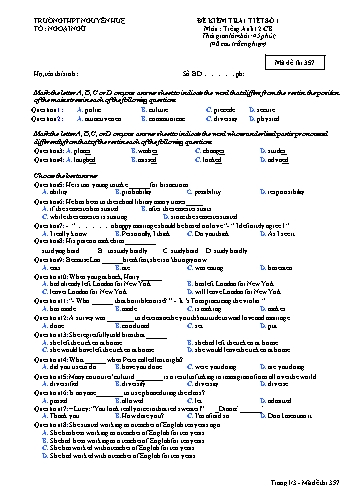
 TRƯỜNG THPT NGUYỄN HUỆ ĐỀ KIỂM TRA 1 TIẾT SỐ 1
 TỔ : NGOẠI NGỮ Môn : Tiếng Anh 12 CB
 Thời gian làm bài: 45 phút;
 (40 câu trắc nghiệm)
 Mã đề thi 357
 Họ, tên thí sinh:.................................................................Số BD ph: ....................
 Mark the letter A, B, C or D on your answer sheet to indicate the word that differs from the rest in the position
 of the main stress in each of the following questions.
Question 1: A. polite B. culture C. precede D. secure
Question 2: A. attractiveness B. communicate C. diversity D. physical
 Mark the letter A, B, C, or D on your answer sheet to indicate the word whose underlined part is pronounced
 differently from that of the rest in each of the following questions.
 Question3: A. places B. washes C. changes D. studies
 Question4: A. laughed B. missed C. looked D. advised
 Choose the best answer
 Question5: He is too young to take ______ for his actions.
 A. ability B. probability C. possibility D. responsibility
 Question6: He has been to the school library many times_____.
 A. if the semester has started B. after the semester starts
 C. while the semester is starting D. since the semester started
 Question7: - “  a happy marriage should be based on love. “- “ I definitely agree ! “
 A. I really know B. Personally, I think C. Do you think D. As I see it
 Question8: His parents make him _________.
 studying hard B. to study hardly C. study hard D. study hardly
 Question9: Because Lan ______ breakfast, she isn’t hungry now.
 A. eats B. ate C. was eating D. has eaten
 Question10: When you got back, Harry ______.
 A. had already left London for New York B. has left London for New York
 C. leaves London for New York D. will leave London for New York
 Question11: “- Who ______ that horrible noise? ” - It ‘s Tom practicing the violin. “
 A. has made B. made C. is making D. makes
 Question12: A survey was ________ to determine the youth’s attitude toward love and marriage .
 A. done B. conducted C. set D. put
 Question13: She regretfully told him that ______.
 A. she left the tickets at home B. she had left the tickets at home
 C. she would have left the tickets at home D. she would leave the tickets at home
 Question14: What ______ when Peter called last night?
 A. did you use to do B. have you done C. were you doing D. are you doing
 Question15: Many countries’ cultural ________ is a result of taking in immigrants from all over the world.
 A. diversified B. diversify C. diversity D. diverse
 Question16: Is anyone ________ to use phone during the class ?
 A. passed B. allowed C. let D. admitted
 Question17: – Lucy: “You look really nice in that red sweater!” _Diana: "______."
 A. Thank you. B. How dare you? C. I’m afraid so. D. Don’t mention it.
 Question18: She started working as a teacher of English ten years ago.
 A. She has been working as a teacher of English for ten years.
 B. She had been working as a teacher of English for ten years.
 C. She has worked with a teacher of English for ten years.
 D. She had worked with a teacher of English for ten years.
 Trang 1/3 - Mã đề thi 357 In France, you shouldn’t rest your feet on tables or chairs. Speaking to someone with your hands in your pockets
will only make matters worse. In the Middle East, you should never show the soles of your feet or shoes to others
as it will be seen as a grave insult. When eating, only use your right hand because they use their left hands when
going to the bathroom.
In Bangladesh, the ‘thumbs-up’ is a rude sign. In Myanmar, people greet each other by clapping,
and in India, whistling in public is considered rude.
In Japan, you should not blow your nose in public, but you can burp at the end of a meal to show that you have
enjoyed it. The ‘OK’ sign (thumb and index finger forming a circle) means ‘everything is good’ in the West, but in
China it means nothing or zero. In Japan, it means money, and in the Middle East, it is a rude gesture.
Question36: It is mentioned in the passage that many gestures ______.
A. are not used to communicate our feelings B. may mean different things in different countries
C. can be used to greet each other in public D. are used in greeting among men and women
Question37: People nod their head to say no in ______.
A. Belgium B. France C. Bulgaria D. Japan
Question38: In the Middle East, people do not use their left hands for eating because they use
their left hands ______.
A. when preparing the meal B. to put in their pockets
C. to clean their tables and chairs D. when going to the bathroom
Question39: Which of the following is NOT true according to the passage?
A. In Belgium, snapping your fingers at someone is very rude.
B. In Myanmar, people greet each other by clapping.
C. In China, the ‘OK’ sign means money.
D. In France, people shouldn’t rest their feet on tables.
Question40: The word “ others” in paragraph 3 refers to ______.
A. other feet B. other people C. other soles D. other shoes
-----------------------------------------------
 ----------- THE END ----------
 Trang 3/3 - Mã đề thi 357
File đính kèm:
- de_kiem_tra_1_tiet_so_1_mon_tieng_anh_lop_12_co_ban_nam_hoc.doc
 DAP AN.rtf

