

Đề khảo sát năng lực học sinh môn Tiếng Anh Khối 12 - Năm học 2017-2018 - Trường THPT Ngô Gia Tự - Mã đề 123 (Có đáp án)
 4 trang
21/12/2025
280
4 trang
21/12/2025
280
Bạn đang xem tài liệu "Đề khảo sát năng lực học sinh môn Tiếng Anh Khối 12 - Năm học 2017-2018 - Trường THPT Ngô Gia Tự - Mã đề 123 (Có đáp án)", để tải tài liệu gốc về máy hãy click vào nút Download ở trên.
Tóm tắt nội dung tài liệu: Đề khảo sát năng lực học sinh môn Tiếng Anh Khối 12 - Năm học 2017-2018 - Trường THPT Ngô Gia Tự - Mã đề 123 (Có đáp án)
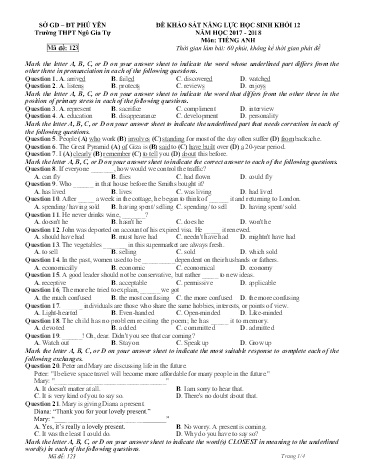
 SỞ GD – ĐT PHÚ YÊN ĐỀ KHẢO SÁT NĂNG LỰC HỌC SINH KHỐI 12
 Trường THPT Ngô Gia Tự NĂM HỌC 2017 - 2018
 Môn: TIẾNG ANH
 Mã đề: 123 Thời gian làm bài: 60 phút, không kể thời gian phát đề
Mark the letter A, B, C, or D on your answer sheet to indicate the word whose underlined part differs from the
other three in pronunciation in each of the following questions.
Question 1. A. arrived B. failed C. discovered D. watched
Question 2. A. listens B. protects C. reviews D. enjoys
Mark the letter A, B, C, or D on your answer sheet to indicate the word that differs from the other three in the
position of primary stress in each of the following questions.
Question 3. A. represent B. sacrifice C. compliment D. interview
Question 4. A. education B. disappearance C. development D. personality
Mark the letter A, B, C, or D on your answer sheet to indicate the underlined part that needs correction in each of
the following questions.
Question 5. People (A) who work (B) involves (C) standing for most of the day often suffer (D) from backache.
Question 6. The Great Pyramid (A) of Giza is (B) said to (C) have built over (D) a 20-year period.
Question 7. I (A) clearly (B) remember (C) to tell you (D) about this before.
Mark the letter A, B, C, or D on your answer sheet to indicate the correct answer to each of the following questions.
Question 8. If everyone _______, how would we control the traffic?
 A. can fly B. flies C. had flown D. could fly
Question 9. Who ______ in that house before the Smiths bought it?
 A. has lived B. lives C. was living D. had lived
Question 10. After _____ a week in the cottage, he began to think of ______ it and returning to London.
 A. spending/ having sold B. having spent/ selling C. spending/ to sell D. having spent/ sold
Question 11. He never drinks wine, _______?
 A. doesn't he B. hasn't he C. does he D. won't he
Question 12. John was deported on account of his expired visa. He _____ it renewed.
 A. should have had B. must have had C. needn't have had D. mightn't have had
Question 13. The vegetables _______ in this supermarket are always fresh.
 A. to sell B. selling C. sold D. which sold
Question 14. In the past, women used to be __________dependent on their husbands or fathers.
 A. economically B. economic C. economical D. economy
Question 15. A good leader should not be conservative, but rather _____ to new ideas.
 A. receptive B. acceptable C. permissive D. applicable
Question 16. The more he tried to explain, ______ we got
 A. the much confused B. the most confusing C. the more confused D. the more confusing
Question 17. ______ individuals are those who share the same hobbies, interests, or points of view.
 A. Light-hearted B. Even-handed C. Open-minded D. Like-minded
Question 18. The child has no problem reciting the poem; he has _____ it to memory.
 A. devoted B. added C. committed D. admitted
Question 19. ______! Oh, dear. Didn't you see that car coming?
 A. Watch out B. Stay on C. Speak up D. Grow up
Mark the letter A, B, C, or D on your answer sheet to indicate the most suitable response to complete each of the
following exchanges.
Question 20. Peter and Mary are discussing life in the future.
 Peter: "I believe space travel will become more affordable for many people in the future."
 Mary: "__________________________________"
 A. It doesn't matter at all. B. I am sorry to hear that.
 C. It is very kind of you to say so. D. There's no doubt about that.
Question 21. Mary is giving Diana a present.
 Diana: “Thank you for your lovely present.”
 Mary: “__________________________________”
 A. Yes, it’s really a lovely present. B. No worry. A present is coming.
 C. It was the least I could do. D. Why do you have to say so?
Mark the letter A, B, C, or D on your answer sheet to indicate the word(s) CLOSEST in meaning to the underlined
word(s) in each of the following questions.
 Mã đề: 123 Trang 1/4 Question 34. A. Because B. Although C. However D. Otherwise
Question 35. A. as B. much C. most D. than
Read the following passage and mark the letter A, B, C, or D on your answer sheet to indicate the correct answer to
each of the questions.
 If you want to turn your hobbies into jobs, consider the following experts' suggestions. If you are a helpful
person, you can teach others to do what you love. "Teach piano lessons, offer cooking classes, or teach another
language if those are your passions. You can do this by teaching through a college or continuing education program,
by creating your own classes, or by creating your own webinars or tele-seminar series online", Collamer says.
 If you are not interested in teaching, appraise, repair or fix items related to what you love. Most hobbies have
"stuff" connected to them, and sometimes, that stuff needs to be fixed by a skilled and knowledgeable person. "You
could fix computers, appraise collectibles, repair bicycles, source missing parts for highly unusual items, and so on,"
Collamer says.
 "The next time you find yourself confused as to how to generate income from your hobbies, search out the
most successful entrepreneurs in your area of interest and study their business models and revenue streams," Collamer
suggests. "Ask yourself: Is their income coming from consulting services, videos, accessories, events, classes or
product sales? What is their mix of products and services? What is their pricing strategy?" In doing this, you will
discover proven models for monetizing your hobbies, as well as helpful information about how to price your own
services and products.
 Mufson, who has interests outside of career coaching, says she managed to turn a hobby into a lucrative part-
time gig. "I personally turned my hobby of creating gemstone jewellery into a side-line business," she explains.
"Jewellery making is an expensive hobby and early on I decided to make it pay for itself. Since then I have developed
two online stores and a relationship with a jewellery gallery that sells most of my work."
Question 36. Which does the phrase "do this" in the first paragraph refer to?
 A. Have your passion B. Create your own webinars
 C. Teach others your hobbies D. Offer cooking classes
Question 37. It can be inferred from the passage that internet-based lessons are often _____.
 A. attended by people far away from their bases B. done using the telephone or smart phone
 C. delivered by college or university professors D. regarded as part of higher education program
Question 38. According to the passage, you can earn money as a _____ in buying and selling rare things.
 A. salesperson B. mechanic C. judge D. middleman
Question 39. Collamer suggests _______.
 A. analyzing successful people's methods B. getting a university degree in business
 C. working for the most popular employer D. interviewing the richest business people
Question 40. What is Mufson most likely to make?
 A. Earrings B. Clothes C. Shoes D. Handbags
Question 41. Where are most of Mufson's products sold?
 A. At her shops B. In the market C. Via the Internet D. At a gallery
Question 42. What is the best title for the passage?
 A. Methods of designing and selling jewellery B. Experts' advice on choosing the best jobs
 C. Tips for turning your interests into careers D. Pros and cons of running a private business
Read the following passage and mark the letter A, B, C, or D on your answer sheet to indicate the correct answer to
each of the questions.
 For many American university students, the weeklong spring break holiday means an endless party on a sunny
beach in Florida or Mexico. In Panama City Beach, Florida, a city with a permanent population of around 36,000,
more than half a million university students arrive during the month of March to play and party, making it the number
one spring break destination in the United States.
 A weeklong drinking binge is not for everyone, however, and a growing number of American university
students have found a way to make spring break matter. For them, joining or leading a group of volunteers to travel
locally or internationally and work to alleviate problems such as poverty, homelessness, or environmental damage
makes spring break a unique learning experience that university students can feel good about.
 During one spring break week, students at James Madison University in Virginia participated in 15
"alternative spring break" trips to nearby states, three others to more distant parts of the United States, and five
international trips. One group of JMU students travelled to Bogalusa, Louisiana, to help rebuild homes damaged by
Hurricane Katrina. Another group travelled to Mississippi to organize creative activities for children living in a
homeless shelter. One group of students did go to Florida, but not to lie on the sand. They performed exhausting
physical labor such as maintaining hiking trails and destroying invasive plant species that threaten the native Florida
ecosystem.
 Mã đề: 123 Trang 3/4
File đính kèm:
- de_khao_sat_nang_luc_hoc_sinh_mon_tieng_anh_khoi_12_nam_hoc.pdf
- ANH VAN -DAP AN DE KSNLHS K12 (2017-2018).pdf

