

Đề cương và bài tập ôn luyện học kì 1 Tiếng Anh Lớp 10 - Trường THCS & THPT Võ Nguyên Giáp
 23 trang
28/01/2026
330
23 trang
28/01/2026
330
Bạn đang xem 20 trang mẫu của tài liệu "Đề cương và bài tập ôn luyện học kì 1 Tiếng Anh Lớp 10 - Trường THCS & THPT Võ Nguyên Giáp", để tải tài liệu gốc về máy hãy click vào nút Download ở trên.
Tóm tắt nội dung tài liệu: Đề cương và bài tập ôn luyện học kì 1 Tiếng Anh Lớp 10 - Trường THCS & THPT Võ Nguyên Giáp
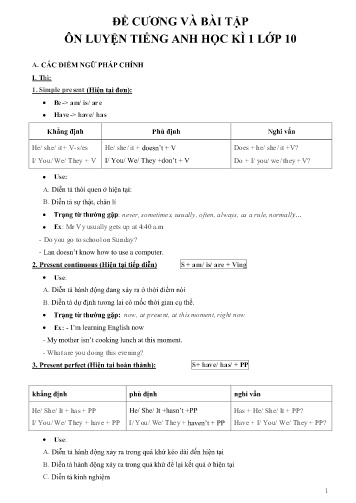
 ĐỀ CƯƠNG VÀ BÀI TẬP
 ÔN LUYỆN TIẾNG ANH HỌC KÌ 1 LỚP 10
A. CÁC ĐIỂM NGỮ PHÁP CHÍNH
I. Thì:
1. Simple present (Hiện tại đơn):
 Be-> am/ is/ are
 Have-> have/ has
 Khẳng định Phủ định Nghi vấn
He/ she/ it + V-s/es He/ she/ it + doesn’t + V Does + he/ she/ it +V?
I/ You/ We/ They + V I/ You/ We/ They +don’t + V Do + I/ you/ we/ they +V?
 Use:
 A. Diễn tả thói quen ở hiện tại:
 B. Diễn tả sự thật, chân lí
 Trạng từ thường gặp: never, sometimes, usually, often, always, as a rule, normally
 Ex: Mr Vy usually gets up at 4:40 a.m
 - Do you go to school on Sunday?
 - Lan doesn’t know how to use a computer.
2. Present continuous (Hiện tại tiếp diễn) S + am/ is/ are + Ving
 Use:
 A. Diễn tả hành động đang xảy ra ở thời điểm nói
 B. Diễn tả dự định tương lai có mốc thời gian cụ thể.
 Trạng từ thường gặp: now, at present, at this moment, right now
 Ex: - I’m learning English now
 - My mother isn’t cooking lunch at this moment.
 - What are you doing this evening?
3. Present perfect (Hiện tại hoàn thành): S+ have/ has/ + PP
khẳng định phủ định nghi vấn
He/ She/ It + has + PP He/ She/ It +hasn’t +PP Has + He/ She/ It + PP?
I/ You/ We/ They + have + PP I/ You/ We/ They + haven’t + PP Have + I/ You/ We/ They + PP?
 Use:
 A. Diễn tả hành động xảy ra trong quá khứ kéo dài đến hiện tại
 B. Diễn tả hành động xảy ra trong quá khứ để lại kết quả ở hiện tại
 C. Diễn tả kinh nghiệm
 1 4/ She (go) __________ to school every day.
 5/ We (do) __________ this exercise at the moment.
 6/ My mother (cook) ___________ some food in the kitchen at present. She always (cook)
__________ in the mornings.
 7/ It (rain) __________ very much in the summer. It (rain) _________ now.
 8/ Bad students never (work) __________ hard.
 9/ He generally (sing) ________ in English, but today he (sing) ________ in Spanish.
 10/ We seldom (eat) __________ before 6.30.
Exercise II: Put the verbs in brackets in the present perfect or the simple past tense.
1/ We (never watch) __________ that TV programme.
2/ We (watch) __________ a good programme on TV last night.
3/ He (read) __________ that novel many times before.
4/ I (have) __________ a little trouble with my car last week.
5/ However, I (have) __________ no trouble with my car since then.
6/ I (not see) __________ John for a long time. I (see) __________ him 3 weeks ago.
7/ I (meet) __________ Mary last night. She (become) __________ a very big girl.
8/ He is very thirsty. He (not drink) __________ since this morning.
9/ It is very hot. Summer (come) __________.
10/ Mr Brown (travel) __________ by air several times in the past.
Exercise III: Put the verbs in brackets in the past simple or the past continuous tense.
1/ He (sit) __________ in a bar when I (see) __________ him.
2/ When I (go) __________ out, the sun (shine) __________.
3/ The light (go) __________ out while I (have) __________ tea.
4/ When it (rain) __________, she(carry) __________ an umbrella.
5/ We (walk) __________ to the station when it (begin) __________ to rain.
Exercise IV: Put the verbs in brackets in the simple present or the simple future tense.
1/ We (go) __________ out when the rain (stop) __________.
2/ I (stay) _________ here until he (answer) __________ me.
3/ Wait until I (catch) __________ you.
4/ I (be) _________ ready before you (count) _________ ten.
5/ John must eat his breakfast before he (go) __________ out.
6/ Miss Helen (help) __________ you as soon as she (finish) ________ that letter.
7/ He (tell) _________ you when you (get) __________ there.
8/ She (not come) __________ until you (be) _________ ready.
9/ He (tell) __________ you when you (ask) __________ him.
10/ I (come) _______ and (see) ________ you before I (leave) _____ for England.
 3 Bài tập áp dụng:
Exercise 1: Active or Passive? Underline the correct verb form.
1. Tom has just promoted / has just been promoted to area manager of East Asia.
2. My father has taken / has been taken English class in the U.S.
3. How many times have you / have you been fired?
4. How much money have you saved / have you been saved for your vacation.
5. My brother has given / has been given tickets to the concert
6. The population of our city has risen / has been risen to nearly one million.
7. A strike has called / has been called by the factory worker.
8. They haven’t offered / haven’t been offered more money by the management.
Exercise 2: Change into passive voice
1. Somebody has stolen my bike. → ..
2. They have postponed the class meeting. →
3. They have built a new school near our house. →
4. Has somebody informed Lan of the change? →
5. They haven’t finished their assignments. →
III. Relative clauses: (Mệnh đề quan hệ)
 chỉ người: who, whom
 chỉ vật: which
 chỉ sở hữu: whose
 chỉ lí do: why
 vừa người vừa vật: that
 that = who, whom, which nhưng that không được dùng sau dấu phẩy và giới từ
 Cách nối câu dùng mệnh đè quan hệ:
 - Xác định từ giống nhau ở 2 câu.
 - Viết câu thứ nhất đến hết phần được lặp lại
 - Xem phần được lặp lại chỉ người hay vật mà dùng đại từ quan hệ phù hợp
 - Viết các phần còn lại sao cho logic về nghĩa
Bài tập áp dụng:
Exercise 1: Fill in the gap with a suitable relative pronoun.
1. Have you got the money ..I lent you yesterday.
2. The man  I had seen before wasn’t at the party.
3. This is a machine ..cost half a million pounds.
4. She’s the singer ..has just signed a contract with a recording company.
5. The girl .was injured in the accident is now in the hospital.
6. What was the name of the man lent you the money.
 5 4. There were a lot of accidents because of the icy roads.
-> Because .
5. They went out in spite of heavy rain.
-> Although .
6. Although his book was successful, he decided not to write any more.
-> In spite of .
7. Cars cause pollution but people still want them.
 - > Although .
8. I wanted to see Mr Brown. I phoned his company.
-> Because I .
9. Jenny ran fast but she didn’t win the race.
-> In spite if the fact that
10.He didn't go to school because his illness.
-> Because he .
V. Reported speech with statements: tường thuật câu phát biểu
- Nguyên tắc: a. Lùi thì b. thay đổi đại từ nhân xưng c. thay đổi từ chỉ thời gian, nơi chốn
- say + (that) + clause
- tell + O + (that)
Here - > there Now - > then Tomorrow - > the next day
Before - > ago/ earlier This - > that Yesterday - > the day before
Last week - > the week before These - > those
Next week - > the next week Today - > that day
 Ex: - "I want to buy it"-> He said he wanted to buy it
- "I'm writing a letter" - > He said he was writing a letter
Bài tập áp dụng:
Exercise 1: Rewrite the sentences, using reported speech.
1. " I won't have enough money to finish this job."-> He said .
2. " It's been a long time since I had such a good meal."-> She said
3. " The weather may get much worse tomorrow"-> He told us ..
4. " I think you should cut down on your smoking."-> The doctor told me
5. " We haven't been to the art gallery for ages".-> They said
6. " I always eats lots of fresh fruit and salad."-> She said .
7. " I'll see you tomorrow, John"-> Peter told John
8. "You letter arrived yesterday" - > David told me ..
9. " I like this hotel very much"-> He said ..
10. " I left my umbrella here two days ago."-> Susan told them .
 7 4. I like English very much → .............................................................................................................
 5. I began to study English six years ago → ........................................................................................
 6. They live in the city centre → ..........................................................................................................
 7. Last night I went to a disco with my friend → ................................................................................
 8. I like "Tom and Jerry" because it's very interesting → ..................................................................
 Exercise 2 Make questions, using the question words in brackets
 1. Mr Robertson came to the party alone. (who) → ............................................................................
 2. I like the red blouse, not the blue one. (which) → ...........................................................................
 3. She felt better after she took a nap (how) → ...................................................................................
 4. She talked to him for an hour (how long) → ...................................................................................
 5. My parents have two cars. (how many) → ......................................................................................
 6. They are coming to visit tomorrow (when) → ................................................................................
 7. We have an English class every day. (how often) → ......................................................................
 8. I like to dance on weekends. (what) → ............................................................................................
 VIII. Gerund and to infinitive: Danh động từ và động từ nguyên mẫu có to
 Danh động từ động từ nguyên mẫu có to
 1. Đứng sau một số động từ: keep, like, enjoy, 1. Đứng sau một số động từ: hope, seem, expect,
 mind, practise, delay, miss, suggest, understand, plan, decide, agree, refuse, wish, offer, promise....
 finish, admit, look forward to....... Ex: We hope to see you again
 Ex: - He likes swimming 2. Đứng sau tính từ, danh từ, từ hỏi, đại từ bất
 2. Đứng sau giới từ(in, at, on, to, from, about...) định, chỉ mục đích
 - She is afraid of going there - It is difficult to do this exercise
 - It is time to go
 - I don't know what to do
 - Do you have something to eat?
 - She went to the library to borrow some books
 Bài tập áp dụng:
Exercise 1: Supply the corrrect form of the verb in brackets.
1. It’s obvious he’s is only interested in (make)..................... money.
2. Ann couldn’t find a taxi so I offered (drive)........................... her to the station.
3. I managed (book)......................... two seats on the morning flight.
4. I promise (send)....................... you our new brochure as soon as it’s available.
5. Peter was delighted (meet) ......................a former colleague at the conference.
6. I avoid (take).................... the car whenever possible, especially in big cities.
7. My father hates (wear)...................... a tie to work
8. We can’t afford (take)........................ a vacation this summer.
9. The company was pleased (receive).......................... your thank-you letter.
 9
File đính kèm:
- de_cuong_va_bai_tap_on_luyen_hoc_ki_1_tieng_anh_lop_10_truon.pdf


