

Đề cương ôn tập học kỳ II Tiếng Anh Lớp 6 - Năm học 2018-2019
 8 trang
07/12/2025
390
8 trang
07/12/2025
390
Bạn đang xem tài liệu "Đề cương ôn tập học kỳ II Tiếng Anh Lớp 6 - Năm học 2018-2019", để tải tài liệu gốc về máy hãy click vào nút Download ở trên.
Tóm tắt nội dung tài liệu: Đề cương ôn tập học kỳ II Tiếng Anh Lớp 6 - Năm học 2018-2019
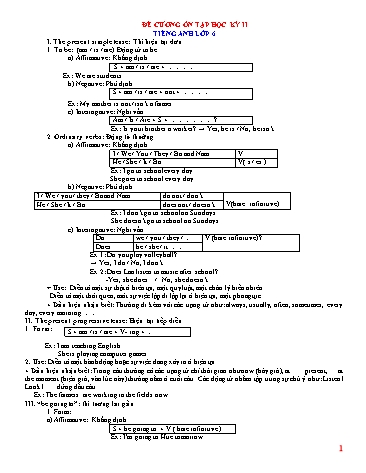
 ĐỀ CƯƠNG ÔN TẬP HỌC KỲ II
 TIẾNG ANH LỚP 6
 I. The present simple tense: Thì hiện tại đơn
 1. To be: (am / is / are) Động từ to be
 a) Affirmative: Khẳng định
 S + am / is / are + ..
 Ex: We are students.
 b) Negative: Phủ định
 S + am / is / are + not +
 Ex: My mother is not / isn’t a farmer.
 c) Interrogative: Nghi vấn
 Am / Is / Are + S + .?
 Ex: Is your brother a worker? → Yes, he is / No, he isn’t.
 2. Ordinary verbs: Động từ thường
 a) Affirmative: Khẳng định
 I / We / You / They / Ba and Nam V
 He / She / It / Ba V( s / es )
 Ex: I go to school every day.
 She goes to school every day.
 b) Negative: Phủ định
 I / We / you / they / Ba and Nam do not / don’t
 He / She / It / Ba does not / doesn’t V(bare infinitive)
 Ex: I don’t go to school on Sundays.
 She doesn’t go to school on Sundays.
 c) Interrogative: Nghi vấn
 Do we / you / they / . V (bare infinitive) ?
 Does he / she / it .
 Ex 1: Do you play volleyball?
 → Yes, I do / No, I don’t
 Ex 2: Does Lan listen to music after school?
 -Yes, she does. / No, she doesn’t.
 + Use: Diễn tả một sự thật ở hiên tại, một quy luật, một chân lý hiển nhiên
 Diễn tả một thói quen, môt sự việc lập đi lập lại ở hiện tại, một phong tục.
 + Dấu hiệu nhận biết: Thường đi kèm với các trạng từ như: always, usually, often, sometimes, every
day, every morning
II. The present progressive tense: Hiện tại tiếp diễn
1. Form: S + am / is / are + V- ing + .
 Ex: I am teaching English.
 She is playing computer games.
2. Use: Diễn tả một hành động hoặc sự việc đang xảy ra ở hiện tại.
+ Dấu hiệu nhận biết: Trong câu thường có các trạng từ chỉ thời gian như now (bây giờ), at present, at
the moment (hiện giờ, vào lúc này) thường nằm ở cuối câu. Các động từ nhằm tập trung sự chú ý như: Listen!
Look! ...... đứng đầu câu.
 Ex: The farmers are working in the fields now.
III. “be going to”: thì tương lai gần
 1. Form:
 a) Affirmative: Khẳng định
 S + be going to + V ( bare infinitive )
 Ex: I’m going to Hue tomorrow.
 1 No, there isn’t any rice.
 There is some milk and some water.
 There are some oranges and some bananas.
 7. Câu hỏi: How much ? / How many ?
 How much + uncountable noun.........?
 How many + countable noun.............?
 Ex: How much rice do you want ? Two kilos of rice.
 How many eggs do you want ? A dozen.
 8. Hỏi, trả lời ai đó thích chơi môn thể thao nào.
 Which sports + do/ does + S + play ?
 S + play/ plays + sports (môn thể thao).
Ex: Which sports do you play ? I play soccer.
 Which sports does she play ? She play badminton.
 9. Hỏi, trả lời ai đó làm gì vào thời gian rỗi.
 What + do/ does + S + do in + possessive pronoun + free time.
 (đại từ sở hữu)
 S + V/ Verb(e/es) .........................
Ex: -What do you do in your free time ?
 I go fishing.
 -What does Ly do in her free time ?
 She goes jogging.
 10. Hỏi, trả lời vói “How often......”
 How often + do/ does + S + verb ?
 S + V/ Verb(e/es) + frequency of activities.
Ex: How often does she listen to music ?
 once
She listens to music twice a week.
 Three times
Or: With adverbs of frequency : always, usually, often, sometime, never.
 S + adverbs of frequency + V/ Vs/es.
Ex: I always play sports.
 He sometimes goes fishing.
11. Hỏi thời tiết như thế nào vào từng mùa.
 What’s the weather like in + season (mùa) ?
 It’s + Adj.
Ex: What’s the weather like in the summer ?
 It’s hot.
12. Hỏi, trả lời ai đó làm gì khi trời nóng, lạnh..
 What + do/ does + S + do + when it’s + adj ?
 S + V/ Verb(e/es) when it’s + adj.
Ex: -What do you do when it’s cold ?
 When it’s cold, I play soccer.
 3 A. plays B. play C. playing
3. Hoa wants _________ a cake.
 A. makes B. to make C. making
4. She _________ what to do.
 A. not know B. don't know C. doesn't know
5. Marie _________ in France.
 A. lives B. live C. living
6. She _________ brown hair.
 A. have B. has C. to have
7. We are going _________ television.
 A. to watch B. watch C. watching
8. Does he _________ sports?
 A. likes B . like C. to like
9. No, he doesn't. He _________ music.
 A. like B. likes C. to like
10. What about _________ to the movies?
 A. going B. go C. goes
11. I'm _______ . I'd like some biscuits.
 A. full B. hungry C. thirsty
12. There is _______ milk in the glass.
 A. a B. any C. some
13. What's he doing? He's _______ English.
 A. learn B. learns C. learning
14. We go to the cinema _______ Saturday afternoon.
 A. at B. on C. to
15. It's very _______ in the summer.
 A. hot B. hotter C. hottest
16. I am doing_______ homework at the moment.
 A. me B. my C. mine
17. He often _______ to the radio.
 A. listens B. reads C. watches
18. How_______ is this T. shirt? It's 40,000 dong.
 A. old B. many C. much
19. - How _______ does she go shopping? - Every day.
 A. far B. long C. often
20. _______ is the weather like in the spring?
 A. How B. What C. Which
21. The Great Wall of China is the world's_______ structure.
 A. long B. longer C. longest
22. - How many _________does he want? - One kilo.
 A. potatoes B. rice C. beef
23. Mai is _________aerobics at the moment.
 A. having B. doing C. playing
24. _________are you going to do this summer vacation?
 A. What B. When C. Who
25. Mai's family are going to stay _________a hotel for a week.
 A. on B. of C. in
26. We don't want _________to Hue.
 A. go B. to go C. going
27. She often listens to the music in _________free time.
 A. her B. his C. your
 5 10. She (be) _____ 45 years old.
V. Read the passage and then answer T or F.
 1. Fishing is my favorite sport. I often fish for hours without catching anything. But this does not worry
me. Some fishermen are unlucky. Instead of catching fish, they catch old boots or rubbish. I am even less
lucky. I never catch anything- not even old boots. After spending whole mornings on the river, I always go
home with an empty bag. “You must give up fishing!” my friends say “It’s a waste of time”. But they don’t
know that I am not really interested in fishing. I am only interested in sitting alone in a boat and doing
nothing.
1.He likes fishing.
2. Catching nothing worries him very much.
3.He often catches something.
4.He is interested in sitting alone in a boat and doing nothing.
2. Miss Hoa is a singer. She is twenty-six years old. She is very beautiful. She has an oval face with round
eyes and full lips. She has long black hair and a small nose. Her favorite food is fish and her favorite drink is
orange juice.
1. Miss Hoa’s 26. ..
2. She has a round face. ..
3. Her hair is black and long. ..
4. She doesn’t like orange juice. ..
VI. Read the passage below and choose one correct answer for each question.(1m)
 1. Today is Sunday. Mrs. Huong goes to the market by motorbike. She needs a lot of things. First, she
 buys a kilo of fish and five hundred grams of beef. Then she wants some vegetables. She needs two cans of
 peas, half a kilo of tomatoes and a dozen eggs. Next, she buys two cans of soda, a packet of tea and a tube of
 toothpaste. She goes home at ten o’clock. (* buy (v): mua)
 1. When does Mrs Huong go to the market?
 A. On Monday B. On Sunday C. On Tuesday D. On Saturday
 2. How much beef does she buy?
 A. 200 grams B. 300grams C. 500 grams D. 400 grams
 3. Does she need any tomatoes?
 A. Yes, she does. B. No, he doesn’t. C. Yes, he is. D. No, he isn’t.
 4. What time does she go home?
 A. At 2.00 B. At 10.00 C. At 3.00 D. At 9.00
2. My uncle is an engineer. His name is Hung. He works in a big company. He is going on vacation this
summer. First,he is going to visit Ha Long Bay. He is going to stay in a small hotel near the bay for two days.
Then he is going to visit Da Lat for three days. Finally, he is going to visit some friends in Ho Chi Minh City.
He is going to stay there for one day. He is going to walk along Saigon River. He is going to fly home.
 1. What does Hung do ?
A. He”s a doctor. B. He’s an engineer. C. He’s a teacher. D. He’s a student.
2. Does he work in a small company ?
 7
File đính kèm:
- de_cuong_on_tap_hoc_ky_ii_tieng_anh_lop_6_nam_hoc_2018_2019.doc


