

Đề cương ôn tập học kỳ I môn Tiếng Anh 8 - Năm học 2019-2020 - Trường THCS & THPT Võ Nguyên Giáp
 10 trang
28/01/2026
320
10 trang
28/01/2026
320
Bạn đang xem tài liệu "Đề cương ôn tập học kỳ I môn Tiếng Anh 8 - Năm học 2019-2020 - Trường THCS & THPT Võ Nguyên Giáp", để tải tài liệu gốc về máy hãy click vào nút Download ở trên.
Tóm tắt nội dung tài liệu: Đề cương ôn tập học kỳ I môn Tiếng Anh 8 - Năm học 2019-2020 - Trường THCS & THPT Võ Nguyên Giáp
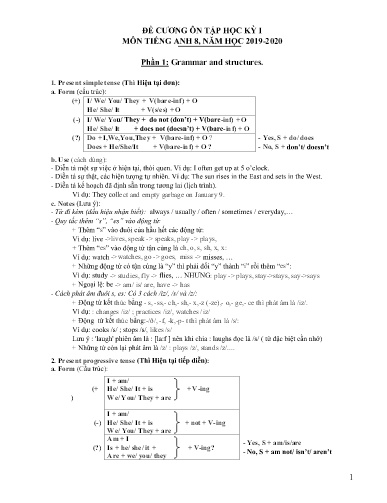
 ĐỀ CƯƠNG ÔN TẬP HỌC KỲ I
 MÔN TIẾNG ANH 8, NĂM HỌC 2019-2020
 Phần 1: Grammar and structures.
1. Present simple tense (Thì Hiện tại đơn):
a. Form (cấu trúc):
 (+) I/ We/ You/ They + V(bare-inf) + O
 He/ She/ It + V(s/es) + O
 (-) I/ We/ You/ They + do not (don’t) + V(bare-inf) + O
 He/ She/ It + does not (doesn’t) + V(bare-inf) + O
 (?) Do + I,We,You,They + V(bare-inf) + O ? - Yes, S + do/ does
 Does + He/She/It + V(bare-inf) + O ? - No, S + don’t/ doesn’t
b. Use (cách dùng):
- Diễn tả một sự việc ở hiện tại, thói quen. Ví dụ: I often get up at 5 o’clock.
- Diễn tả sự thật, các hiện tượng tự nhiên. Ví dụ: The sun rises in the East and sets in the West.
- Diễn tả kế hoạch đã định sẵn trong tương lai (lịch trình).
 Ví dụ: They collect and empty garbage on January 9.
c. Notes (Lưu ý):
- Từ đi kèm (dấu hiệu nhận biết): always / usually / often / sometimes / everyday,
- Quy tắc thêm “s”, “es” vào động từ:
 + Thêm “s” vào đuôi của hầu hết các động từ:
 Ví dụ: live ->lives, speak -> speaks, play -> plays,
 + Thêm “es” vào động từ tận cùng là ch, o, s, sh, x, x:
 Ví dụ: watch ->watches, go -> goes, miss -> misses,
 + Những động từ có tận cùng là “y” thì phải đổi “y” thành “i” rồi thêm “es”:
 Ví dụ: study -> studies, fly -> flies,  NHƯNG: play -> plays, stay->stays, say->says
 + Ngoại lệ: be -> am/ is/ are, have -> has
- Cách phát âm đuôi s, es: Có 3 cách /iz/, /s/ và /z/:
 + Động từ kết thúc bằng - s, -ss,- ch,- sh,- x,-z (-ze),- o,- ge,- ce thì phát âm là /iz/.
 Ví dụ: : changes /iz/ ; practices /iz/, watches /iz/
 + Động từ kết thúc bằng:-/ð/, -f, -k,-p- t thì phát âm là /s/:
 Ví dụ: cooks /s/ ; stops /s/, likes /s/
 Lưu ý : 'laugh' phiên âm là : [la:f ] nên khi chia : laughs đọc là /s/ ( từ đặc biệt cần nhớ)
 + Những từ còn lại phát âm là /z/ : plays /z/, stands /z/....
2. Present progressive tense (Thì Hiện tại tiếp diễn):
a. Form (Cấu trúc):
 I + am/
 (+ He/ She/ It + is + V-ing
 ) We/ You/ They + are
 I + am/
 (-) He/ She/ It + is + not + V-ing
 We/ You/ They + are
 Am + I
 - Yes, S + am/is/are
 (?) Is + he/ she/ it + + V-ing?
 - No, S + am not/ isn’t/ aren’t
 Are + we/ you/ they
 1 b. Use (cách dùng): Thì quá khứ đơn được dùng để chỉ hành động, sự kiện đã xảy ra và kết thúc ở quá
khứ.
 e.g. Tom visited China last year
c. Notes (Lưu ý):
- Từ đi kèm với thì Quá khứ đơn: ago, last night/ week/ month, in, yesterday
- Cách thêm ed vào động từ (Chỉ áp dụng với động từ có quy tắc):
 + Thêm “ed” vào sau của hầu hết các động từ nguyên mẫu.
 VD: visit->visited, work->worked, watch->watched
 + Chỉ thêm “d” đối với những động từ có tận cùng là “d”. VD: live->lived, race ->
raced
 + Nếu động từ tận cùng là “y”, hãy đổi “y” thành “i” rồi thêm ‘ed’: dry->dried, study->studied
 NGOẠI TRỪ: stay > stayed, play->played, enjoy->enjoyed
 + Nếu là động từ có một nguyên âm duy nhất + phụ âm, hãy gấp đôi phụ âm cuối rồi thêm ed:
 shop->shopped, wrap->wrapped, plan->planned, stop->stopped
 + Nếu động từ có hai vần trở lên, tận cùng bằng một nguyên âm đơn + phụ âm, và có trọng âm
cuối cùng, thì hãy gấp đôi vần cuối cùng rồi hãy thêm ed: VD: occur->occurred, prefer->preferred
 + Không gấp đôi những phụ âm cuối cùng như x, w, y: snow->snowed, fix->fixed
- Cách phát âm của /ed/: Có 3 cách phát âm của ed là /id/, /t/, /d/:
 + Những động từ tận cùng bằng các âm /t/ hoặc /d/, thì ed thêm vào được đọc là /id/.
 VD: need->needed, want->wanted, decide->decided
 + Những động từ tận cùng bằng các âm /f/, /k/, /p/, /s/, /∫/, /f∫/, / ks/, thì ed thêm vào được đọc là
/t/.
 VD: wash->washed, book->booked, stop->stopped, watch->watched, laugh->laughed
 + Những động từ tận cùng bằng các âm khác ngoài hai trường hợp trên, thì ed thêm vào đọc là
/d/.
 Vd: play->played, plan->planed, offer->offered
5. Be going to:
a. Form (cấu trúc): S + am/ is/ are + going to + V(bare-inf)
b. Use (cách dùng): Diễn tả dự định chắc chắn sẽ thực hiện trong tương lai gần.
 Vd: - I am going to buy a new hat for my sister. Tôi sẽ mua một cái mũ mới cho em gái tôi.
 - They are going to go fishing this afternoon. Họ dự định đi câu cá chiều nay
 - I’m going to visit my grandma this weekend.
 - She is going to be a singer.
6. Use to: đã từng, đã thường.
a. Form (Cấu trúc): (+) S + used to + V(bare-inf)
 (-) S + didn’t + used to + V(bare-inf)
 (?) Did + S + used to + V(bare-inf) ?
b. Usage (cách dùng): Diễn tả hành động, sự việc thường xảy ra ở quá khứ, bây giờ không còn nữa.
 - Last year, I used to go swimming . Năm ngoái ,tôi thường đi bơi .
 - My father used to drink beer,but now he doesn’t. Cha tôi thường uống bia, nhưng bây giờ thì
không.
 - I didn’t use to get up early a year ago . Cách đây 1 năm tôi đã không thường thức dậy sớm
7. Trạng từ chỉ mức độ “ENOUGH” (adv): đủ để
 S + be + (not) + adj + enough + (for + O) + to- inf.
 - The house is big enough for us to live in. (Ngôi nhà lớn đủ để chúng tôi ở)
 - She is beautiful enough to become Miss World. (Cô ấy đẹp đủ để trở thành hoa hậu thế giới)
 - She was not old enough to be on my class
8. Modal verbs (Động từ khiếm khuyết): must , have to , ought to , should.
 a) must: phải
 We must go now. Tôi phải đi ngay bây giờ . (sự cần thiết)
 You mustn’t talk in class. Các em không được nói chuyện trong lớp. (sự bắt buộc)
 3 - I myself was new here last year.
 - Oh. I cut myself.
 - I look myself in the mirror.
12. Comparison (so s¸nh):
 Comparison Comparative (So sánh hơn) Superlative ( So sánh nhất)
 Short adj S +V+ adj _er + than + S2 S + V + the adj –est + n
 (tính từ ngắn) small → smaller; big → bigger small → the smallest; big → the biggest
 Long adj S +V+ more + adj + than + S2 S + V + the most + adj + n
 ( tính từ dài) expensive → more expensive expensive → the most expensive
 beautiful → more beautiful beautiful → the most beautiful
Một số dạng so sánh khác:
 - S1 + be (not) + as + adj + as + S2. Vd: Tam is (not) as tall as his brother.
 - S1 + V(not) the same as + S2. Vd: My book is (not) the same as yours.
 - S1 + V + different from + S2. Vd: My hat is different from yours.
13. Adverbs of manner (trạng từ chỉ thể cách):
- Cách thành lập: Adjective + ly -> Adverb (Thêm đuôi “ly” vào tính từ)
 Ví dụ: bad -> badly, slow -> slowly, beautiful -> beautifully
- Các trạng từ bất quy tắc:
 good -> well, hard -> hard, fast -> fast
- Cách dùng: Trạng từ chỉ thể cách đứng sau động từ thường hoặc cuối câu để diễn tả hành động xảy ra
như thế nào.
 - She always drives carefully (Cô ấy thường lái xe cẩn thận)
14. Gerunds (Danh động từ V-ing):
a. Một số động từ thường được theo sau bởi một danh động từ, đó là love, like, enjoy, dislike, hate
 e.g. - I enjoy/ love/ like traveling. Tôi thích đi du lịch
b. Một số cụm từ thường đòi hỏi theo sau chúng là một danh động từ: Be busy: bận rộn, Can’t help:
không thể nhịn được, It’s no use: chẳng ợi ích gì
 e.g. - No use crying. Khóc chẳng lợi ích gì
 - My mother is always busy doing the housework. Mẹ tôi luôn bận rộn làm việc nhà.
c. Go + danh động từ: Tao thành nhiều cụm từ liên quan đến các hoạt động giải trí và mua sắm như: go
boating (bơi thuyền), go fishing (đi câu cá), go shopping (đi mua sắm)
 Phần 2: Practice
I. Phonetics: Choose the word having the underlined letters pronounced differently.
 1. A. how B. hour C. humorous D. hair
 2. A. visited B. heated C. locked D. corresponded
 3. A. generous B. reserved C. device D. experiment
 4. A. study B. music C. fun D. subject
 5. A. pancake B. stadium C. tasty D. change
 6. A. grocery B. money C. month D. comfort
 7. A. effect B. delicious C. resident D. selection
 8. A. just B. summer C. much D. humid
 9. A. write B. drive C. driven D. mine
 10. A. started B. helped C. wanted D. decided
 11. A. bank B. match C. hat D. mall
 12. A. great B. please C. greedy D. reach
 13. A. children B. chicken C. Chemistry D. kitchen
 14. A. fine B. visit C. slim D. thin
 15. A. tiger B. wife C. wisdom D. fire
II. Vocabulary and Grammar:
Exercise 1: Choose the best option A,B,C or D to complete each sentence.
1. There are different ways ..............learning new words.
 5 2. How long you (know) .............................................Mrs. Chi?
 – I (know) ................................... her for five years.
3. We (not see) ................................... her since we were on holiday in Ha Long bay.
4. Trung usually (go) ................................... to the library three times a week.
5. Yesterday I (be) ................................... busy, so I (not have) ................................... time
6. They (play) ................................... badminton in the school yard at the moment.
7. The moon .. around the Earth. (go)
8. The sun (rise) ....................................in the East and sets in the west..
9. I’m going (tell)..................................... my parents about the result of my exam.
10. What time (you / go) .........................................to the market tomorrow ? 11. Last night,
my children (make)..................................a lot of noise , so I couldn’t sleep.
12. My son (be) .............................. five years old next year.
13. Life in the countryside (get)................................. better.
14. My father used (smoke) .............................. a lot.
15. She is not old enough (be) ................................ in my class.
16. My sister doesn't like (play) ...................................... soccer.
17. That girl is old enough (go) ............................... to school.
Exercise 3. Give the correct form of the words in brackets.
1. I am.................................to have a friend like you. (luck)
2. My brother like reading and he has got a lot of ................................ book (interest)
3. I am .. in learning English. (interest)
4. Don’t go to see that play. It’s not very ................................................ . (interest)
5. They made an ..................................... to see her yesterday morning. (arrange)
6. My parents enjoy the ............................................. of the countryside. (peaceful)
7. Alexander is the .......................... of the telephone. (invent)
8. Hoa looks more .than her sister. (beauty)
9. My mom cooks very  (good). I love all her dishes.
Exercise 4. One sentences has one mistake. Find correct them (Tìm lỗi sai và sửa lại)
1. She would like going out with her Mom. .
 A B C D
2. Our Dad is interest in watching film. .
 A B C D
3. We used to going out when we were in high school. ..
 A B C D
4. She said me to work hard on the next semester. .
 A B C D
5.Our granddad will come with us in Saturday evening .
III. Reading:
Exercise 1. Read the passage carefully then answer the questions below.
 Peter is my pen pal. He is fifteen years old. He lives in a house in London. He has lived there for ten
years. He is an excellent student. He always works hard at school and gets good marks. He loves learning
Vietnamese in his free time. He often practices writing letters in Vietnamese. Sometimes he helps me to
correct my writing, and I help him to correct his spelling mistakes. Next summer, he is going to visit Ho
Chi Minh City with his family. I'm expecting to see him.
1. Where does he live?
2. What does he like doing in his free time?
3. Does he often practice Vietnamese by writing and reading?
4. Where is he going to do next summer?
Exercise 2. Complete the passage with the suitable words in the box.
 interesting visit because neighbor
 7
File đính kèm:
- de_cuong_on_tap_hoc_ky_i_mon_tieng_anh_8_nam_hoc_2019_2020_t.pdf


