

Đề cương ôn tập học kỳ 1 môn Tiếng Anh Lớp 9 - Năm học 2018-2019
 9 trang
03/12/2025
350
9 trang
03/12/2025
350
Bạn đang xem tài liệu "Đề cương ôn tập học kỳ 1 môn Tiếng Anh Lớp 9 - Năm học 2018-2019", để tải tài liệu gốc về máy hãy click vào nút Download ở trên.
Tóm tắt nội dung tài liệu: Đề cương ôn tập học kỳ 1 môn Tiếng Anh Lớp 9 - Năm học 2018-2019
Teacher : Trịnh Cương
ĐỀ CƯƠNG ÔN TẬP HỌC KỲ 1 LỚP 9 NĂM HỌC 2018-2019
*GRAMMAR:
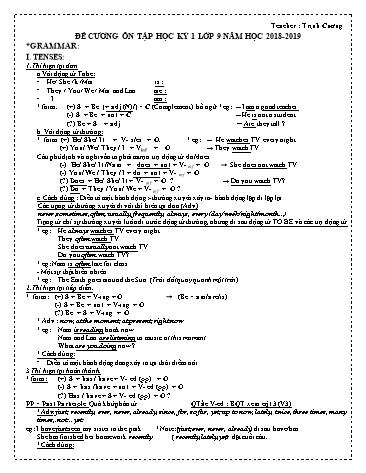
I. TENSES:
1.Thì hiện tại đơn
a.Với động từ Tobe:
- He/ She /It /Mai is :
- They / You/ We / Mai and Lan are :
- I am :
* form. (+) S + Be {+ adj (N)/} = C (Complement) bổ ngữ *eg: I am a good teacher
(-) S + Be + not + C He is not a student
(?) Be + S + adj Are they tall ?
b. Với động từ thường:
* form. (+) He/ She/ It + V- s/es + O. * eg: He watches TV every night.
(+) You/ We/ They / I + Vinf + O They watch TV
Câu phủ định và nghi vấn ta phải mượn trợ động từ do/does
(-) He/ She/ It /Nam + does + not + V- inf + O She does not watch TV
(-) You/ We / They / I + do + not + V- inf + O
(?) Does + He/ She/ It + V- inf + O ? Do you watch TV?
(?) Do + They / You/ We + V- inf + O ?
c. Cách dùng : Diễn tả một hành động:- thường xuyên xảy ra- hành động lặp đi lặp lại
Các trạng từ thường xuyên đi với thì hiên tại đơn (Adv)
never,sometimes,often, usually, frequently, always, every (day/week/night/month)
Trạng từ chỉ sự thường xuyên luôn đi trước động từ thường, nhưng đi sau động từ TO BE và các trợ động từ
* eg: He always watches TV every night.
They often watch TV
She does usually not watch TV
Do you often watch TV?
* eg: Nam is often late for class.
- Một sự thật hiển nhiên.
* eg: The Earth goes around the Sun. (Trái đất quay quanh mặt trời)
2.Thì hiện tại tiếp diễn.
* form: (+) S + Be + V-ing + O (Be = am/are/is)
(-) S + Be + not + V-ing + O
(?) Be + S + V-ing + O
* Adv : now, at the moment, at present, right now
* eg: Nam is reading book now
Nam and Lan are listening to music at this moment.
What are you doing now ?
* Cách dùng:
- Diễn tả một hành động đang xảy ra tại thời điểm nói
3.Thì hiện tại hoàn thành.
* form: (+) S + has / have + V- ed (pp) + O
(-) S + has /have + not + V- ed (pp) + O
(?) Has / have + S + V- ed (pp) + O ?
PP = Past Participle Quá khứ phân từ QTắc V-ed : BQT xem cột 3 (V3)
*Adv: just, recently, ever, never, already, since, for, so far, yet, up to now, lately, twice, three times, many
times,. notyet.
eg: I have just seen my sister in the park. *Note: (just,ever, never, already) đi sau have/has
She has finished her homework recently. ( recently,lately,yet) đặt cuối câu.
*Cách dùng: Teacher : Trịnh Cương
III. Prepositions of time: at, in, on, before.
- I have a meeting on Tuesday.
- She was born in 2014.
IV. Adverb clauses of result: SO
- It is dark, so I open all the windows.
V. Modals with IF.
- If you want to lose weight, you should do a lot of exercises.
VI. Reported speech.
1) Statements:
S + said(told + O) + S + V (lùi 1 bậc thì)
Ex. “You have to come home before 10.00,” my parents said.
My parents said I had to come home before 10.00.
2) Questions:
2.1) Yes – No questions:
S + asked + O + if/ whether + S + V (lùi 1 bậc thì)
Ex. “Do you like cartoons?”
She asked me if I liked cartoons.
2.2)Wh-questions:
S + asked + O + what/ why/ how+ S + V (lùi 1 bậc thì)
Ex. “Where are you from?”
He asked her where she was from.
VI. CÂU BỊ ĐỘNG (THE PASSIVE VOICE)
• Quan sát:
- Câu chủ động: Mr Smith teaches English. (Active)
- Câu bị động: English is taught by Mr Smith. (Passive)
• Qui tắc:
- Tân ngữ chủ động chủ ngữ bị động
- Động từ bị động Be + Past Participle (pp)
- Chủ ngữ chủ động tân ngữ bị động ( trước có giới từ by chỉ tác nhân)
*Note: by them/ by people/ by someone . Bỏ
• Sơ đồ: S V O (Active)
1 2 3
a b
S be + V-ed (pp) by + O (Passive)
Bảng tóm tắt công thức các thì trong câu bị động.
HTĐ Am, is, are + pp
QKĐ Was, were + pp
HTTD Am,is, are + being + pp
QKTD Was, were + being + pp
HTHT Have, has + been + pp
MODEL Can,may,might,should,will
VERBS Have to, used to, be going to + be + pp
Cách đổi: Bước 1: Lấy Tân ngữ (O) câu chủ động xuống làm Chủ từ (S)câu bị động.
Bước 2: a/ Lưu ý Động từ câu chủ động ở thì nào To Be ở ngay thì đó.
b/ Động từ chính đổi sang dạng PP (QK phân từ)
Bước 3: Lấy Chủ từ (S)câu chủ động xuống làm Tân ngữ (O)câu bị động đặt sau By chỉ tác nhân.
Ex. They have discovered oil at the North Pole.
Oil has been discovered at the North Pole
VII .GERUND (Verb- ing.) Sử dụng trong các trường hợp sau: Teacher : Trịnh Cương
II. LANGUAGE FOCUS.
Question I. Choose the best answers to complete the following sentences.
1. I ________ it 5 years ago.
A. have been B. saw C. was seeing D. am seeing
2. We ________ in Lenin Park when it rained.
A. walked B. have walked C. were walking D. walk
3. I often play soccer ________ Sunday afternoon.
A. in B. at C. on D. after
4. My father was good at swimming. He is used to________swimming in summer.
A. go B. goes C. went D. going
5. Kate hates ________ to classical music.
A. listen B. listened C. listens D. listening
6. I’ve lived in this house ________1990
A. from B. since C. for D. in
7. Mr. Smith ________his car for 15 years, but it still looks very new.
A. has B. had C. have had D. has had
8. We must be there ________ 7.30 and 8.25.
A. at B. before C. between D. after
9. I wish you________me with my work.
A. help B. will help C. helped D. would help
10. My father started ________in a small village 10 years ago.
A. teaching B. teach C. taught D. teaches
11. They ________in that house for several months.
A. live B. lived C. have lived D. are living
12. My father ________teaching in a small village 10 years ago.
A. starts B. started C. has started D. is starting
13. We have lived in Ha Noi ________ 4 years
A. in B. since C. for D. at
14. Lan and Maryam are penpals. They ________each other twice a month.
A. writing B. write C. has written D. wrote
15. Lan enjoyed the peaceful atmosphere ________Maryam was praying.
A. when B. during C. while D. where
16. She has taught English here ________ 10 years.
A. in B. for C. since D. from
17. He wishes he ________fly
A. can B. will C. should D. could
18. Vietnamese language is different ________English language.
A. from B. on C. in D. at
19. A: Would you like to have lunch with us? B: _________________.
A. All right B. Yes, I would
C. No, I wouldn’t like D. Yes, I’d love to
20. A: Congratulations on your winning B: _________________.
A. You’re welcome B. That’s very kind of you
C. No, thanks D. Yes, of course Teacher : Trịnh Cương
42. Please let Tim ________ with you.
A. go B. going C. to go D. goes
43. Ba________ go to Dalat in summer when he was young.
A. use to B. used to C. is used to D. is used
44. He wishes he________ a pilot.
A. were B. is C. will be D. can be
45. He________ English for 4 years.
A. learns B. learnt C. has learnt D. will learn
45. She sings very________
A. beauty B. beautiful C. beautify D. beautifully
46. She asked me where I ________ from.
A. come B. came C. to come D. coming
47. Be________! He is looking at you.
A. care B. careful C. carefully D. carelessly
48. Remember to turn ________ the lights before going to bed.
A. of B. off C. on D. up
49. Does your father enjoy _______newspapers?
A. read B. reading C. to read D. be read
50. Ha Noi is a ________ city.
A. beauty B. beautiful C. beautifully D. friendly
51. She said that she______learning English with you.
A. liked B. to like C. liking D. like
52. She asked me where I______from?
A. came B. to come C. come D. coming
53. If you want to attend the course, you______pass the examinatin.
A. has to B. have to C. had to D. could
54. She______me whether I liked classical music or not.
A. asks B. Asked C. asking D. ask
55. He wants to know whether I______back tomorrow.
A. will come B. would come C. come D. came
Question II. Give the correct form of the following verbs:
1. If you (study )_________harder, you will pass the exam.
2. I wish he (not leave) _________________ here
3.He (live) __________________in Australia for 10 years.
4.Ba enjoys (play)_________________ football in the morning.
5. My house ( build)__________________ in 2004.
6. If the weather gets worse, we (not go) ________________ to the beach.
7.I wish I (live) ________________ near my school.
8. Last night, my father ( watch) ______________ TV
9.I wish I ( know) ______________her address
10. My father enjoys (watch) _______________ television in the evenings.
11.I wish I ( be ) ________________ taller..
12. My house (build) ________ yesterday.
13. We (not see) ________each other since Monday. Teacher : Trịnh Cương
VI.Read the following passage and choose the best answers.
Tet is a national and .................... (1) festival in Vietnam . It is occasion for every Vietnamese to be
reunited to think .................(2) their past activities and hope for good luck in the new year.
Before Tet all houses .................. (3) whitewashed and ...................... (4) with colourful lights.
Everybody is looking ......................... ( 5 ) to a better life. In the new year’s eve, children are smartly
dressed . ......................... (6) are hoping to receive money put in small red envelopes as they are wishing
longevity to ................... (7) grandparents and parents. Wrong doings should ...................... (8) avoided on
these days .
1. A. traditional B. modern C. compulsory D. convenient.
2. A. about B. with C. after D. for
3. A. was B. were C. are D. is
4. A. decorate B. decorating C. to decorate D. decorated
5. A. for B. forward C. after D. at
6. A. them B. who C. these D. they
7. A. his B. her C. my D. their
8. A. take B. not C. we D. be
VII. Choose A, B, C or D to complete the following passage:
English is a very useful language. If we (1)________ English, we can go to any contries we like. We
will not find it hard to make people understand (2)_________ we want to say. English also help us to learn all
kinds of(3)__________ hundreds of boks are (4)________in English everyday in (5)__________ countries.
English has also helped to spread ideasand knowledge (6)__________ all corners of the world. Therefore,
the English language has helped to spread better (7)__________ and (8)_________ among the countriesof
the world.
1. A. to know B. know C. knew D. known
2. A. what B. where C. when D. how
3. A. subjects B. things C. ideas D. plans
4. A. write B. wrote C. written D. writing
5. A. much B. lot of C. many D. a lots of
6. A. in B. with C. at D. to
7. A. to understand B. understanding C. understand D. understood
8. A. friend B. friendly C. friendliness D. friendshipFile đính kèm:
- de_cuong_on_tap_hoc_ky_1_mon_tieng_anh_lop_9_nam_hoc_2018_20.doc

