

Đề cương ôn tập học kì II môn Anh văn 11 - Năm học 2018-2019 - Trường THCS&THPT Võ Nguyên Giáp
 9 trang
07/12/2025
380
9 trang
07/12/2025
380
Bạn đang xem tài liệu "Đề cương ôn tập học kì II môn Anh văn 11 - Năm học 2018-2019 - Trường THCS&THPT Võ Nguyên Giáp", để tải tài liệu gốc về máy hãy click vào nút Download ở trên.
Tóm tắt nội dung tài liệu: Đề cương ôn tập học kì II môn Anh văn 11 - Năm học 2018-2019 - Trường THCS&THPT Võ Nguyên Giáp
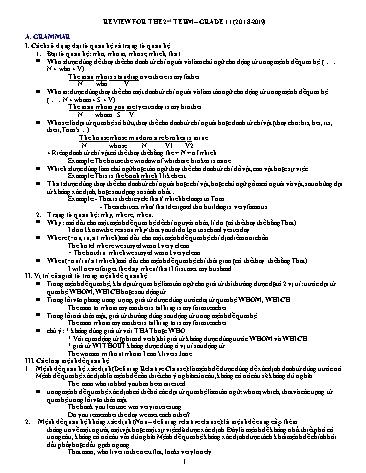
 REVIEW FOR THE 2nd TERM – GRADE 11 (2018-2019)
A. GRAMMAR
I. Cách sử dụng đại từ quan hệ và trạng từ quan hệ
 1. Đại từ quan hệ: who, whom, whose, which, that.
 • Who: được dùng để thay thế cho danh từ chỉ người và làm chủ ngữ cho động từ trong mệnh đề quan hệ (
 N + who + V)
 The man who is standing over there is my father.
 N who V
 • Whom: được dùng thay thế cho một danh từ chỉ người và làm tân ngữ cho động từ trong mệnh đề quan hệ.
 (N + whom + S + V)
 The man whom you met yesterday is my brother.
 N whom S V
 • Whose: là đại từ quan hệ sở hữu, thay thế cho danh từ chỉ người hoặc danh từ chỉ vật (thay cho: his, her, its,
 their, Tom’s)
 The house whose windows are broken is mine.
 N whose N V1 V2
 + Riêng danh từ chỉ vật có thể thay thế bằng the + N + of which
 Example: The house the window of which are broken is mine
 • Which: được dùng làm chủ ngữ hoặc tân ngữ thay thế cho danh từ chỉ đồ vật, con vật hoặc sự việc.
 Example: This is the book which I like best.
 • That: được dùng thay thế cho danh từ chỉ người hoặc chỉ vật, hoặc chủ ngữ gồm cả người và vật, sau những đại
 từ không xác định, hoặc sau dạng so sánh nhất
 Example: - That is the bicycle that/ which belongs to Tom.
 - The architect who/ that designed this building is very famous.
 2. Trạng từ quan hệ: why, where, when.
 • Why: mở đầu cho một mệnh đề quan hệ để chỉ nguyên nhân, lí do.(có thể thay thế bằng That)
 I don’t know the reason why/ that you didn’t go to school yesterday.
 • Where (=on, in, at which) mở đầu cho một mệnh đề quan hệ chỉ địa điểm nơi chốn.
 The hotel where we stayed wasn’t very clean.
 = The hotel in which we stayed wasn’t very clean.
 • When (=on/ in/ at which) mở đầu cho mệnh đề quan hệ chỉ thời gian. (có thể thay thế bằng That)
 I will never forget the day when/ that I first met my husband
II. Vị trí của giới từ trong mệnh đề quan hệ
 • Trong mệnh đề quan hệ, khi đại từ quan hệ làm tân ngữ cho giới từ thì thường được đặt ở 2 vị trí: trước đại từ
 quan hệ WHOM, WHICH hoặc sau động từ.
 • Trong lối văn phong trang trọng, giới từ được đứng trước đaị từ quan hệ WHOM, WHICH
 The man to whom my mother is talking is my form teacher.
 • Trong lối nói thân mật, giới từ thường đứng sau động từ trong mệnh đề quan hệ
 The man whom my mother is talking to is my form teacher.
 • chú ý: * không dùng giới từ với THAT hoặc WHO
 * Với cụm động từ (phrasal verb) thì giới từ không được dùng trước WHOM và WHICH
 * giới từ WITHOUT không được dùng ở vị trí sau động từ
 The woman without whom I can’t live is Jane.
III. Các loại mệnh đề quan hệ
1. Mệnh đề quan hệ xác định (Defining Relative Clause): là mệnh đề được dùng để xác định danh từ đứng trước nó.
 Mệnh đề quan hệ xác định là mệnh đề cần thiết cho ý nghĩa của câu, không có nó câu sẽ không đủ nghĩa.
 The man who robbed you has been arrested.
 • trong mệnh đề quan hệ xác định có thể bỏ các đại từ quan hệ làm tân ngữ: whom, which, that và các trạng từ
 quan hệ trong lối văn thân mật
 The book you lent me was very interesting.
 Do you remember the day we met each other?
2. Mệnh đề quan hệ không xác định (Non – defining relative clause): là mệnh đề cung cấp thêm
 thông tin về một người, một vật hoặc một sự việc đã được xác định. Đây là mệnh đề không nhất thiết phải có
 trong câu, không có nó câu vẫn đủ nghĩa. Mệnh đề quan hệ không xác định được tách khỏi mệnh đề chính bởi
 dấu phẩy hoặc dấu gạch ngang.
 That man, who lives in the next flat, looks very lonely.
 1
 • Cách dùng Not onlybut also, either or, neithernor tương tự như both and tuy nhiên trong các cấu trúc
 này động từ chia phù hợp với chủ ngữ thứ 2 (đứng gần động từ nhất), còn Both and động từ luôn chia ở
 dạng số nhiều
 ----Either you or he is right
 ----Either he or you are wrong
 ----Either they or I am right
 ----Neither he nor I am sad
 ----Neither she nor you are happy
VII. CAN, COULD và BE ABLE TO
1. Could
a. Đôi khi "could" là dạng quá khứ của "can". Chúng ta dùng "could" đặc biệt với:
see, hear, smell, taste, feel, remember, understand
Eg:
- When we went into the house,we could smell burning.
- She spoke in a very low voice, but I could understand what she said.
b. Chúng ta dùng could để diễn tả ai đó nói chung có khả năng hay được phép làm điều gì:
- My grandfather could speak five languages.
- We were completely free. We could do what we wanted. (= we were allowed to do)
c. Chúng ta dùng could để chỉ khả năng nói chung (general ability).
d. Dạng phủ định couldn't (could not) có thể được dùng cho tất cả các trường hợp:
- My grandfather couldn'tswim.
- We tried hard but wecouldn't persuade them to come with us.
- Alf played well but hecouldn't beat Jack.
2. To be able to
a. Dùng để chỉ khả năng làm được một việc gì đó, đôi khi có thể sử dụng thay thế cho "can", nhưng không thông dụng
bằng "Can"
Eg:I'm able to read = I can read
b. Dùng để đề cập tới một sự việc xảy ra trong một tình huống đặc biệt (particular situation), chúng ta dùng was/were
able to (không dùng could):
- The fire spread throughthe building quickly but everybody was able to escape or  everybody managed toescape (but
not 'could escape').
- They didn't want tocome with us at first but we managed to persuade them or  we were able topersuade them (but
not 'could persuade').
Một vài ví dụ:
- Jack was an excellent tennisplayer. He could beat anybody. (= He had the general ability to beat anybody)
Jack là một vận động viênquần vợt cừ khôi. Anh ấy có thể đánh bại bất cứ ai. (= anh ấy có một khả năngnói chung là
đánh bại bất cứ ai)
nhưng
- Jack and Alf had a gameof tennis yesterday. Alf played very well but in the end Jack managed to beathim or was
able to beat him (= he managed to beat him in this particular game)
Jack và Alf đã thi đấuquần vợt với nhau ngày hôm qua. Alf đã chơi rất hay nhưng cuối cùng Jack đã cóthể hạ được Alf.
(= Jack đã thắng được anh ấy trong trận đấu đặc biệt này).
 B. EXERCISES
 ❖ . PHONETICS
I. Circle the word whose underlined part is pronounced differently from that of the other words.
1. A. supply B. dirty C. energy D. happy
2. A. decreased B. influenced C. endangered D. established
3. A. heat B. nuclear C. feat D. clean
4. A. power B. slow C. snow D. show
5. A. plenty B. energy C. only D. hydropower
6. A. rugby B. nearby C. cycling D. apply
7. A. strength B. event C. athlete D. wrestling
8. A. admired B. looked C. missed D. hoped
9. A. admire B. avid C. variety D. while
10. A. engrave B. pastime C. undertake D. spectator
11. A. seats B. meets C. sits D. feats
12. A. rugby B. music C. undertaken D. dull
 3
20. This energy is useful because it can create electricity.
 A. produce B. do C. design D. shape
21. Norman won the first prize in the cookery competition.
 A. contest B. occasion C. course D. organization
22. He is good at accompanying people’s singing by his guitar and I admire him very much.
 A. expect B. respect C. like D. welcome
23. I just collect stamps from discarded envelopes.
 A. thrown away B. given up C. got away D. done up
24. The astronauts were able to send the information back to the earth.
 A. spaceships B. space stations C. space man D. space shots
25. Yuri Gagarin lifted off into space aboard the Vostok 1
 A. attracted B. occurred C. reacted D. launched
26. The Great Pyramid of Giza is one of the famous man-made wonders of the world.
 A. artificial B. natural C. modern D. Enternal
27. The thieves broke into the tomb to steal the treasures.
 A. mummies B. bodies C. materials D. valuable objects
III.PREPOSITION:
28. I specially indulge __________ some hobbies
 A. at B. of C. from D. in
29. Yuri Gagarin became the first man to travel into space ____ April 12th, 1961.
 A. at B. on C. in D. from
30. Everybody congratulated the astronauts ____ their successful trip into space.
 A. on B. for C. of D. in
31. We do not have plenty _______ energy as we think.
 A. of B. on C. over D. with
32. The solar energy can change _______electricity.
 A. to B. for C. with D. into
33. The purpose ______ the research was to find out more information about the pyramid.
 A. of B. for C. in D. from
34. The Sun releases large amount _________ energy everyday.
 A. for B. in C. for D. of
35. A new satellite has been put _________ orbit around the earth.
 A. at B. into C. through D. to
36. Why are these two schools so different __________ each other?
 A. with B. in C. from D. between
IV. COMMUNICATION:
37. Jack: “.” John: “I’ll make my collection richer and richer”
 A. What is your hobby, David?
 B. How do you organize your collection, David?
 C. What do you plan to do next, David?
 D. How do you collect your books, David?
38. Jack: “The movie ..last night was terrible.”
 John: “Oh, really! What is it about?”
 A. I went B. I went to it C. I went to D. that I went
39. Jack: “My writing has improved a lot in this class.”
 John: “Mine has, too. All the studentsdo well in writing.
 A. whom Mr. David teaches them B. which Mr. David teaches
 C. that Mr. David teaches them D. Mr. David teaches
40. “Can you turn the lights off before leaving the room?” – “______”
 A. Yes, I can B. No, I can’t C. Yes, of course D. No, I don’t.
41. ‘Thank you very much for the lovely flowers.’ ‘___________.’
 A. You’re welcome. B. You like flowers, don’t you?
 C. Yeah, the flowers are nice. D. It was an excellent choice.
B. VOCABULARY:
I. MEANING:
42. There are some hobbies that I  in for a while besides reading and collecting.
 A. occupy B. accomplish C. fascinate D. indulge
43. British people are very interested in . in sports.
 5
 B. He wasn’t the first man to discovered this land.
 C. He wasn’t the first man to discovering this land.
 D. He wasn’t the first man to discovers this land.
2 – Do you know a woman who was injured in the accident last night?
 A. Do you know a woman injured in the accident last night.
 B. Do you know a woman injure in the accident last night.
 C. Do you know a woman injuring in the accident last night.
 D. Do you know a woman injures in the accident last night.
3 “The policeman said that the thief robbed the bank.”
 A. The policeman congratulated the thief on robbing the bank.
 B. The policeman thanked the thief for robbing the bank.
 C. The policeman warned the thief against robbing the bank.
 D. The policeman accused the thief of robbing the bank.
4“ If I don’t practice my English, I won’t get any better,” she said.
A. She said if I don’t practice my English, I won’t get any better.
B. She said if I didn’t practice my English, I would’t get any better.
C. She said if she didn’t practice her English, she wouldn’t get any better.
A. She said if she hadn’t practiced her English, she wouldn’t have got any better.
5.The weather is fine now, so we have a picnic.
A. If the weather isn’t fine now, we can have a picnic
B. If the weather had been fine now, we couldn’t have a picnic
C. We couldn’t have a picnic if the weather weren’t fine now.
D. We could have a picnic if the weather were fine now.
 6.“I will come to see you if I have time,” the man said to her.
A. The man told her that he would come to see her if he had time.
B. The man told her that he will come to see her if he has time.
C. The man told her that he would not come to see her if he had time.
D. The man told her that he would have come to see her if he had had time.
7. My brother is interested in football , and he is also interested in movies .
 A. My brother is both interested in football and movies.
 B. My brother is interested in not only football but allso movies.
 C. My brother is both interested in football and interested in movies.
 D. My brother is interested in both football and movie.
8. He doesn’t like coffee . He doesn’t like tea .
 A. He likes neither coffee nor tea . C. He likes either coffee or tea .
 B. He neither likes coffee nor tea. D. He doesn’t like both coffee and tea.
9. Lan didn’t go camping yesterday . Lan didn’t do homework yesterday.
 A. Lan didn’t neither go camping nor do homework yesterday.
 B. Lan neither go camping nor do homework yesterday.
 C. Lan neither went camping yesterday nor did homework yesterday .
 D. Lan neither went camping nor did homework yesterday.
10. You can come on Sunday , or you can come on Monday.
A. You can either come on Sunday or on Monday. C. You can come on both Sunday and Monday.
B. You either can come on Sunday or can come on Monday. D. You can come on either Sunday or Monday.
C.WRITING
I.Write these sentence in another way, beginning as shown or the cues given in the blanks.
1. He seldom goes to the library, ...? (tag question)
2. Your friends wanted a drink, ...? (tag question)
3. I’m too late, ..? (tag question)
4. This won’t take long, .? (tag question)
5. My brother prefers pop music. (objective focus) -> It
6. He described his hometown in his novel! (Adverbial focus) -> It
7. My teacher sent the bill to Mr Harding yesterday. (subjective focus) -> It
8. The man who lives in the house next door is my uncle. (using present participle)
9. He was the first man who left the burning building. (using infinitive phrase)
10. Only a few of the movies that are shown at the Gray Theater are suitable for children. (using past participle)
II. Replace the clauses in underline type by infinitives.
 1. He was the first man who left the burning building.
 7
File đính kèm:
- de_cuong_on_tap_hoc_ki_ii_mon_anh_van_11_nam_hoc_2018_2019_t.doc


