

Đề cương kiểm tra học kì I môn Tiếng Anh Lớp 11 - Năm học 2019-2020 - Trường THCS-THPT Võ Nguyên Giáp
 16 trang
11/01/2026
420
16 trang
11/01/2026
420
Bạn đang xem tài liệu "Đề cương kiểm tra học kì I môn Tiếng Anh Lớp 11 - Năm học 2019-2020 - Trường THCS-THPT Võ Nguyên Giáp", để tải tài liệu gốc về máy hãy click vào nút Download ở trên.
Tóm tắt nội dung tài liệu: Đề cương kiểm tra học kì I môn Tiếng Anh Lớp 11 - Năm học 2019-2020 - Trường THCS-THPT Võ Nguyên Giáp
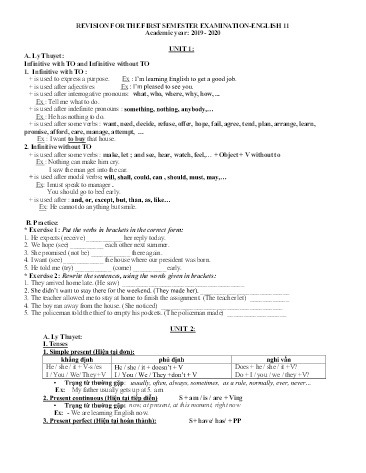
 REVISION FOR THE FIRST SEMESTER EXAMINATION-ENGLISH 11
 Academic year: 2019- 2020
 UNIT 1:
A. Ly Thuyet:
Infinitive with TO and Infinitive without TO
1. Infinitive with TO :
 + is used to express a purpose. Ex : I’m learning English to get a good job.
 + is used after adjectives Ex : I’m pleased to see you.
 + is used after interrogative pronouns: what, who, where, why, how, ...
 Ex : Tell me what to do.
 + is used after indefinite pronouns : something, nothing, anybody,
 Ex : He has nothing to do.
 + is used after some verbs : want, need, decide, refuse, offer, hope, fail, agree, tend, plan, arrange, learn,
promise, afford, care, manage, attempt, ...
 Ex : I want to buy that house.
2. Infinitive without TO
 + is used after some verbs : make, let ; and see, hear, watch, feel, + Object + V without to
 Ex : Nothing can make him cry.
 I saw the man get into the car.
 + is used after modal verbs: will, shall, could, can , should, must, may,
 Ex: I must speak to manager .
 You should go to bed early.
 + is used after : and, or, except, but, than, as, like
 Ex: He cannot do anything but smile.
 B. Practice:
* Exercise 1: Put the verbs in brackets in the correct form:
1. He expects (receive) ___________ her reply today.
2. We hope (see) __________ each other next summer.
3. She promised (not be) ____________ there again.
4. I want (see) ____________ the house where our president was born.
5. He told me (try) ___________ (come) __________ early.
* Exercise 2: Rewrite the sentences, using the words given in brackets:
1. They arrived home late. (He saw) _____________________________________
2. She didn’t want to stay there for the weekend. (They made her). ___________________________
3. The teacher allowed me to stay at home to finish the assignment. (The teacher let) ____________
4. The boy ran away from the house. (She noticed) _____________________________________
5. The policeman told the thief to empty his pockets. (The policeman made) __________________
 UNIT 2:
 A. Ly Thuyet:
 I. Tenses
 1. Simple present (Hiện tại đơn):
 khẳng định phủ định nghi vấn
 He / she / it + V-s /es He / she / it + doesn’t + V Does + he / she / it +V?
 I / You / We/ They +V I / You / We / They +don’t + V Do + I / you / we / they +V?
 • Trạng từ thường gặp: usually, often, always, sometimes, as a rule, normally, ever, never
 Ex: My father usually gets up at 5. a.m
 2. Present continuous (Hiện tại tiếp diễn) S + am / is / are + Ving
 • Trạng từ thường gặp: now, at present, at this moment, right now
 Ex: - We are learning English now.
 3. Present perfect (Hiện tại hoàn thành): S+ have/ has/ + PP - decide - expect - try / attempt - would like / love - agree - advise
 - tend - ask / want - refuse - intend - be willing - fail
 - desire / wish - order / require - demand - hope - tend - hesitate
 Ex: I expect to meet him tomorrow.
 1.2 Verbs followed by the gerund
 V+ (O) + V-ing
 - avoid - mind - appreciate - practise - consider - finish
 - deny - delay / - miss - enjoy - keep - dislike/ hate / detest
 * Expressions:
 - look forward to - be worth - can’t help / bear / stand - be accustomed to
 - There’s no point in - be busy - It’s no good / use - be / get used to
 * Adj phrase with preposition + V-ing
 Ex: He is good at solving mathematical problems
 2. PASSIVE INFINITIVE AND GERUND
 2.1. Examples:
 - She expects to be invited to Minh’s birthday party.
 V to be + PP
 - She enjoys being invited to Minh’s birthday party.
 V being + PP
 2.2 Form:
 1 Passive infinitive:
 To be + Past Participle
 2 Passive gerund:
 Being + Past Participle
 B. Practice:
1/Put the verbs in the brackets into the correct form: gerund or infinitive.
1. He tried (explain) but she refused (listen)
2. At dinner she annoyed me by (smoke) between two courses.
3. He avoided _______________ (see), so he wore a big false bear.
4. He decided (disguise) .................. himself by (dress) ................... as a woman.
5. Would you mind (show) ...................... me how (work) the lift?
6. After (walk) _______for three hours, we stopped to let the others (catch up) __ with us.
7. He didn’t want ______________ (see) by them at the airport.
8. I regret (inform) you that your application has been refused.
9. I couldn’t help (overhear) what you said.
 10. A: I don’t allow (smoke) in my drawing room.
B: I don’t allow my family (smoke) at all
 UNIT 4:
 A. Ly Thuyet:
 GERUND AND PRESENT PARTICIPLE:
 V-ING
 1. Form:
 2. Use
 a. To form continuous tenses.+ Example: She is reading book now.
 b. As adjectives + Example: I love the noise of falling rain.
 2
 c. Present participle is used after verbs of sensation (see, hear, smell, feel, listen to, notice, watch).
 + Example: I see him passing my house everyday.
 d. Present participle is used after verbs: catch, find, leave + Object. 2. “ Give me your homework.” The teacher told _________________________
 3. “Please, don’t smoke in my car.” He asked _______________________________
 4. Would you like to have a drink with me?” He invited ______________________________
 5. “You should give up smoking” The doctor advised _______________________
 UNIT 6:
 A. Ly Thuyet:
 Reported Speech with gerund
a/ Having object:
 S + V + Object + preposition + V-ing
* Verbs: accused of, suspect  of, congratulate  on, prevent  from, thank  for, warm  against.
* Example:- “You are not telling the truth, you are a liar!”
 They accused me of telling lies.
b/ Having no object:
 S + V + preposition + V-ing
* Verbs: dream of, approve/ disapprove of, insist on, apologize for, think of, look forward to,
deny, admit,+ V-ING
 B. Practice:
 Write the following sentences using the words given.
1. “It’s not a good idea to change these plans at this late date.”
 He objected to. .
2. He deserted his ship two months ago. He was accused of it.
 He was accused of .
3. John spent his own money. I can’t prevent him from that.
 I can’t prevent
4.’’Congratulations! You’ve succeeded in the interview, Kate,’’
 Jane congratulated ..
B. Ly Thuyet:
 Reported Speech with TO INFINITIVE
• V + O + to V
Verbs: ask, advise, command, invite, order, recommend, encourage, urge, warn, want., beg, instruct,
persuade
• V + to V
Verbs: agree, demand, hope, promise, threaten, offer, refuse, decide...
 Would you/ Could you / Will you/ Can you -> asked+ sb + to + V
 Would you mind + V-ing /Do you mind + V-ing -> asked + sb + to +V
 Would you like/ Will you -> invited + sb + to + V
a. Đề nghị, lời mời:
 S + invite + (O) + to V
 S + offer + to V
Ex: He said, “Would you like to go out for a drink?”
---> He invited me to go out for a drink.
b. Yêu cầu: (động từ tường thuật ask)
 S + asked + sb + for + something
Ex: In a restaurant, the man said; “I’d like a bottle of red wine, please”
-> The man asked for a bottle of red wine
c. Khuyên bảo: S + advised + O + to V  UNIT 7:
 A. Ly Thuyet:
 CONDITIONAL SENTENCES (CÂU ĐIỀU KIỆN)
 1. Điều kiện loại 1 :
 IF CLAUSE (Mệnh đề If) MAIN CLAUSE (Mệnh đề chính)
 Simple Future
 Simple Present
 S + will + V(inf)
 S + V[-e/es]
 S + will not + V(inf)
 S + don’t / doesn’t + V(inf)
 Will + S + V(inf)?
 Unless = if.not
 Ví dụ Unless you study hard , you will fail the exam.
 If you don’t study hard , you will fail the exam.
 - Sau Unless không được dùng dạng phủ định (Ví dụ : không được viết Unless you don’t write)
 2. Điều kiện loại 2, loại 3 :
 TYPE IF CLAUSE (Mệnh đề If) MAIN CLAUSE (Mệnh đề chính)
 Simple Past S + would / could + V(inf)
 Be were (was) S + wouldn’t / couldn’t +V(inf)
 II
 S + V-ed/2
 Would / Could + S + V(inf) ?
 S + didn’t + V(inf)
 Past Perfect S + would / could have + V-ed/3
 III S + had + V-ed/Vpp S + wouldn’t / couldn’t have + V-ed/3
 S + hadn’t + V-ed/Vpp Would / Could + S + have + V-ed/3?
 Điều kiện loại 2 : diễn tả một sự việc không có thật ở hiện tại
 Điều kiện loại 3 : diễn tả một sự việc không có thật ở quá khứ
 Dạng bài tập : Biến đổi câu. Dựa vào tình huống (thường có 2 câu hoặc 2 mệnh đề) để xác định
 + 1 câu hoặc mệnh đề chỉ nguyên nhân
 + 1 câu hoặc mệnh đề chỉ kết quả
 So
 Because Therefore
 + nguyên nhân + kết quả
 Because of As a result
 That’s why
 => Áp dụng trong câu điều kiện : If + (nguyên nhân) , (kết quả)
 Lưu ý : + Nếu tình huống được cho ở thì hiện tại đơn, ta áp dụng câu điều kiện loại 2
 + Nếu tình huống được cho ở thì quá khứ đơn, ta áp dụng câu điều kiện loại 3
 + Câu điều kiện loại 2, loại 3 là không có thật ở hiện tại nên cả hai mệnh đề trong câu điều kiện
phải ở dạng phủ định của câu hoặc mệnh đề ban đầu.
 Ví dụ : He doesn’t hurry, so he misses the train (tình huống hiện tại loại 2)
 = If he hurried, he wouldn’t miss the train
 They don’t go camping because the weather is bad. (tình huống hiện tại loại 2)
 = If the weather weren’t bad, they would go camping.
 She stayed up late. That’s why she was ill. (tình huống quá khứ loại 3)
 = If she hadn’t stayed up late, she wouldn’t have been ill.
 II. CONDITIONAL IN REPORTED SPEECH
 Ex: 1.“If I have a lot of money, I’ll build houses for the poor.”, John said.
 • John said if he had a lot of money, he would build houses for the poor.
 2. “ If today were Sunday, we wouldn’t go to school” they said to me.
 => They told me if that day were/ had been Sunday, they wouldn’t go/ wouldn’t have gone to school.
 B. Practice:
 1: Put the verbs into the correct form.
 1. If he (eat)____________ all that he will be ill.
File đính kèm:
- de_cuong_kiem_tra_hoc_ki_i_mon_tieng_anh_lop_11_nam_hoc_2019.pdf


