

Đề cương học kì I môn Tiếng Anh Lớp 10 - Năm học 2018-2019 - Trường THPT Phan Bội Châu
 11 trang
05/02/2026
40
11 trang
05/02/2026
40
Bạn đang xem tài liệu "Đề cương học kì I môn Tiếng Anh Lớp 10 - Năm học 2018-2019 - Trường THPT Phan Bội Châu", để tải tài liệu gốc về máy hãy click vào nút Download ở trên.
Tóm tắt nội dung tài liệu: Đề cương học kì I môn Tiếng Anh Lớp 10 - Năm học 2018-2019 - Trường THPT Phan Bội Châu
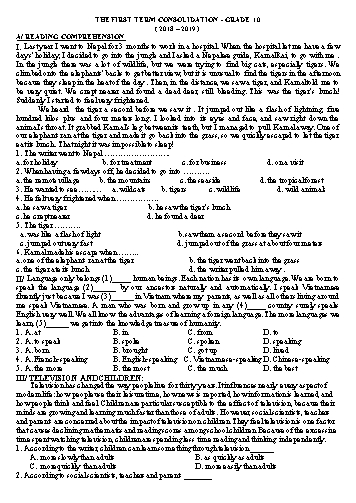
 THE FIRST TERM CONSOLIDATION - GRADE 10
 ( 2018 – 2019 )
A/ READING COMPREHENSION
I. Last year I went to Nepal for 3 months to work in a hospital. When the hospital let me have a few
days’ holiday, I decided to go into the jungle and I asked a Nepalese guide, Kamal Rai, to go with me .
In the jungle there was a lot of wildlife, but we were trying to find big cats, especially tigers. We
climbed onto the elephants’ backs to get better view, but it is unusual to find the tigers in the afternoon
because they sleep in the heat of the day . Then, in the distance, we saw a tiger, and Kamal told me to
be very quiet. We crept nearer and found a dead deer, still bleeding. This was the tiger’s lunch!
Suddenly I started to feel very frightened.
 We heard the tiger a second before we saw it . It jumped out like a flash of lightning, five
hundred kilos plus and four meters long. I looked into its eyes and face, and saw right down the
animal’s throat. It grabbed Kamal’s leg between its teeth, but I managed to pull Kamal away. One of
our elephants ran at the tiger and made it go back into the grass, so we quickly escaped to let the tiger
eat its lunch. That night it was impossible to sleep!
1. The writer went to Nepal .
a. for holiday b. for treatment c. for business d. on a visit
2. When having a few days off, he decided to go into .
a. the remote village b. the mountains c. the seaside d. the tropical forest
3. He wanted to see a. wildcats b. tigers c. wildlife d. wild animals
4. He felt very frightened when .
a. he saw a tiger b. he saw the tiger’s lunch
c. he crept nearer d. he found a deer
5. The tiger .
 a. was like a flash of light b. saw them a second before they saw it
 c. jumped out very fast d. jumped out of the grass at about four meters
6. Kamal made his escape when ..
a. one of the elephants ran at the tiger b. the tiger went back into the grass
c. the tiger ate its lunch d. the writer pulled him away .
II/ Language only belongs (1)_____ human beings. Each nation has its own language. We are born to
speak the language (2)______ by our ancestors naturally and automatically. I speak Vietnamese
fluently just because I was (3)______ in Vietnam where my parents, as well as all others living around
me speak Vietnamese. A man who was born and grow up in any (4)_____ country surely speaks
English very well. We all know the advantages of learning a foreign language. The more languages we
learn, (5)______ we get into the knowledge treasure of humanity.
1. A. at B. in C. from D. to
2. A. to speak B. spoke C. spoken D. speaking
3. A. born B. brought C. got up D. lived
4. A. French-speaking B. English-speaking C. Vietnamese-speaking D. Chinese-speaking
5. A. the more B. the most C. the much D. the best
III/ TELEVISION AND CHILDREN :
 Television has changed the way people live for thirty years. It influences nearly every aspect of
modern life: how people use their leisure time, how news is reported, how information is learned, and
how people think and feel. Children are particular susceptible to the effects of television, because their
minds are growing and learning much faster than those of adults. However, social scientists, teachers
and parents are concerned about the impact of television on children. They feel television is one factor
that causes declining mathematics and reading scores among school children. Because of the excessive
time spent watching television, children are spending less time reading and thinking independently.
1. According to the writer, children can learn something through television ______
 A. more slowly than adults B. as quickly as adults
 C. more quickly than adults D. more easily than adults
2. According to social scientists, teachers and parents _______ VI/ The first school for blind , deaf and mute children in the Tibet Autonomous Region celebrated its
first anniversary on Friday. The school is built in the eastern suburb of Lhasa, capital of Tibet, and is
designed to hold 200 students . It covered 20,000 square meters .
 The school curriculum includes Braille and sign language training , Tibetan, mathematics ,
writing , ethics training, physical education, arts , handicrafts speech and walking courses . At the
celebration, the audience was touched by a silent song expressed by the students with sign language .
Baiba Toinzhub, a 10-year-old blind child , can speak fluent Chinese and is good at singing and
dancing . He told the visitors that life in the broading school was comfortable.
1. What type of students attend the school?
a. Children who live in the Tibet Autonomous Region . b. Children with a variety of disabilities
c. Children who can not see, hear and speak d. Children who are visually impaired.
2. The school is located in .
a. the capital of Tibet b. the suburb of the capital of Tibet
c. the eastern of Tibet d. 20,000 square meters
3. The school is . a. able to hold 200 students b. the first boarding school in Tibet
 c. 20,000 square meters in area d. a and c are correct
4. Which subject is taught in the school ?
a. Physics b. Foreign Language c. Computers d. Braille
5. Which of the following is not true ? a. The visitors are welcomed with a beautiful song
b. Tibet’s first deaf-mute school celebrated its first birthday
c. Life in the boarding school is comfortable d. Baiba Toizhub can sing and dance very well .
VII/ News media are the means or methods by which people learn what is happening in the city, in the
country and in the world. The news media cab be classified into two categories: the categories of print
media and electronic media. Print media use the written material to communicate news to readers.
Electronic media use air waves to send news into homes, offices and public places. Print media are
usually divided into magazines and newspapers. Most newspapers print news daily . For example, the
newspaper “ The New York Times” is published every day of the year. Most news magazines are
published weekly, for instance. Newsweek and Time magazines are published once a week. The
electronic media are generally divided into radio and television. Radio news is news that you listen to.
In the United States, many radio stations broadcast five minutes of news every hour. TV news is news
that you not only listen to but also watch . In Canada and the United States, for example, many people
watch an hour of news on TV at 6 o’clock in the evening. Even today computers are beginning to
influence the transmission and reception of news.
1. What do the print media use to communicate the news ?
a. TV b. radio c. air waves d. newspapers
2. What do the electronic media use to broadcast news ?
a. air waves b. magazines c. newspapers d. all of the above
3. What is the new York Times an example of ?
a. magazine b. newspapers c. radio program d. TV program
4. Which of the following print media are published ?
a. news week b. Time c. The New York Times d . All are correct
5. Which of the following electronic media are broadcast ?
a. TV program b. newspapers c. magazines d. None is correct
VIII/ In the last 100 years , technology has completely changed the way we live . At the touch of a
button , we can look up almost anything we need to know on the Internet. We have electricity ,
aeroplanes, television nad we have ever been to the moon. So what sort of inventions will there be in
the 21st century ? Indeed, is there anything important still left to invent ?
 It seems that there is , Scientists all over the world are looking into nanotechnology with a great
deal of interest. This is the science of building small machines-and when we say small, we mean very
small. To give you an idea of the size scientists are talking about , these machines would be about, a
million billion times smaller that the smallest bit of dust . 9. That man, ..name I didn’t remember is an architect.
10. Do you know the girl ...Tom is talking to ?
11. The novel ...you need can’t be found in the library.
12. Marie Curie, ...discovered radium, is one of the greatest time in our time.
13. The hotel.. we are looking at is the biggest in HCM city.
14. Mr Pike ........is our boss, has just come back from Paris.
15. The botanists are examining the plants..were brought from Africa.
16. That is the new teacher about ...the students are talking.
17. This subject, .is going to discuss, is very important.
18. The scientist...we met yesterday, became very famous.
19. What is the name of the woman ..you are talking about ?
20. That is the businessman ...owns a big company.
III/ Fill in the blanks with : Because - Because of - Although - In spite of
1. .. the heavy rain, they couldn’t go for a picnic last weekend.
2. Rice grows well here .. the weather is warm and wet.
3. She didn’t go to school .. she was seriously ill.
4. He didn’t go to work  his broken leg .
5. We couldn’t go camping .. the bad weather.
6. They are always happy  they have very little money.
7. . his injured foot, he managed to walk to the nearest town.
8.  their poverty, they seemed happy.
9. .. we live on the same street, we hardly ever see each other.
10. Mark went on working  he felt unwell.
11. John lost his jobhis laziness.
12. I went to the club last Saturday..it rained heavily.
13. She accepted the job ..the salary, which was rather low.
14. The Villagers refused to leave the flood warnings.
15. . the cold weather, We all wore shorts.
16. He had to cancel the appointment his illness.
17. There were enough seats for everyone .the large crowds.
18. They enjoyed living there the bad condition of the house.
19. We kept the fire burning all day  the weather was cold.
20. We could not see what was going on ..the large crowds.
IV. Choose the best answer :
1. Some of the more time – consuming jobs can now be done by machines.
 a. taking much time b. taking little time c. odd d. not affected by time
2. He invented a new kind of wheelchair for..
 a. the unemployed b. the poor c. the disabled d. the unhappy
3. She displayed some of her paintings at the local.
 a. commune b. post office c. demonstration d. exhibition
4. He earns his living by taking photographs. He’s a/an.photographer.
 a. amateur b. professional c. talent d. determined
5.The computer can process the _______ quickly.
 a. language b. information c. entertainment d. invention
6. The port is capable.handing ten million tons of coal a year.
 a. in b. on c. of d. for
7. It is now safe to turn.your computer. a. on b. of c. out d. off
8. Most girls have a very narrow view of the world, don’t you think?
a. limited b. tiny c. small d. poor
9. I work from Tuesday to Saturday, and Sunday and Monday are my
 a. working day b. days out c. break d. days off
10. A calculating machine can do calculations with lightning speed.
File đính kèm:
- de_cuong_hoc_ki_i_mon_tieng_anh_lop_10_truong_thpt_phan_boi.doc


