

Đề cương học kì 1 môn Tiếng Anh Lớp 11 - Năm học 2018-2019 - Trường THCS-THPT Võ Nguyên Giáp
 16 trang
11/01/2026
410
16 trang
11/01/2026
410
Bạn đang xem tài liệu "Đề cương học kì 1 môn Tiếng Anh Lớp 11 - Năm học 2018-2019 - Trường THCS-THPT Võ Nguyên Giáp", để tải tài liệu gốc về máy hãy click vào nút Download ở trên.
Tóm tắt nội dung tài liệu: Đề cương học kì 1 môn Tiếng Anh Lớp 11 - Năm học 2018-2019 - Trường THCS-THPT Võ Nguyên Giáp
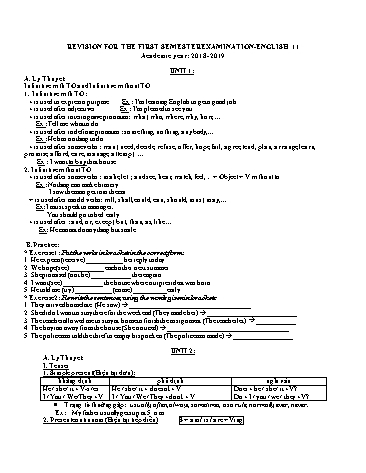
REVISION FOR THE FIRST SEMESTER EXAMINATION-ENGLISH 11 Academic year: 2018- 2019 UNIT 1: A. Ly Thuyet: Infinitive with TO and Infinitive without TO 1. Infinitive with TO : + is used to express a purpose. Ex : I’m learning English to get a good job. + is used after adjectives Ex : I’m pleased to see you. + is used after interrogative pronouns: what, who, where, why, how, ... Ex : Tell me what to do. + is used after indefinite pronouns : something, nothing, anybody, Ex : He has nothing to do. + is used after some verbs : want, need, decide, refuse, offer, hope, fail, agree, tend, plan, arrange, learn, promise, afford, care, manage, attempt, ... Ex : I want to buy that house. 2. Infinitive without TO + is used after some verbs : make, let ; and see, hear, watch, feel, + Object + V without to Ex : Nothing can make him cry. I saw the man get into the car. + is used after modal verbs: will, shall, could, can , should, must, may, Ex: I must speak to manager . You should go to bed early. + is used after : and, or, except, but, than, as, like Ex: He cannot do anything but smile. B. Practice: * Exercise 1: Put the verbs in brackets in the correct form: 1. He expects (receive) ___________ her reply today. 2. We hope (see) __________ each other next summer. 3. She promised (not be) ____________ there again. 4. I want (see) ____________ the house where our president was born. 5. He told me (try) ___________ (come) __________ early. * Exercise 2: Rewrite the sentences, using the words given in brackets: 1. They arrived home late. (He saw) _____________________________________ 2. She didn’t want to stay there for the weekend. (They made her). ___________________________ 3. The teacher allowed me to stay at home to finish the assignment. (The teacher let) ____________ 4. The boy ran away from the house. (She noticed) _____________________________________ 5. The policeman told the thief to empty his pockets. (The policeman made) __________________ UNIT 2: A. Ly Thuyet: I. Tenses 1. Simple present (Hiện tại đơn): khẳng định phủ định nghi vấn He / she / it + V-s /es He / she / it + doesn’t + V Does + he / she / it +V? I / You / We/ They +V I / You / We / They +don’t + V Do + I / you / we / they +V? • Trạng từ thường gặp: usually, often, always, sometimes, as a rule, normally, ever, never Ex: My father usually gets up at 5. a.m 2. Present continuous (Hiện tại tiếp diễn) S + am / is / are + Ving UNIT 3: A. Ly Thuyet: 1. INFINITIVE AND GERUND 1.1 Verbs followed by To-inf: V + (O) + To-inf - decide - expect - try / attempt - would like / love - agree - advise - tend - ask / want - refuse - intend - be willing - fail - desire / wish - order / require - demand - hope - tend - hesitate Ex: I expect to meet him tomorrow. 1.2 Verbs followed by the gerund V + (O) + V-ing - avoid - mind - appreciate - practise - consider - finish - deny - delay / - miss - enjoy - keep - dislike/ hate / detest * Expressions: - look forward to - be worth - can’t help / bear / stand - be accustomed to - There’s no point in - be busy - It’s no good / use - be / get used to * Adj phrase with preposition + V-ing Ex: He is good at solving mathematical problems 2. PASSIVE INFINITIVE AND GERUND 2.1. Examples: - She expects to be invited to Minh’s birthday party. V to be + PP - She enjoys being invited to Minh’s birthday party. V being + PP 2.2 Form: 1 Passive infinitive: To be + Past Participle 2 Passive gerund: Being + Past Participle B. Practice: 1/Put the verbs in the brackets into the correct form: gerund or infinitive. 1. He tried (explain) but she refused (listen) 2. At dinner she annoyed me by (smoke) between two courses. 3. He avoided _______________ (see), so he wore a big false bear. 4. He decided (disguise) .................. himself by (dress) ................... as a woman. 5. Would you mind (show) ...................... me how (work) the lift? 6. After (walk) _______for three hours, we stopped to let the others (catch up) __ with us. 7. He didn’t want ______________ (see) by them at the airport. 8. I regret (inform) you that your application has been refused. 9. I couldn’t help (overhear) what you said. 10. A: I don’t allow (smoke) in my drawing room. B: I don’t allow my family (smoke) at all. * Verbs: accused of, suspect of, congratulate on, prevent from, thank for, warm against. * Example:- “You are not telling the truth, you are a liar!” They accused me of telling lies. b/ Having no object: S + V + preposition + V-ing * Verbs: dream of, approve/ disapprove of, insist on, apologize for, think of, look forward to, deny, admit,+ V-ING B. Practice: Write the following sentences using the words given. 1. “It’s not a good idea to change these plans at this late date.” He objected to. . 2. He deserted his ship two months ago. He was accused of it. He was accused of . 3. John spent his own money. I can’t prevent him from that. I can’t prevent 4.’’Congratulations! You’ve succeeded in the interview, Kate,’’ Jane congratulated .. B. Ly Thuyet: Reported Speech with TO INFINITIVE • V + O + to V Verbs: ask, advise, command, invite, order, recommend, encourage, urge, warn, want., beg, instruct, persuade • V + to V Verbs: agree, demand, hope, promise, threaten, offer, refuse, decide... Would you/ Could you / Will you/ Can you -> asked+ sb + to + V Would you mind + V-ing /Do you mind + V-ing -> asked + sb + to +V Would you like/ Will you -> invited + sb + to + V a. Đề nghị, lời mời: S + invite + (O) + to V S + offer + to V Ex: He said, “Would you like to go out for a drink?” ---> He invited me to go out for a drink. b. Yêu cầu: (động từ tường thuật ask) S + asked + sb + for + something Ex: In a restaurant, the man said; “I’d like a bottle of red wine, please” -> The man asked for a bottle of red wine c. Khuyên bảo: S + advised + O + to V Ex: “You should study harder,” my mother said. ---> My mother advised me to study harder. Lời khuyên thường bắt đầu bằng: - You should / You ought to V........... - If I were you , I would/ should - You had better - Why don’t you . Eg: ’ Why don’t you repaint our room? She advised me to repaint their room. d. Lời nhắc nhở Remember khi chuyển sang lời nói gián tiếp ta áp dụng cấu trúc sau UNIT 7: A. Ly Thuyet: CONDITIONAL SENTENCES (CÂU ĐIỀU KIỆN) 1. Điều kiện loại 1 : IF CLAUSE (Mệnh đề If) MAIN CLAUSE (Mệnh đề chính) Simple Future Simple Present S + will + V(inf) S + V[-e/es] S + will not + V(inf) S + don’t / doesn’t + V(inf) Will + S + V(inf)? Unless = if.not Ví dụ Unless you study hard , you will fail the exam. If you don’t study hard , you will fail the exam. - Sau Unless không được dùng dạng phủ định (Ví dụ : không được viết Unless you don’t write) 2. Điều kiện loại 2, loại 3 : TYPE IF CLAUSE (Mệnh đề If) MAIN CLAUSE (Mệnh đề chính) Simple Past S + would / could + V(inf) Be were (was) II S + wouldn’t / couldn’t +V(inf) S + V-ed/2 S + didn’t + V(inf) Would / Could + S + V(inf) ? S + would / could have + V-ed/3 Past Perfect III S + had + V-ed/Vpp S + wouldn’t / couldn’t have + V-ed/3 S + hadn’t + V-ed/Vpp Would / Could + S + have + V-ed/3? Điều kiện loại 2 : diễn tả một sự việc không có thật ở hiện tại Điều kiện loại 3 : diễn tả một sự việc không có thật ở quá khứ II. CONDITIONAL IN REPORTED SPEECH Ex: 1.“If I have a lot of money, I’ll build houses for the poor.”, John said. John said if he had a lot of money, he would build houses for the poor. 2. “ If today were Sunday, we wouldn’t go to school” they said to me. => They told me if that day were/ had been Sunday, they wouldn’t go/ wouldn’t have gone to school. B. Practice: 1: Put the verbs into the correct form. 1. If he (eat)____________ all that he will be ill. 2. If I (know)______________ his address, I’d give it to you. 3. I shouldn’t drink that wine if I (be) ________________ you. 4. If the rain (stop) _______________, I would have gone for a walk. 2. Rewrite these sentences by using “If”: 1. She will fail in the examination because she is very lazy 2. We don’t have holiday because we haven’t got any money. 3. I don’t know the answer so I can’t tell you.. 4. The little boy couldn’t eat the cake because it was very hot. 3. Change the following conditional sentences into reported speech 1/ “ If I had any money I’d buy you a drink”, she said to me -> 2/ “ If I catch the plane I ‘ll be home by five” he said.-> 3/ “ You should stay in bed if you feel unwell” my mother said.-> 4/ “ If I’d had my mobile yesterday, I could have contacted you,” Tom said-> B. GRAMMAR AND VOCABULARY I. Choose the best answer to complete the following sentences. 1. How many _______ are there in the competition? A. participates B. participants C. participations D. participating 2. I would like to take part in the competitions like these? A. contests B. rivals C. participation D. races 3. The teacher made them __________ silent. A. to keep B. keeping C. keep D. kept 3. She was able __________ English when she was very young. A. to sing B. sing C. singing D. sang 4. Please let me __________ my result as soon as possible. A. to know B. know C. knew D. knowing 5. I want __________ the film that you told me yesterday. A. see B. seeing C. saw D. to see 6. Mr. John thanked me___________ helping him with the homework. A. to B. for C. of D. on 7.Population growth rate_______________ in recent years. A. has fallen B. had fallen C. have fallen D. fell 8.The children were warned ______ in the lake without an adult present. A. not swim B. not to swim C. not swimming D. to not swim 9. Let your name__________ in the sheet of paper. A. write B. be written C. written D. to write 10. My handbag was stolen ____________we were playing tennis. A. before B. while C. after D. during 11.If I had enough money , I ___________ a good dictionary. A. would buy B. would have bought C. will buy D. will have bought 11. I was very__________ when my mom kept calling me “honey” in front of my friends. A. embarrassing B. embarrassed C. embarrassment D. embarrassingly 12. We don’t mind __________ photographs of your wedding party. A. to take B. take C. taking D. took 13. We hoped __________ by our teacher. A. to help B. helping C. to be helped D. being helped 14. Nick didn’t expect __________ to Caroline’s party. A. to invite B. to be invited C. inviting D. being invited 16. They decided __________ their old house. A. to not sell B. not selling C. not sold D. not to sell 17. When I __________ home, my parents __________ T.V in the sitting room. A. went/ watched B. was going/ watched C. went/ had watched D. went/ were watching 18. My brother suggested ______ to the movies tonight. A. to go B. going C. go D. goes 19. Your idea is quite different _______ mine. A. to B. with C. about D. from 20. My friends congratulated me _______the final examination. A. passing B. for passing C. about passing D. on passing 21. Banh Chung is made_________ sticky rice, green beans and fatty pork. A. on B. from C. with D. by
File đính kèm:
- de_cuong_hoc_ki_1_mon_tieng_anh_lop_11_nam_hoc_2018_2019_tru.docx


