

Dạy học theo chủ đề môn Tiếng Anh 8 - Chủ đề: Language (vocabulary + grammar ) - Unit 11: Traveling around Viet Nam
 4 trang
22/10/2025
1060
4 trang
22/10/2025
1060
Bạn đang xem tài liệu "Dạy học theo chủ đề môn Tiếng Anh 8 - Chủ đề: Language (vocabulary + grammar ) - Unit 11: Traveling around Viet Nam", để tải tài liệu gốc về máy hãy click vào nút Download ở trên.
Tóm tắt nội dung tài liệu: Dạy học theo chủ đề môn Tiếng Anh 8 - Chủ đề: Language (vocabulary + grammar ) - Unit 11: Traveling around Viet Nam
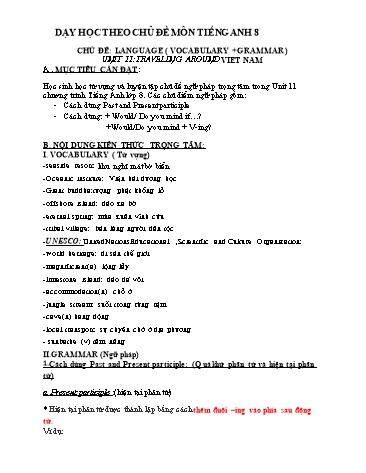
 DẠY HỌC THEO CHỦ ĐỀ MƠN TIẾNG ANH 8
 CHỦ ĐỀ: LANGUAGE ( VOCABULARY +GRAMMAR )
 UNIT 11:TRAVELING AROUNDVIET NAM
A . MỤC TIÊU CẦN ĐẠT:
Học sinh học từ vựng và luyện tập chủ đề ngữ pháp trọng tâm trong Unit 11
chương trình Tiếng Anh lớp 8. Các chủ điểm ngữ pháp gồm:
 - Cách dùng Past and Present participle
 - Cách dùng: + Would/ Do you mind if?
 +Would/Do you mind + V-ing?
B. NỘI DUNG KIẾN THỨC TRỌNG TÂM:
I. VOCABULARY ( Từ vựng)
-seaside resort: khu nghỉ mát bờ biển
-Oceanic institute: Viện hải dương học
-Giant buddha:tượng phật khổng lồ
-offshore island: đảo xa bờ
-eternal spring: mùa xuân vĩnh cửu
-tribal village: bản làng người dân tộc
-UNESCO:UnitedNationsEducational ,Scientific and Culture Organization:
-world heritage: di sản thế giới
-magnificient(a) lộng lẫy
-limestone island: đảo đá vôi
-accommodation(n) chỗ ở
-jungle stream: suối trong rừng rậm
-cave(n) hang động
-local transport: sự chyên chở ở địa phương
- sunbathe (v) tắm nắng
II.GRAMMAR (Ngữ pháp)
1.Cách dùng Past and Present participle: (Quá khứ phân từ và hiện tại phân
từ)
a. Present participle:(hiện tại phân từ)
* Hiện tại phân từ được thành lập bằng cách thêm đuơi –ing vào phía sau động
từ.
Ví dụ: 2.The old lamp is five dollars. It’s made in China.
...................................................................................................
3.The baby is crying for her mother. She is sitting in an armchair.
................................................................................................................
4.The boy was taken to the hospital. He was injured in the accident.
.
5.The road is very narrow. It joins the two villages.
.
6.Do you know the man? The man is talking to Tom.
....................................................................................
7.The widow has been repaired. It was broken last night.
........................................................................................................................
8.The taxi broke down. It was taking us to the airport.
.............................................................................................
9.A bridge has been declared unsafe. It was built only two years ago.
..........................................................................................................................
10.Most of the good are exported. They are made in this factory.
.............................................................................................................................
2. Use ‘Would/ Do you mind + verb-ing?’ to make these requests more polite.
 1. Can you take me a photograph?--> Would/Do you mind taking me..?
 2. Could you wait a moment, please?
 3. Will you turn down the TV, please?
 4. Please make some tea.
 5. Could you lend me some money?
 6. Will you post the letters for me?
 7. Could you open the windows?
3. Use ‘Would/ Do you mind if ?’ to make the following sentences more
polite.
 1. Can I move the refrigerator to the right corner?--> Would you mind if I
 moved?
 2. Could I smoke? Do .................................................................
 3. May I ask you a question? Would ...........................................
 4. Could I sit here ? Do ................................................................
 5. Can I use your headphone? Do ...............................................
 6. Shall I carry your luggage? Would .........................................
 7. Could I borrow your newspaper? Do ......................................
 D. HƯỚNG DẪN TỰ HỌC Ở NHÀ
 -Học sinh học thuộc từ vựng của UNIT 11:TRAVELING AROUNDVIET NAM
File đính kèm:
- day_hoc_theo_chu_de_mon_tieng_anh_8_chu_de_language_vocabula.docx


